Deterministic sustainability checks orchestrated by AI agents 🤖 #
A few weeks ago I made the case to rethink Shift Left accessibility with agentic AI. I thought it was time to share some actual results, with a concrete example: experiments to automate audits for the latest Web Sustainability Guidelines.
The goal is to combine deterministic measurements with repeatable procedures and AI-assisted interpretation, so human auditors start their time-consuming work with a high-quality first draft rather than a blank page.
The results #
For those who directly want to see what AI is capable of, here are five experimental AI-generated(!) reports:
- Tate : 10 checks passed, 3 issues detected, site footprint estimated at 20 tCO2e/year. Very close totheir own estimates !
- [NHS](https://thibaudcolas.github.io/web-sustainability-agents/reports/nhs/) : 11 passes, 2 issues, 200 tons per year.
- [Google Blog](https://thibaudcolas.github.io/web-sustainability-agents/reports/google-blog/) : 9 passes, 4 issues, 120 tons/year.
- [W3C](https://thibaudcolas.github.io/web-sustainability-agents/reports/w3c/) : 10 passes, 2 fails, estimated at 2 tons of CO2 per year.
- [Low-tech Magazine](https://thibaudcolas.github.io/web-sustainability-agents/reports/lowtech/) : 17 passes, 1 issue, 17 kgCO2e/year.
This is only a first draft of an agentic process, and it’s worth being clear those reports are the audit equivalent of vibe coding. They follow a set process to retrieve information but way too much is left to AI interpretation. And the writing is complete rubbish.
There are nonetheless some solid findings - here are the best bits:
- Three of those websites load videos without user interaction. One of those homepages loads 50MB(!) of video resources without any user interaction.
- Where there is sustainability data disclosed, agents can check whether methodology information is sufficient .
- It’s not just for environmental sustainability, it also flags possible accessibility issues. Apparently the Web Content Accessibility Guidelines (WCAG) report doesn’t contain a main landmark ?
All three could be identified with other approaches, but it’s impressive breadth for a single audit. It’s worth taking a step back and explaining how this is made.
Methodology #
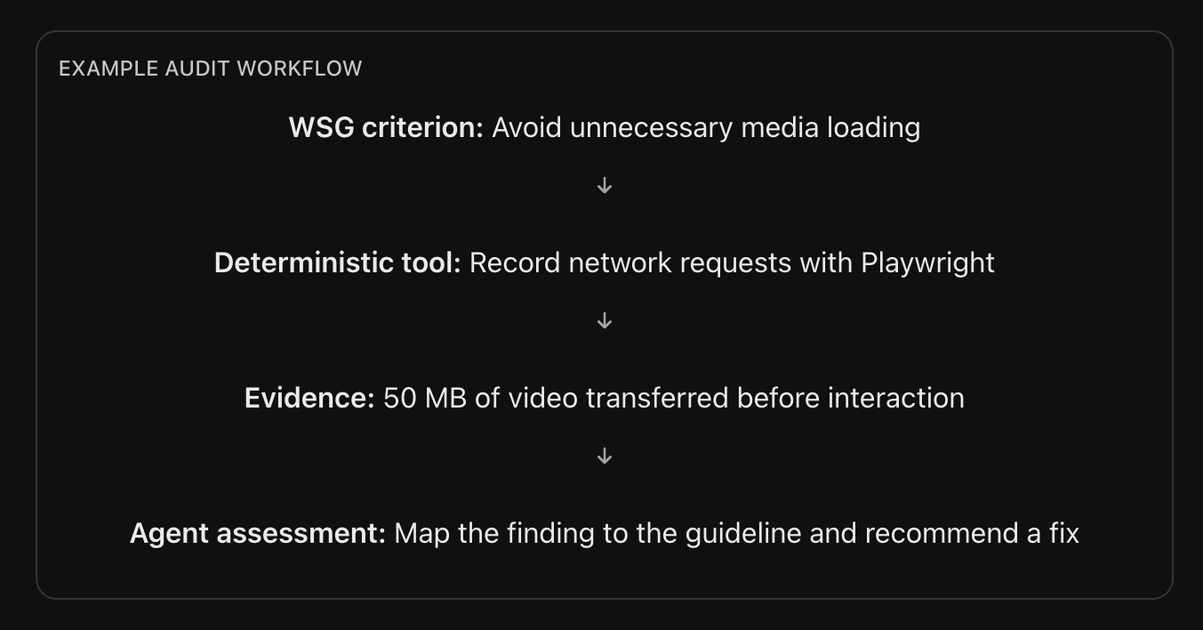
As a birds’eye view, this is what the auditing looks like as a sequence of steps, with the example of one specific WSG criterion:
- WSG criterion:3.3 Modularize bandwidth-heavy components
- Deterministic check: Record network requests with Playwright
- Evidence: 50 MB of video transferred before interaction
- Agent assessment: Map the finding to the guideline and recommend a fix
Here’s what this looks like on the NHS website audit: That’s the rough process for all implemented checks in the audit. We’ll break this down a bit more, starting with why the WSG work so well for this (and why we care).
Why sustainability, why WSG
It’s a topic we care deeply about, having spent years estimating the carbon footprint of Wagtail. And the WSG are a great fit, as an emerging standard that needs more adoption to prove itself.
It’s also a good opportunity to explore whether/how AI adoption can deliver measurable climate benefits! We can estimate the energy required to run an audit, quantify potential savings from its recommendations, and compare the two. Then we can tell whether this specific application of AI results in a net reduction or increase.
If you’re interested in this, here’s an excellent research article: AI-driven productivity gains enable more CO₂ emissions than they avoid in a global energy–economy model, that illustrates the challenges of "green AI" very well: In this study, "avoided emissions" would have to grow about 5x to match the increase in "enabled emissions" due to AI. A tall order to say the least. But worth exploring, as those automated audits can clearly quantify the potential impact of the suggested improvements.
Suitability of the standard
When I wrote about my rating of web sustainability guidelines way back, I thought lots of its consulting-style tasks were a problem as they’re very time-intensive and would require a lot of documentation. Turns out this is exactly what generative AI is great at, with the right framework. Classifying all of the WSG’s 238 success criteria, we can understand which ones are suitable for:
- Desk review of internal information.
- Qualitative manual checks from an auditor
- Quantitative checks from an auditor, with a repeatable process
- Automated checks
Instrumenting this with LLMs, we can decide which aspects to cover as skills to provide a qualitative assessment with a repeatable procedure. And for which to use a deterministic measurement / QA tool, which the LLM can use and triage the results of.
The WSG are also unique in that a lot of this "guidelines triage" happens as part of the guidelines being written, with supporting documents like:
Agentic auditing is entirely dependent on such high-quality information. That, and deterministic tools to actually check the pages.
Deterministic tools
It’s counter-intuitive but the success of this kind of agentic checker is in large part its ability to integrate data from many different sources. So far, the agentic auditor includes:
- [Playwright](https://playwright.dev/) , to retrieve data directly from the pages in a deterministic process
- [Agent Browser](https://github.com/vercel-labs/agent-browser) , when the agent drives the navigation.
- [GreenFrame](https://greenframe.io/) , an excellent energy usage profiler for websites.
- Tapping into the [Firefox energy and CO2 measurements](https://www.thegreenwebfoundation.org/news/carbon-emissions-in-browser-devtools-firefox-profiler-and-co2-js/)
Some of those tools rely on systems capabilities, so it’s worth thinking whether the auditing should work regardless of what is available but in a reduced capacity. There are lots of deterministic tools we could use here, it’s mostly just a question of how to combine their data in a coherent way to achieve greater deterministic coverage of the audit’s scope.
Unsolved challenges
Aside from increasing the coverage of the standard and the quality of the LLM interpretation, there are a few high-level aspects of this kind of agentic reviewing that aren’t clear at all yet. Some "load-bearing" but probably solvable, some more existential:
- With LLMs doing so much of the work, what’s the best way to use and develop the human reviewer’s expertise as part of this?
- How can we do this in an agent-agnostic way? This is crucial per our AI guiding principles , and right now this type of audit only works with more advanced agents and models.
- What are the journeys to actually audit? Going for "user loads the page" is natural but will be irrelevant when agents navigate sites on users’ behalf. And when they do, can we quantify and reduce the energy use of this processing?
Takeaways #
I think it’s worth taking a step back and acknowledging that none of this approach is specific to sustainability, and none of the challenges are either. The web is changing rapidly. AI can be used to raise the bar for quality just as well as it can lower it.
We have Wagtail Space 2026 later this week, where I think our speakers will further unpack some of the challenges here, in those four talks:
As for product work on Wagtail, I hope that by commoditizing such accessibility / sustainability audits, we’ll get to increase the quality of the websites. Both from direct fixes, and also making better decisions on what and how to build things. Onwards!