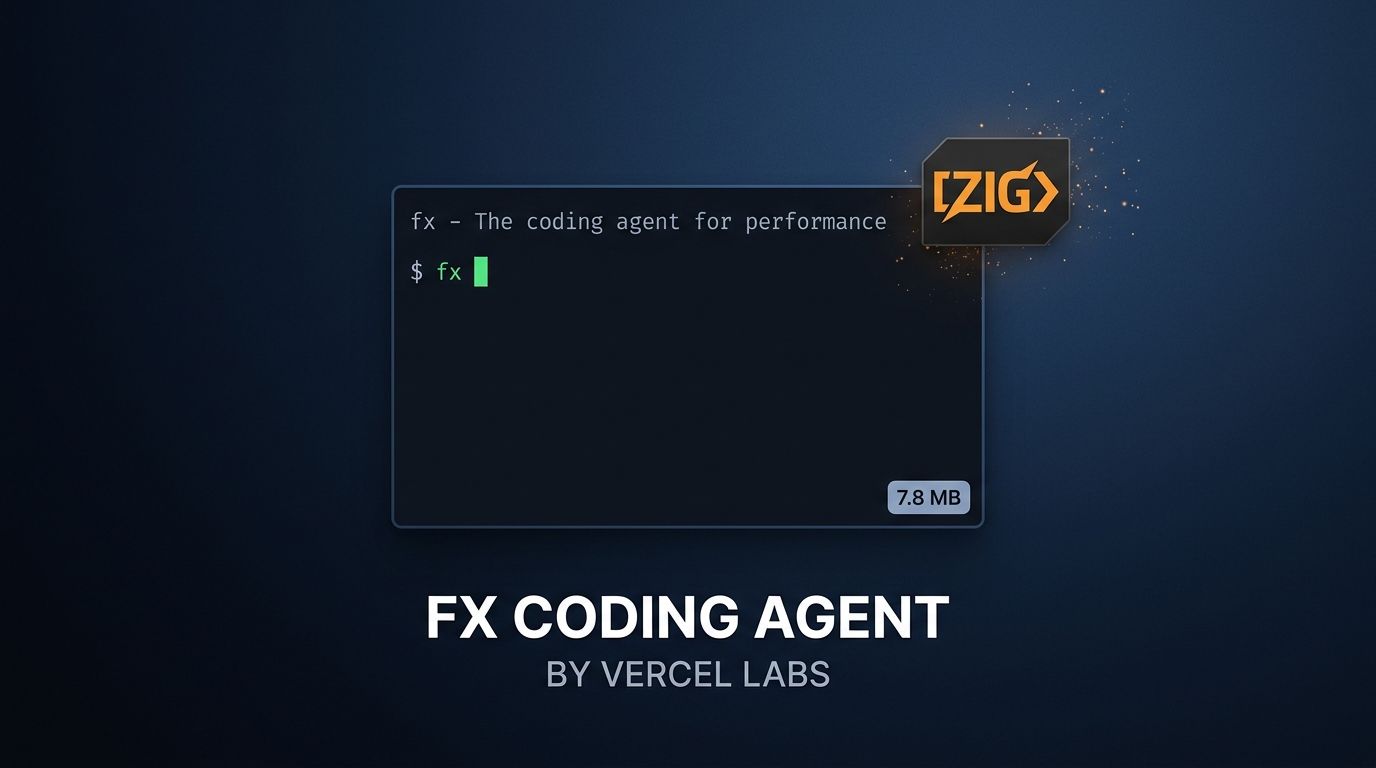
Vercel Labs open-sourced fx yesterday: a coding agent CLI written in Zig that ships as a 7.8 MiB binary, cold-starts in 10 microseconds, and requires no runtime to install. It surfaced on Hacker News front page with 225 points and 96 comments. The developer reaction is worth reading before you write this off as yet another coding agent release — because fx is doing something genuinely different.
Why the Zig Choice Matters #
fx is built in Zig — the same systems language behind Bun, the JavaScript runtime with 89,000 GitHub stars. That choice is not incidental. Zig produces small, static binaries with no hidden runtime, no garbage collector, and clean WebAssembly output. The result: a 7.8 MiB binary that starts in 10 microseconds. Compare that to Claude Code’s Node.js boot or Codex’s cloud-only execution model, and the design philosophy becomes clear.
Getting started is a single line:
curl -fsSL https://fx.sh/setup.sh | bash
No npm install, no pip install, no brew cask. One curl command, one binary, ready to run. Once installed, you authenticate and navigate to any project:
fx login        # authenticate
cd your-project
fx              # start interactive session
fx ask "What does this function do?"  # single-shot query
The Zig decision also explains fx’s WASM SDK. Because Zig cross-compiles to WebAssembly cleanly, fx can run inside browsers and build pipelines — not just in your terminal. That opens up deployment scenarios that most coding agents cannot support without a server-side component.
Built to Be Embedded, Not Just Used #
Here is the part most coverage is missing. fx is not a consumer interface designed for you to chat with. It’s a harness — built to be embedded inside other systems. The GitHub README describes it explicitly as “optimized for research and embedding in larger systems.” This is not typical product marketing; it’s an honest description of the intended use case.
The evidence is in the features: Agent Client Protocol (ACP) for host system integration, a WebAssembly SDK for browser and build system deployment, Model Context Protocol (MCP) connections, skills and plugin extensibility, and subagent support. These are not features for a developer who wants to write code faster. They are features for a developer who is building tooling that includes an agent as a component. Vercel built fx internally to run inside CI/CD pipelines and build infrastructure — and open-sourcing it puts that design in your hands. If you’re interested in how the Cline CLI approach to CI/CD coding agents works, fx is taking a similar idea further at the systems level.
What to Know Before You Try It #
Two honest caveats. First, fx is experimental — currently at v0.0.4. The Apache-2.0 license and 1.2k GitHub stars are encouraging, but if your team needs a stable, production-tested coding agent, Claude Code and Codex exist for exactly that reason. Second, the initial authentication flow routes through Vercel AI Gateway by default. The docs describe fx as model-agnostic, and local inference is supported, but the default path creates a Vercel dependency that the “neutral and open” framing doesn’t fully resolve. The HN community flagged this, and it’s a fair concern. Watch whether the team makes alternative auth paths more prominent in upcoming releases.
Who Should Actually Try fx #
fx makes immediate sense for four groups: AI researchers evaluating agent architectures who need a minimal, embeddable base to build on; developers building editor plugins, CI steps, or other tooling that includes an agent as a sub-component; terminal-first developers who want shell ergonomics instead of a heavy IDE layer; and anyone experimenting with local model inference via Ollama or LM Studio. Moreover, if you’re interested in the WASM SDK and ACP specifically — browser-based agents without a server round-trip is a real capability gap in the current market. fx is an early implementation of something that may matter more in 12 months.
For everyday development where you want the best-in-class coding agent experience, Claude Code and Cursor remain the benchmark. fx is not competing there yet, and it knows it. However, for the infrastructure and tooling layer of AI development, it’s the most interesting open-source agent release this week.
Key Takeaways #
- Vercel Labs open-sourced fx — a Zig-based coding agent CLI that is 7.8 MiB, starts in 10µs, and needs no runtime installation
- The key differentiator is embeddability: fx is designed as a harness for AI tooling builders, not an end-user chat interface
- Current caveats: experimental v0.0.4 status, and the default auth flow carries a Vercel AI Gateway dependency — watch future releases
- Best fit: AI researchers, infrastructure and tooling builders, terminal-first developers, local model experimenters