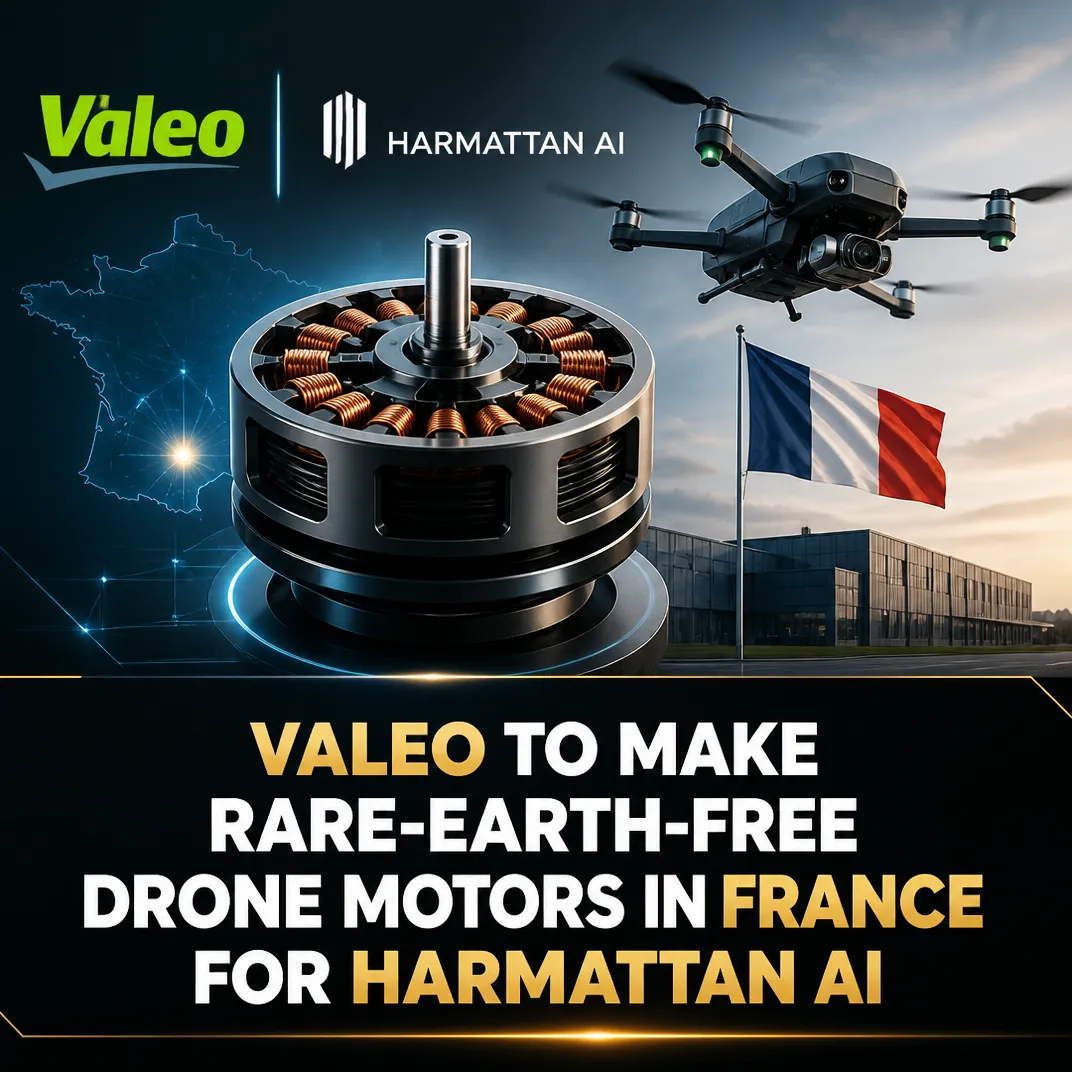
July 21, 2026, (Inside AI) — French automotive supplier Valeo will design and manufacture electric drone motors for defense tech firm Harmattan AI entirely on French soil, the companies announced Monday.
The motors will power drones for both civil and military use. Crucially, they will be built without heavy rare earth elements. This design choice aims to insulate the supply chain from geopolitical shocks and material shortages.
Production will take place at a Valeo facility in France, though the exact site was not disclosed. The deal marks a rare convergence of automotive electrification expertise and defense autonomy.
A Strategic Pivot Away from Rare Earths #
Heavy rare earths—dysprosium and terbium—are essential for high-performance permanent magnets. China controls over 90% of global rare earth processing. Removing them from drone motors is a direct hedge against supply disruption.
Valeo has spent years developing magnet-free or reduced-rare-earth motor designs for electric vehicles. Applying that knowledge to drones compresses development cycles and leverages existing R&D.
The companies did not reveal technical specifics. However, rare-earth-free motors typically use wound-rotor or induction designs that trade slight power density for supply security. For many drone missions, that trade-off is acceptable.
Harmattan AI, a rising player in autonomous defense systems, gains a locally sourced propulsion module. This aligns with France's broader push for sovereign defense capabilities, accelerated by the war in Ukraine.
France's Quiet Drone Motor Revolution #
France has been aggressively funding dual-use technology. The France 2030 investment plan earmarks billions for robotics, AI, and advanced manufacturing. Valeo's involvement signals that automotive suppliers see defense as a growth vertical.
Industry analysts note that drone motor supply chains remain fragmented. Many European firms rely on Asian components. A localized, rare-earth-free motor could become a template for NATO allies seeking to reduce dependencies.
Yet challenges persist. Rare-earth-free motors often require more copper and sophisticated cooling. Scaling production without sacrificing reliability demands rigorous testing—especially for defense applications where failure is not an option.
Valeo's move also pressures competitors like Bosch and Continental, who have their own electrification portfolios but limited defense exposure. The deal could trigger a wave of automotive-defense partnerships across Europe.
Harmattan AI gains more than hardware. By co-developing with Valeo, it embeds its software and control systems early in the design phase. That tight integration can yield performance gains that off-the-shelf motors never achieve.
The announcement did not include production timelines or contract value. However, the strategic implications are immediate. France now has a clear path to sovereign drone propulsion, decoupled from Chinese rare earth dominance.
This partnership also underscores a broader trend: defense tech startups are bypassing traditional primes and tapping into adjacent industries. Automotive electrification, once seen as a climate solution, is becoming a national security asset.