A couple of months ago, I published How Experts Sensemake, which explains the best theory of sensemaking we currently have. I argued that that theory — The Data-Frame Theory of Sensemaking — is
veryuseful to internalise, because we can adapt it to understand a fast-moving, rapidly-developing technology like AI. At the time, I said that Commoncog would begin producing cases of people and businesses making sense of and adapting to the threat of technological revolution, and I asked in the members’s forum for suggestions of cases that folks wanted to see.
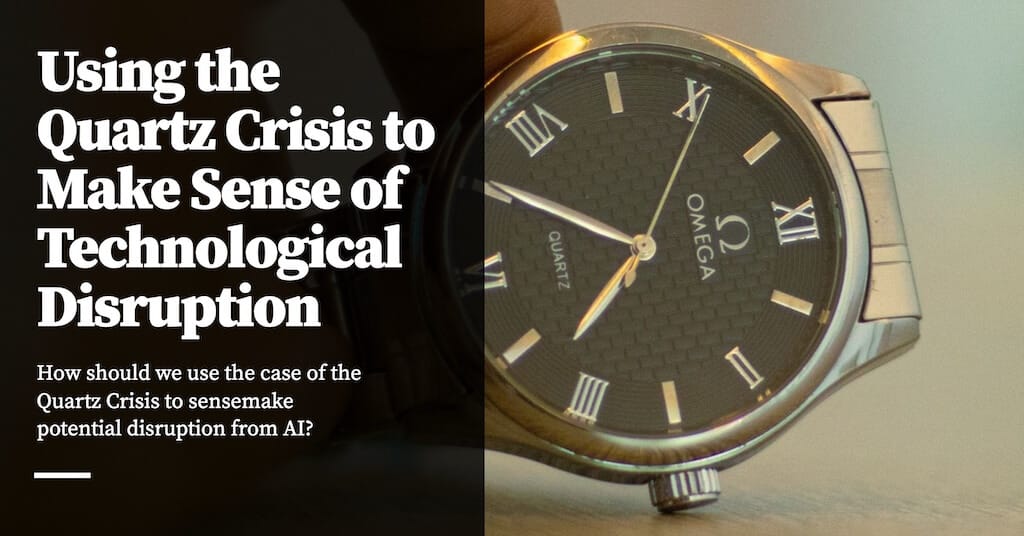
One member suggested the Quartz Crisis — the famous event where the invention of quartz watches threatened Swiss watchmakers. We know how that turned out, of course. The Swiss watchmakers are still around today, and quartz watches are now seen as a commodity. But for roughly a decade, the entire Swiss watch industry was on the back foot, and many weaker firms went bankrupt.
What can we learn from that turnaround? How did the primary actors during that crisis adapt to the incoming quartz threat? How long did they take to respond? And how did they survive?
As I mentioned last week, I had commissioned a case on the crisis and was about to publish it, when on a lark I read the definitive history of the Swatch Group. This was Pierre-Yves Donzé’s A Business History of the Swatch Group; Donzé being the greatest living historian of the Swiss watch industry. And I quickly learned that the mainstream narrative of the Quartz Crisis — a crisis precipitated by new technology, an open-and-shut case of technological disruption — was simply ... wrong. In reality, the Swiss watch industry crisis of the 70s was not caused by quartz. Instead, it is a more complicated and more interesting story: a story of duelling competitive advantages, of broken industry structure; also the story of a business turnaround by a singular business personality, and the story of the emergence of the global luxury business.
And so I decided not to publish that original case. Instead, I edited it to incorporate Donzé’s work. This case is freely available, and I think it is the most accessible, most accurate account of what happened in the Swiss watch crisis of 1975 to 1985 that’s published on the Internet today. It’s also a whopper — clocking in at 12,171 words.
You may read it here:
This presents us with an interesting problem. I said that we may consume cases where firms succeeded (or failed) to deal with rapid disruption in order to improve our sensemaking of AI. But here is a vastly more complicated story.
How can we use this?
How to Practice Sensemaking With This Case #
This is the first major case that I’ve made freely available for sensemaking practice. Previous cases have been members-only, as I outlined in Sensemaking as the Heart of Expertise. In that essay I described an approach to accelerated expertise, arguing that so much of expertise acceleration that I’ve covered in the literature is actually about improving your sensemaking. With this case you get to try this learning approach, and you don’t even have to be a member to experience it.
Here’s a recap of how to do this:
- Read the casefrom top to bottom. - At the bottom of the case, take out your phone, and record a voice memo, talking through what you’ve noticed whilst reading the case. You can go on for as long as you’d like, but I strongly recommend a minimum of two minutes of making sense of it in your own words. Having a recording prevents you from lying to yourself later.
- Listen to my case reaction at the bottom of the case.
- Then record a final voice note, reflecting on what I noticed that you didn’t, and what you noticed that I didn’t.
So how can you use this case to improve your own sensemaking around AI disruption? Here are several quick suggestions before you start reading.
- Note that we are nottrying to learn lessons from this case. So don’t spend time asking “what is the lesson here?” There is no lesson, because history is always unique. I think this is common sense: quartz technology is not like AI, and your industry is probably not like the Swiss watch industry. Instead, as I’ve already explained in myessay on the Data-Frame theory, what you want to is to collect fragments that you may use to construct frames later, when you’re making sense of AI in your personal context. (If you’d like more information on this ‘don’t read history for lessons’ idea, and how to use it, see this explainer on theCalibration Case Method). - With that said, there aremultiple frames you may use to m this case. For instance, you may read this case as either a) a turnaround story, b) a case about the rise of global luxury,beforethe strategies became legible, and c) a case about dealing with technological disruption. You may sensemake usingallthose frames, of course, but if you’d like to sensemake using (c), I recommend that you keep an eye on what the various players knew at each point in the case, and what they didNOTknow. Remember: they were operating under the fog of uncertainty, just as you are today, andcould not predict the future. - Also recall: the goal here is to collect fragments. Lean into the fact that your brain is well-adapted to collecting and remembering stories, as this will ground you. After all, people tend to make sense of the present with very little historical context, because not many actively read history. As a result, most folks don’t have a good sense of what has come before. The more stories you have of prior technological revolutions in your head, the more calibrated you become — and the better positioned you will be to reject certain frames as improbable, or consider frames others might consider outlandish. Why? Because you’ve seen similar things.
Anyway, don’t worry too much about it — this isn’t supposed to be very hard. It also should be quite fun, so go ahead and enjoy it!
The Luxury Strategy #
One unexpected outcome of this case is that it actually answers some of the questions I had around how Bernard Arnault created LVMH (we last saw Arnault and his luxury conglomerate Moët Hennessy Louis Vuitton in How to Become an Asian Tycoon).
I’d noticed for a while now that several business people seem able to create — or at least rejuvenate — luxury brands, which seems like a wonderful skill to have! Luxury businesses are, after all, pretty remarkable things — the luxury bit of it enables you to sell products at extremely high margins, which is nice. (The branding thing is also a moat, which — as you probably already know — is also very nice).
Well, this case turns out to occur right at the very start of the global luxury business phenomenon, and many of the protagonists in this case work out the principles of the business for themselves, through experimentation, for the very first time. I now believe that reading Jean-Noël Kapferer and Vincent Bastien’s famous 2008 book The Luxury Strategy is not a waste of time, because I have a case to anchor my understanding of the book.
Here’s an excerpt to whet your appetite:
How do you make a lot of money in luxury? You might think that the answer is to concentrate at the tippy-top of the market: small volume, artisanal products sold at astronomical prices, executed at the highest possible levels of craftsmanship and quality.
You would be wrong.
The key to making a lot of money in luxury is to own an
affordable luxury brand. This is in contrast to an ‘exclusive luxury’ brand. Affordable luxury is something that can be sold at an aspirational price point, slightly out of reach of the middle class. These goods should have high margins, but be mass produced at volume so that you enjoy economies of scale,and therefore generate large amounts of absolute dollars.To use a watch world example, Patek Phillippe sits near the top of the luxury pyramid. It uses the most expensive materials (gold, platinum, titanium), with the best craftsmanship (unique enamel artwork hand-painted and fired by artisans), producing complex, handmade watch movements (e.g. movements with moonphase dials, as an example) and with a small total output of timepieces a year (around 62,000, by most estimates). The cheapest Patek costs in the tens of thousands of dollars. It is not mass produced. By contrast, Rolex makes between 800,000 to a million watches a year, at a lower price point. And this makes sense: a young professional could save for a few months (as opposed to a few years) to buy a Rolex. Because Rolex uses mass production techniques, their scale enables them to drive costs down, matching (or even exceeding) the profit margins of a Patek watch. But because Rolex sells more
absolutewatches at its lower prices, it generatesfarmore cash than Patek ever will.Rolex is affordable luxury. Patek Philippe is exclusive luxury. Both are good businesses. However, Rolex is what you want to own if you want to generate huge gobs of cash in the luxury business.
This is easy to say today, since the approach has been explicated in books and papers by luxury industry practitioners, often in partnership with academics. But back in the 90s this approach was still being developed. It was not widely understood. Folks such as Bernard Arnault at LVMH and then Johann Rupert at Richemont were putting together the dynamics of the luxury business throughout the 80s and 90s. Much of the tactical know-how to execute this strategy was still stuck in the heads of various brand managers within the industry.
Perhaps we’ll publish more cases around luxury brands in the future, but for now: one thing at a time.
Originally published , last updated .
This article is part of the Operations topic cluster, which belongs to the Business Expertise Triad. Read more from this topic here→
This article is part of the Market topic cluster, which belongs to the Business Expertise Triad. Read more from this topic here→
The thought of business school make you go ‘eww’? #
You’re in good company.
9,000+ investors and operators read Commoncog to sharpen their business acumen ... WITHOUT going back to school.
Sign up for our newsletter and get a weekly dose of good business thinking (no BS guaranteed):