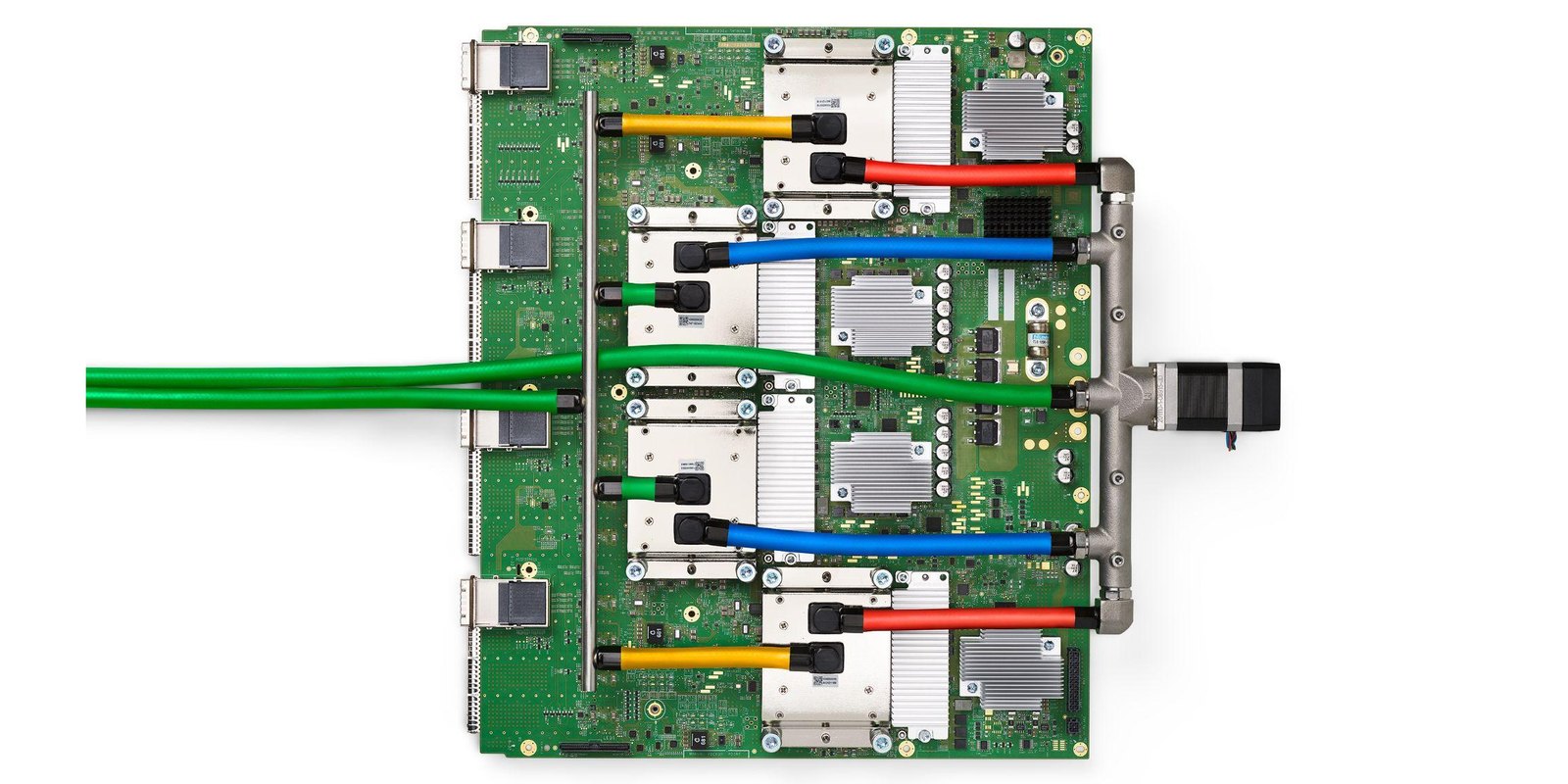
A Google TPU v4 board with four liquid-cooled chip packages, from Google’s 2023 TPU v4 research paper. Ding was convicted of stealing details of Google’s TPU chips and systems. Image: Norman P. Jouppi, George Kurian, Sheng Li et al. (Google) / Wikimedia Commons, CC BY 4.0, cropped

The US government has sanctioned five China-based companies tied to Linwei Ding, the former Google engineer convicted this year of stealing Google’s AI trade secrets, including the startup he set up while still at Google and MiraclePlus, the Beijing venture firm that grew out of Y Combinator’s China programme.
The State Department announced the designations on October 19 under the Protecting American Intellectual Property Act, a 2023 law that requires sanctions on foreign companies and people that carry out or benefit from significant theft of American trade secrets. The Treasury’s Office of Foreign Assets Control added all five to its sanctions list the same day.
Who was sanctioned #
The main target is Shanghai Zhisuan Technology, which Ding founded in 2023. The State Department says Zhisuan was marketed as able to build a software platform to speed up machine learning work, “including training large super intelligence (SI) models powered by supercomputing chips”.
The other four are MiraclePlus (legally Qiji Chuangtan Beijing Investment Management) and three entities it controls: two venture funds set up in 2020 and 2022, and a partnership wholly owned by the first fund. MiraclePlus was founded by Qi Lu, a former Microsoft executive and Baidu president, and runs two startup camps a year where selected companies pitch to other investors.
According to the State Department, Ding applied to the MiraclePlus programme on Zhisuan’s behalf, “touting his experience with and knowledge of Google’s technology and internal systems” and claiming Zhisuan could copy Google’s AI infrastructure. MiraclePlus then gave Zhisuan seed money for an ownership stake. On the firm’s stage, the department says, Ding pitched his ability to replicate Google’s technology “to fit China’s national conditions”.
What the sanctions do #
All five companies’ property under US jurisdiction is blocked and Americans are barred from dealing with them, according to OFAC’s listing. US banks can’t lend them more than $10 million a year, foreign exchange and bank transfers involving them are banned, and Americans can’t invest in their shares or debt.
OFAC gave anyone doing business with MiraclePlus and its three funds until January 19, 2027 to wind those dealings down. Zhisuan got no such grace period. The wind-down licence also covers any company that MiraclePlus or its funds own 50 per cent or more of.
Neither MiraclePlus nor the Chinese government had commented publicly when this article was published.
The case behind it #
A San Francisco jury convicted Ding in January on seven counts of economic espionage and seven of theft of trade secrets. Prosecutors showed that between May 2022 and April 2023 he uploaded more than 2,000 pages of confidential files to his personal cloud account. The Justice Department says they covered the architecture of Google’s custom Tensor Processing Unit (TPU) chips, its GPU systems and the software that ties thousands of chips into an AI supercomputer.
In August, US District Judge Vince Chhabria threw out the espionage counts, finding too little evidence that Ding meant to benefit the Chinese government, but kept the seven theft convictions. On September 1 he sentenced Ding to 12 months minus a day, two years of supervised release and more than $198,000 in restitution to Google, Courthouse News reported. Prosecutors had asked for 70 months. The judge told the court:
This was a systematic, brazen effort to steal Google’s property and to benefit himself with it.
Judge Vince Chhabria, US District Court for the Northern District of California
The sanctions land as Washington tightens its grip on Chinese AI on several fronts: the government ordered every civilian agency to remove DeepSeek the same week, while Beijing has moved to control exports of its largest AI models. Earlier this month, researchers caught Chinese hackers posing as an Anthropic employee to target AI policy experts.
Why it matters #
A sentence of under a year was not the end of Ding’s case: the US has now gone after the money behind his startup, and named one of China’s best-known startup investors as a backer of stolen AI technology. For Chinese founders and the investors who fund them, a pitch built on a former employer’s secrets now carries a cost far beyond one courtroom.
Sources: US State Department fact sheet, OFAC recent actions and General License 2, US Justice Department, Courthouse News.