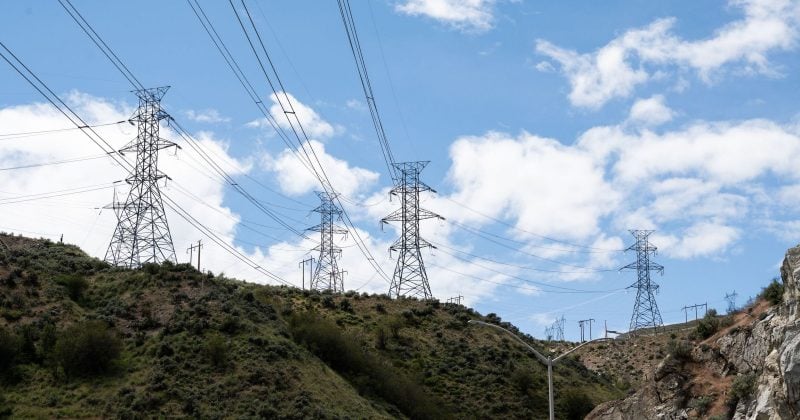
Via pnnl.gov
The largest US power grid is gearing up for a demand surge driven by AI data centers, EVs, and yes, crypto mining operations that could reshape energy economics for years
America’s electricity grid is about to get a serious makeover. The largest US power grid operators are expanding infrastructure plans to meet a demand surge that hasn’t been seen in decades, driven by a convergence of AI data centers, electric vehicles, manufacturing growth, and crypto mining operations that are collectively straining a system built for a different era.
For roughly two decades, US electricity demand was essentially flat. Efficiency gains quietly offset population growth and economic expansion. That streak is definitively over.
The numbers behind the power scramble #
The US Energy Information Administration projects electricity consumption will climb from 4,195 billion kilowatt-hours in 2025 to 4,269 billion kWh in 2026, then to 4,399 billion kWh by 2027. That increase adds a continuous load equivalent to roughly 23 gigawatts, which is enough to power millions of homes.
Annual demand growth is expected to average around 5.7% over the next five years, according to findings from Grid Strategies and ICF. Peak demand growth could reach 166 GW. To put that in perspective, the entire country of France has a peak demand of around 100 GW.
On the infrastructure side, 888 miles of new high-voltage transmission lines (345-kV and above) were constructed in one recent year, up from just 322 miles the year prior.
US utility capital expenditure plans for the next five years are projected to exceed $1.4 trillion, reflecting a year-over-year increase of more than 20%.
Where crypto mining fits into the picture #
Crypto mining’s electricity consumption in the US currently accounts for between 0.6% and 2.3% of overall consumption. The Electric Reliability Council of Texas, which manages the grid for most of the Lone Star State, has received interconnection requests for tens of gigawatts from miners alone.
But crypto mining has one characteristic that most other demand sources don’t: flexibility. Mining operations can ramp down during peak demand periods, effectively acting as a pressure valve for the grid. This concept, known as demand response, is becoming increasingly important as operators try to balance reliability with growth.
PJM, MISO, and the regional reshuffling #
The demand story isn’t playing out uniformly across the country. Two of the largest regional grid operators, PJM Interconnection and the Midcontinent Independent System Operator (MISO), are revising their load forecasts significantly upward.
PJM, which serves 65 million people across 13 states and Washington DC, is seeing particular pressure from data center development in Northern Virginia, already the world’s largest data center market. MISO covers much of the Midwest and is dealing with its own surge from manufacturing and electrification trends.
Both operators are advancing long-term transmission plans worth billions of dollars in response to interconnection queues that are already overflowing with requests from data center developers, renewable energy projects, and industrial facilities.
Disclosure: This article was edited by Editorial Team. For more information on how we create and review content, see our