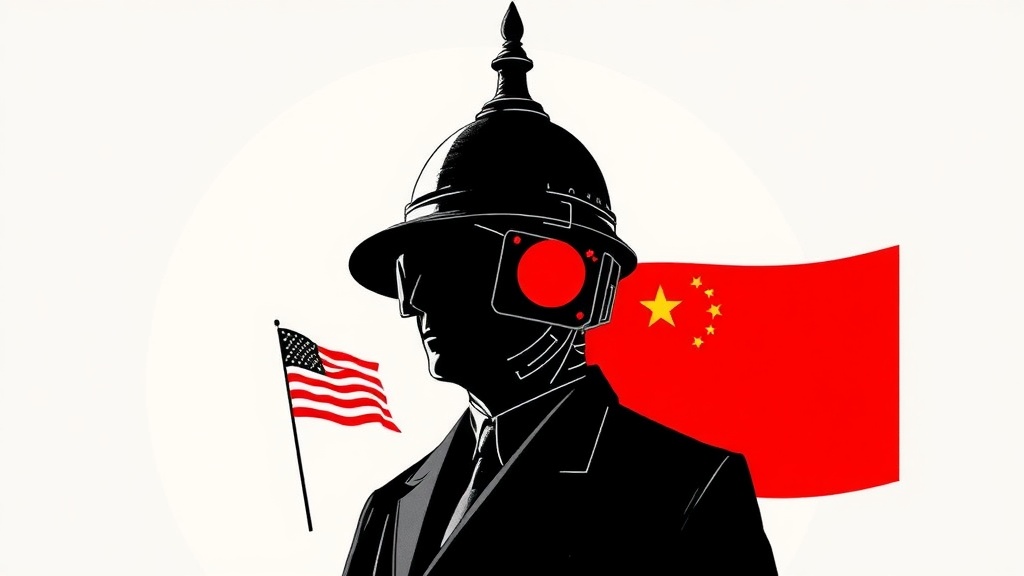
Washington and Beijing are swapping spy accusations over artificial intelligence, but the escalating tech Cold War is a Trojan horse for state control—giving both governments the perfect excuse to monitor code and dictate what tools Americans can run.
This week, China branded a U.S. AI coding tool a security threat just as U.S. lawmakers ramped up probes into American companies using cheap Chinese models. The mutual fear-mongering obscures the real danger: a bipartisan push to regulate open-source software and expand state surveillance under the guise of safety.
China’s Ministry of Industry and Information Technology flagged Anthropic’s Claude Code—versions 2.1.91 to 2.1.196—claiming the tool carries a “security back-door vulnerability” that sends user data to a remote server without consent, according to TNW. Anthropic declined to comment.
Meanwhile, Washington is running the exact same playbook. Two U.S. House committees are investigating American companies that rely on Chinese AI models, sending letters to Cursor and Airbnb. The driving force isn't national security; it's price. Chinese open-source models are cheap and closing the performance gap. Executives from Coinbase to the startup Lindy have publicly touted them to cut costs. Even Cursor—which Elon Musk’s SpaceX is acquiring for $60 billion—built its Composer 2 model on China’s Kimi. Airbnb told CNBC it uses a “limited number” of Chinese open-source models through approved U.S. providers.
The establishment framing is predictable. CNBC leaned into the institutional line, highlighting a State Department spokesperson who declared Chinese models “advance Beijing's narratives, censor dissent, and reflect CCP ideology and values.” Congressman Andrew Garbarino called China's progress on cybersecurity tasks “highly alarming.”
TNW, however, noted the mirror-image hypocrisy and pointed out the glaring free-speech problem: Washington cannot easily ban Chinese open-source models because the weights sit free online. A ban would hit free-expression law and the U.S. startups that depend on cheap code, making procurement rules the more likely weapon of choice.
Beijing is playing the same game, threatening to curb foreign access to its own top-tier models after the Trump administration accused Chinese entities of “industrial-scale campaigns” to rip off U.S. AI systems.
Both capitals are racing to wall off their digital economies and lock down the code their citizens can use. The open question is whether Americans will let their own government ban open-source software in the name of keeping them safe from Beijing.