Researchers #
研究者名
Asaoka, Nozomi
研究者名
Diane Pagano
研究者名
Hayashi, Yasunori
Overview #
Kyoto, Japan -- Habit formation describes the repeated performance of a behavior until it becomes routine: in other words, the shift from deliberate to automatic decision-making. This concept is often invoked as a way to improve one's life by making a routine of beneficial activities that can otherwise feel tedious, such as cleaning, studying, and regular exercise.
That repeating the same behavior is essential for forming a habit has become well-established, but whether a habit develops as an exact replication of the original behavior, or if the behavior itself gradually changes as it becomes a habit, remains unclear. Because habit formation takes a long time, comparing behavioral and neural changes within the same subject before and after a habit develops has been difficult. To overcome this challenge, a team of researchers at Kyoto University developed a new training method that achieves rapid habit formation in mice, allowing them to track these transitions directly.
"Habits are one of the brain's most mysterious functions, and we often struggle to control them even though they are our own actions," says co-corresponding author Nozomi Asaoka. "By uncovering how habits work, we may eventually find ways to take control of them rather than letting them control us."
Just like how humans develop habits, the team first trained subject mice to use goal-directed strategies, followed by an additional four-days of training designed to facilitate the adoption of habitual strategies. With this two-stage training approach, the researchers were able to assess the transition from goal-directed to habitual behavior in the brains of individual mice.
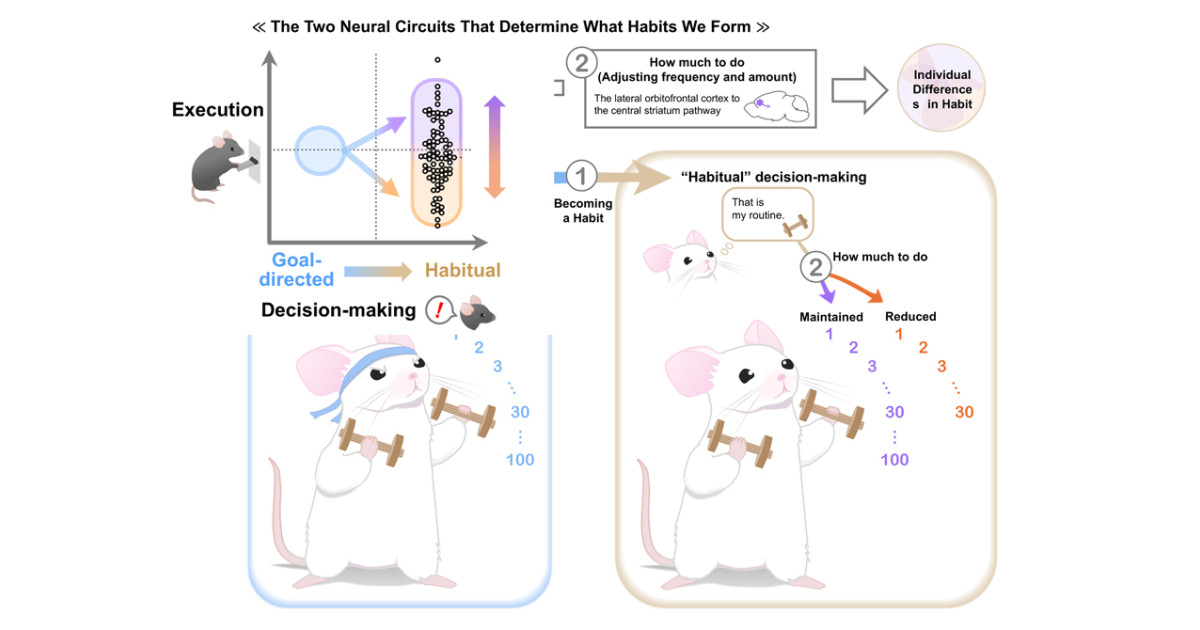
The team discovered that two distinct neural circuits manage completely different aspects of habits. The first circuit, with neurons projecting from the anterior cingulate cortex to the retrosplenial cortex, determines whether a behavior becomes a habit, with its connections weakening during the transition. Crucially, the second circuit, from the lateral orbitofrontal cortex to the central striatum, controls how much the habit is executed, explaining individual differences. In this second circuit, habit-formed mice with strong neural responses maintained high behavioral execution levels, while those with weaker responses showed reduced execution. By artificially manipulating these pathways, the team was able to selectively promote habit formation or alter execution levels, proving the distinct roles of these two brain circuits.
One key finding is that the habit formation process is much more complex than the traditional view that repetition simply replicates an action into a habit in its original form. In particular, the team demonstrated that even after a habit successfully forms, there are significant individual differences in the frequency and volume of that behavior.
"Our study has uncovered previously overlooked control mechanisms involved in habit formation, showing what determines how strongly a habit is carried out and helping explain why habits differ from person to person," says team leader Yasunori Hayashi.
The team plans to expand their investigations to find out what drives these individual differences in habit intensity, hoping that better understanding may help us acquire more beneficial habits and improve treatment for problematic habits linked to conditions such as obsessive-compulsive disorder.
【DOI】[https://doi.org/10.1038/s41467-026-75706-1](https://doi.org/10.1038/s41467-026-75706-1)

【KURENAI ACCESS URL】[http://hdl.handle.net/2433/302283](http://hdl.handle.net/2433/302283)
Nozomi Asaoka, Diane Pagano, Yasunori Hayashi (2026). Dissociable roles of prefrontal plasticity in decision-making strategy and execution of habitual behavior. Nature Communications, 17, 6822.