Open Source CEO by Bill Kerr- Posts
- Unfinished Business, Product Intelligence & The AI Moment
An interview with Jen Taylor, CEO at Mixpanel. 🏹 #
👋 Howdy to the 1,895 new legends who joined since our last edition! You are now part of a 518,049-strong tribe outperforming the competition together.
LATEST POSTS 📚
If you’re new, not yet a subscriber, or just plain missed it, here are some of our recent editions. 🧞 Deepfakes, Trust & Selling Video To The Mainstream. An interview with Andrew Mok, CMO at HeyGen.
🗝️ Marketing Has Too Many Humans In The Loop. An interview with Doug Tallmadge, Co-Founder & CEO at Gradial.
🛡️ The Agentic CRM For AI‐Native Companies. An interview with Keith Peiris, Co-Founder & CEO at Lightfield.
**PARTNERS **💫
ZeroClick lets you sell your product to AI agents. One in two visitors to your site is already an agent, but most businesses have no way to sell to them. ZeroClick changes that by turning any API or offering into an agent-purchasable service with x402 & MPP support, a machine-readable storefront, agent transaction analytics, and robust pricing controls.
Founding a company is easy, scaling it is hard. Operational systems break, people problems increase, and your calendar keeps getting fuller. Mochary Method is an executive coaching firm founded by Matt Mochary—coach of Sam Altman and Brian Armstrong, and writer of The Great CEO Within—that specializes in helping growing startups.
The Mochary coaching team, who coaches companies like AngelList, Lovable, and Midjourney, is offering a complimentary coaching session to founders and executives for a limited time.
Interested in sponsoring these emails? See our partnership options here.
HOUSEKEEPING 📨
I know we are still a long way from the 2028 U.S. election, but I’m placing my bet now on the eventual winner: Jon Ossoff from Georgia. 39-year-old Ossoff speaks with the gravitas of a leader and has been a shining light pushing back on the corruption of the Trump administration.
There is a lot of time between now and 2028, but Vanca lacks the charisma and is too attached to Trump’s administration to win. Rubio could do well if he ends up with the Republican nod; something I could stomach, even as a liberal. The Democrats may run AOC, or Newsom, or someone else, but if they run Ossoff, he wins in a landslide. You heard it here first.
INTERVIEW 🎙️
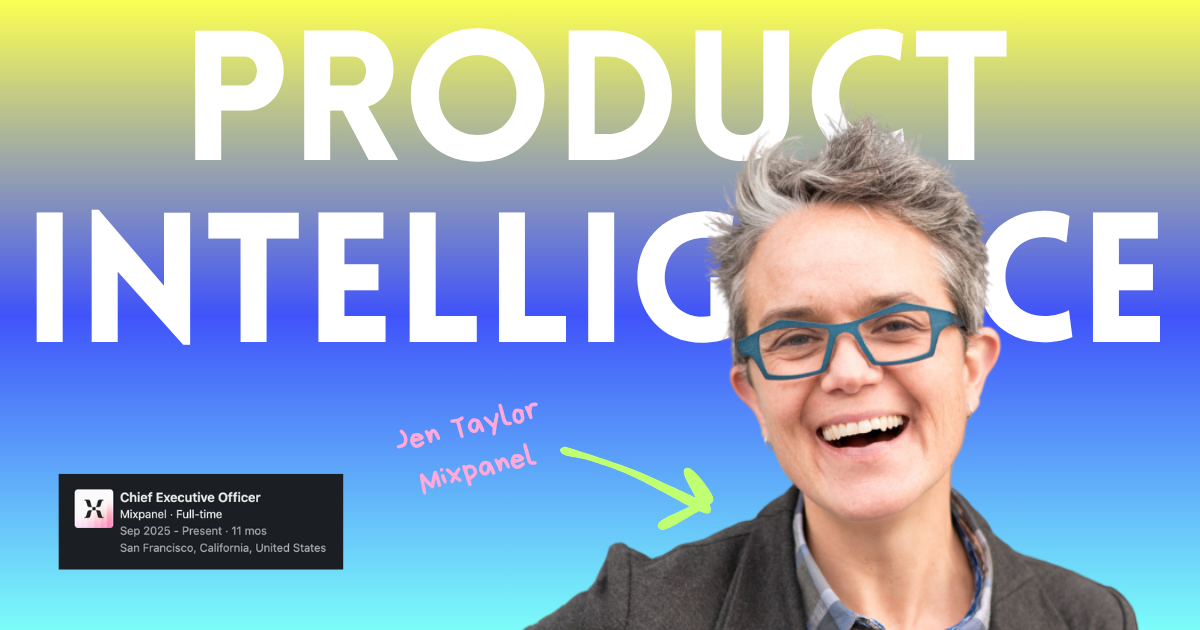
Jen Taylor is the CEO of Mixpanel, a San Francisco-based product intelligence platform founded in 2009 that serves around 29,000 customers globally, including LG, Experian, and Airbnb. Backed by $277M in total funding and valued at $1.1B following a $200M Series C in 2021, Mixpanel tracks how users behave inside digital products at a company that reached an estimated $210M in annual revenue in 2025. Jen joined in September 2025, succeeding Amir Movafaghi after his nine-year tenure. Before Mixpanel, she was President at Plaid and before that Chief Product Officer at Cloudflare, where she helped take the company from $100M to $1B in revenue. Her career also includes roles at Salesforce, Facebook, and Adobe.
Jen. What makes Jen's situation genuinely interesting is that she walked into something already working. Mixpanel had double-digit annual growth, consistent profitability, and a product freshly transformed from standalone analytics to an integrated platform. Her mandate is acceleration, full stop. She spent two decades as a product and marketing leader who used tools like Mixpanel every day and always felt they fell short: too hard to start, too limited, too easy to ultimately ignore. Now she's running one, at exactly the moment AI is about to blow the category open.
Mixpanel helps product teams understand how their users experience their application, so they can identify what's working and what's not, and continue to improve the product, delight their users, and grow their business.
Take a ride-hailing app, for example. They'd instrument their mobile application to understand how new users engage when they first open the app, how they convert through the onboarding funnel, and then, over time, how individual users or cohorts continue to drive engagement and retention. That foundation lets you layer in experimentation, so the same app might use us to run an A/B variation of its onboarding funnel. | Source: |
And then there's session replay, where if they identify an error somewhere in the application, they can actually watch short video clips of what the user was experiencing to help them debug and figure out what to do next.
If you build on that ride-hailing example, historically, all of that instrumentation, dashboard creation, and analysis has been manual. What we've embraced with AI falls into three buckets. The first is AI turbocharging our core value proposition. Within the application today, people can use chat to query, create a dashboard, instrument their product, and summarize session replays. A lot of those use cases are directly inside the product. The second is using AI technologies like MCP to integrate Mixpanel's capabilities wherever people already work, whether that's Claude or Slack. So users, regardless of their technical understanding of analytics, can get the information and insights wherever they live. The third is the new frontier: helping people who are building and delivering AI-based applications figure out how to define and measure success. Think about the transition from web to mobile. You had different user paradigms and different definitions of what success looked like. We're seeing the same shift happen with AI-powered applications. In a mobile app, success might be a purchase flow. In an AI-powered application, it's more non-deterministic, and you have to identify different signals along the way. So those are the three buckets. AI turbocharging the analysis, democratising access to it, and helping people define success for AI-powered applications.
Being totally transparent, we're still in the very early days. This is the stuff happening in the lab right now. Within that, there are three things we're helping people who are building agent experiences think about. The first is about how an agent experiences their site or application. Today, we've all been building largely for humans and not really thinking about what it means when a technology-driven, non-human user is the one experiencing an application. In a world of AI, you may need to optimize for that. So, as you do the analysis, you need to be able to understand both things separately.
Source: Mixpanel. The second is looking for different signals. This is where it gets more speculative. A lot of how you look at different flows and usage patterns comes back to helping people think about what success could look like before you can even start to measure it. And the third is providing an ongoing, living feedback loop so people can continue to optimize and adjust the weightings of the models or data sources they're using underneath, to keep improving the application.
I was excited about this opportunity because I have unfinished business. Most of my career has been as a product and marketing leader in B2B SaaS, in places like Adobe and Salesforce, where the ground truth was always the data and the analytics. I've used tools like Mixpanel my entire career, but I always felt they underdelivered. Too hard to get started, the analysis was too limited, and, frankly, they were too easy to ignore. The moment we're living in with AI really changes all of that. Both from what's now possible and the urgency behind it. People are shipping faster with AI, and they desperately need insights to figure out whether what they're building is any good. So we're on the edge of a massive opportunity, and for me, it's my life's work to figure out how to make this happen for people, because I've wanted it my whole career. As for how it came about, I've spent a lot of time in and around the industry.
I started putting it out into the universe that I was interested in stepping up into a CEO role and looking for opportunities to have more impact and challenge myself further. I was fortunate enough to get connected to this opportunity through a friend. |
You're spot on. When you filter for companies where the underlying business is strong, where you have genuine passion and fit, and where you're bumping into the right people at the right time, it really is a needle in a haystack. A lightning strike moment. That's why I feel so fortunate to be here. A lot of people who step into the role I stepped into walk into an organization, open a cupboard, and have skeletons fall out.
A few of the 29k.
I'm immensely grateful to my predecessor, who stepped out to spend time with his family and follow his own passions. He built a company that's a tank. I walked into a business with 29,000 customers around the globe, solid financials, and a healthy, growing operation. For me, the mandate was to come in with my experience and my lens and figure out how to drive this AI transformation and be a catalyst for innovation.
No two weeks are the same. My first few months were really about a listening tour, but the structure hasn't changed much since. I love customers.
They are the whole reason I've done everything I've done in my career, and they're the whole reason I'm in this company. About a third of my time is with customers in some form, whether that's here in the Bay Area, across the US, or globally. Another third is really with the team. The most important work I've been doing in my first nine months is building and rebuilding the leadership team, bringing in new people, and setting those leaders up for growth and scale. And then the last third, which varies, is spent on the craft of the industry. |
Experimenting and tinkering myself, whether that's playing with AI or riffing on ideas with the product team, trying to stay on the edge of what's happening in the space and bringing that energy back into the organization.
The way I was brought up as a leader, and the way I like to lead, is to identify goals and objectives, then empower and delegate to the leaders under me to figure out how to get there. One of the best methods I've found for doing that is built on the back of the Salesforce V2MOM. That's the framework Salesforce has used since the beginning to set the highest-level goals within the organization and cascade them down. You set the goals, objectives, and metrics at the start of the year, the CEO signs up for it, staff signs up for aspects of it, and it flows all the way down. I've brought some version of it into almost every organization I've worked in, and it's one of the things I really brought to Mixpanel to kick off the year. It creates strategic clarity, the right level of alignment, and most importantly, it gives teams the empowerment and autonomy to figure out how to get there themselves.
The Salesforce V2MOM, defined. Source: Visible.
The other thing I focused on was introducing Monthly Business Reviews. I really value that cadence of getting together as a leadership team and looking at the business as a whole. You'll have engineering looking at what's happening in sales, marketing looking at what's happening in operations, and that comprehensive, collaborative view has been really important. Outside of those, the ritual that already existed and that I've kept is the bi-weekly company All Hands. I've seen it in almost every organization I've been in, and for distributed teams especially, the ritual of coming together, sharing quick wins, and talking about where you're struggling is incredibly powerful.
The first thing was adapting it to the organization. I was fortunate to have some Salesforce alumni at Mixpanel who helped articulate what was possible and helped me think through the adaptations we'd need to make it culturally appropriate. We don't call it the V2MOM here. Steph Robotham, our interim CMO, adapted it for us. She calls it the ‘Go Plan’, and I love that. Steph took the first pass at drafting it. At our staff offsite in Q4, the leadership team discussed our financial and strategic goals and objectives. Steph then translated that into the Go Plan framework. My new VP of Operations started around the same time and was critical in operationalizing it, creating the right accountability mechanisms and the right level of visibility. We're still tweaking and refining as we go. Lotte, our VP of Operations, is working with Claude and other tools to build an automated dashboard that shares updates on this with the whole organization.
Interestingly, I don't think Mixpanel had a strong heritage of company-level goals. One of the first things I heard when I joined was that people really wanted to understand our strategy and objectives.
The Mixpanel leaders. | They wanted to understand what winning looked like. So the organization was actually hungry for something like this. You always have to be careful bringing frameworks in from the outside and look at the room you're in, but the reception has been genuinely great. I'd say we launched the Go Plan this year. Fully adopting and living it will probably take two cycles before it really soaks into the fabric of the organization. |
The most surprising thing about my job is that it's the one I interviewed for. Going back to what we said about the needle in a haystack, many of my peers who've stepped into a CEO role have walked into an organization, opened a cupboard, and had skeletons fall out. My predecessor left a genuinely healthy organization, and the conversations I had with the board during the process were very direct, very clear-eyed, and truthful in both directions. There've been very few surprises and nothing of substance. Also, I was surprised by the office. I hadn't actually visited before my first day, since the whole interviewing process is confidential. The day before I started, our Head of People said, "Come meet me, I'll show you around." I walked in and thought, ‘Wow’. It's right next to the Ferry Building, right on the pier. You walk outside, and there are seagulls and ferries. It almost feels like Australia.
The first thing I did was hire an interim CMO. As I was onboarding, it was clear that the organization really didn't have a marketing function and hadn't had a strong heritage of one. That played out in near-term and longer-term ways. In the near-term, there was no clear articulation of who we were or what we stood for in the market. No amplification of that out to the world. People didn't really know what Mixpanel felt like out there. |
So I brought Steph in, and she's been absolutely transformational. In October of last year, she sat me down and said, “Here's the scoop. Next spring, we're going to do a series of customer events around the globe, starting in San Francisco, to relaunch Mixpanel and launch all of our new AI capabilities.” I thought she was crazy. We hadn't even built the products yet. I wondered what narrative we were going to create and how we were going to go around the globe. And here I am, four events into a 16-city global tour, doing exactly that. Those big, audacious goals—that's what I needed from day one. Someone to create an anchor and barrel through the organization with me.
My leadership style has always been to hire people who are so smart I'd ultimately want to work for them, and then figure out how to delegate, empower, and make them successful. I've always been a team athlete. I grew up playing sports and genuinely love being on teams. I love the diversity of thought and perspective. What I'm trying to create in my leadership team is a place where people feel ownership and accountability, but also feel empowered to stretch their legs.
I believe firmly in a collaborative culture where people feel safe to disagree. But they have to disagree, commit, and move on. I always say the privilege of a bad decision is that you usually get the opportunity to make it again. Very few one-way doors. More broadly across the organization, I really try to hire for and encourage curiosity. Curiosity is how you take a diverse environment and make it a genuinely inclusive one, because people are curious about understanding each other's points of view and feel invited to bring that to the table. It is also the core of how you drive innovation. It's the ‘how might we do this?’ or ‘what would happen if we did it this way?’ questions that tend to become the springboards.
My direct reports are the Chief Revenue Officer, Chief Marketing Officer, CTO, General Counsel, Head of People, Head of Finance, and VP of Operations. With each of them, I do weekly one-on-ones, in person whenever possible. A good portion of our leadership team is based in San Francisco, and we all come into the office every Wednesday. They may come on other days to spend time with their teams, but Wednesday is the constant. We also have a weekly hour-long staff meeting, which the VP of Operations sets and runs. Outside of that, I'm essentially on Slack with people all the time. Right now, I'm spending more time with the engineering, product, and design team because we're short on a CPO. But I'm in Slack channels with each leader individually and in groups across different topics.
Mixcursion time. | Great Place to Work in India. |
There's a running thread with my CTO and CRO where we're constantly talking about what we're hearing from customers, what we're thinking about building, and passing each other podcasts, wherever we happen to be in the world. On top of that, we do monthly MBRs: a corporate MBR, a people team MBR with the e-staff, and I'll sit in or listen to recordings of the QBRs within the go-to-market organization.
I'll start with where the industry is headed, because it provides context for where we're going. The industry has already moved from a world of best-of-breed standalone tools, where you'd have a separate product analytics, a separate experimentation, a separate session replay offering, to integrated platforms that give customers a more complete picture. We made that transformation over the past couple of years, and it was already underway when I walked in. What I think is happening now is the next shift. As the roles of product managers, engineers, and designers get blurrier and blurrier, as everyone starts to occupy different parts of each other's workflow, people are building things faster with AI. But it's absolutely critical that as they're building, they understand whether or not what they're building is any good.
That's the transformation we're making, from product analytics to a product intelligence platform. We're going to be the solution that helps all of those builders understand what's working, what's not working, and what to do about it. Powered by AI, but also through ongoing product innovation to keep deepening the understanding of users. Two shifts are driving this: from product analytics to product intelligence, and from SaaS to AI native. We're already starting to see both play out.
Source: Mixpanel. Looking further out, I increasingly see Mixpanel as a critical data infrastructure for building and delivering products. And you'll see us integrate more deeply with additional data sources, including CRM solutions and revenue systems, so that the intelligence we can provide gives a much deeper context—not just the user, but the product and the business as a whole. Where I hope all of that gets us is to continue accelerating growth and delighting users, from large enterprises to innovative new startups.
Claude and Cowork are basically attached to me. That's where I spend a lot of my time. I create projects within Cowork for different areas: personal coaching and monitoring, helping me mentor and coach my team, and organizing and delivering projects. For example, I have a CEO coach project where I've built in context and asked it to give me very specific feedback, taking into account the Go Plan and how I've shown up on Slack, and basically giving me weekly updates on how I'm doing, what's working, what's not, and where the opportunities are for me to step in and deliver more as a leader.
I also have a project for the open CPO search, with the job description and interview guides. Every time I have an interview, I come back to it with information about the candidate to think about how to tailor the conversation. And then I use AI as a sparring partner. If I'm writing something like a board memo, I'll use it to challenge myself about what I'm missing, where I'm going to get caught. I've also fed in the personas of the people I work with regularly, so I can ask what I'm likely to hear from a particular person and think around corners before I walk into the room.
Three things. The first is spending time with customers. I do what I do because I love customers. Every conversation energizes me and grounds me. I genuinely love helping people think through how to build and grow their business through the products they deliver. The second: I work with people I love. Life is short, man. I've gotten to a point where I really care who I work with.
I want to have fun, I want to enjoy it, but beyond that, we're building this thing together. There are hard days and exciting days, and I want to be doing both with people I genuinely care about. The other thing I need in the people around me is someone who will tell me what I need to hear, not what I want to hear. When you're a CEO, a lot of people really, really want to tell you what you want to hear. | Energised. |
The third: I try to set aside some time every day when I'm not thinking. I'm a morning person. Whether it's a dog walk or a run, I do my best thinking when I'm not thinking. My brain needs to off-gas, to release some of what I'm carrying. And almost always, I'll come back from a dog walk with a voice memo or a post-it note that I may never look at again. But that's where a lot of the synthesis happens, just giving my brain a chance to marinate and digest everything.
Mixpanel Introduces Mixpanel AI, Delivering Always-On Product Intelligence- May, 2026Why I joined Mixpanel as CEO: A new era in analytics- February, 2026A New Chapter for Mixpanel: My Conversation with CEO Jen Taylor- September, 20257 Leadership Principles for Product Managers Lessons from Jen Taylor- June, 2021
BRAIN FOOD 🧠
TOOLS WE RECOMMEND 🛠️
Every week, we highlight tools we like and those we actually use inside our business and give them an honest review. Today, we are highlighting BILL—Your AI-powered financial operations platform.
See the full set of tools we use inside Athyna & Open Source CEO here.
**HOW I CAN HELP **🥳
Hiring global talent:If you’re hiringtech, business or ops talent and want to do it 80% less, check out my startup,Athyna. 🌏See my tech stack: Find our suite oftools & resourcesfor both this newsletter and Athynahere. 🧰Reach an audience of tech leaders:Advertisewith us if you want to get in front offounders, investors and leadersin tech. 👀