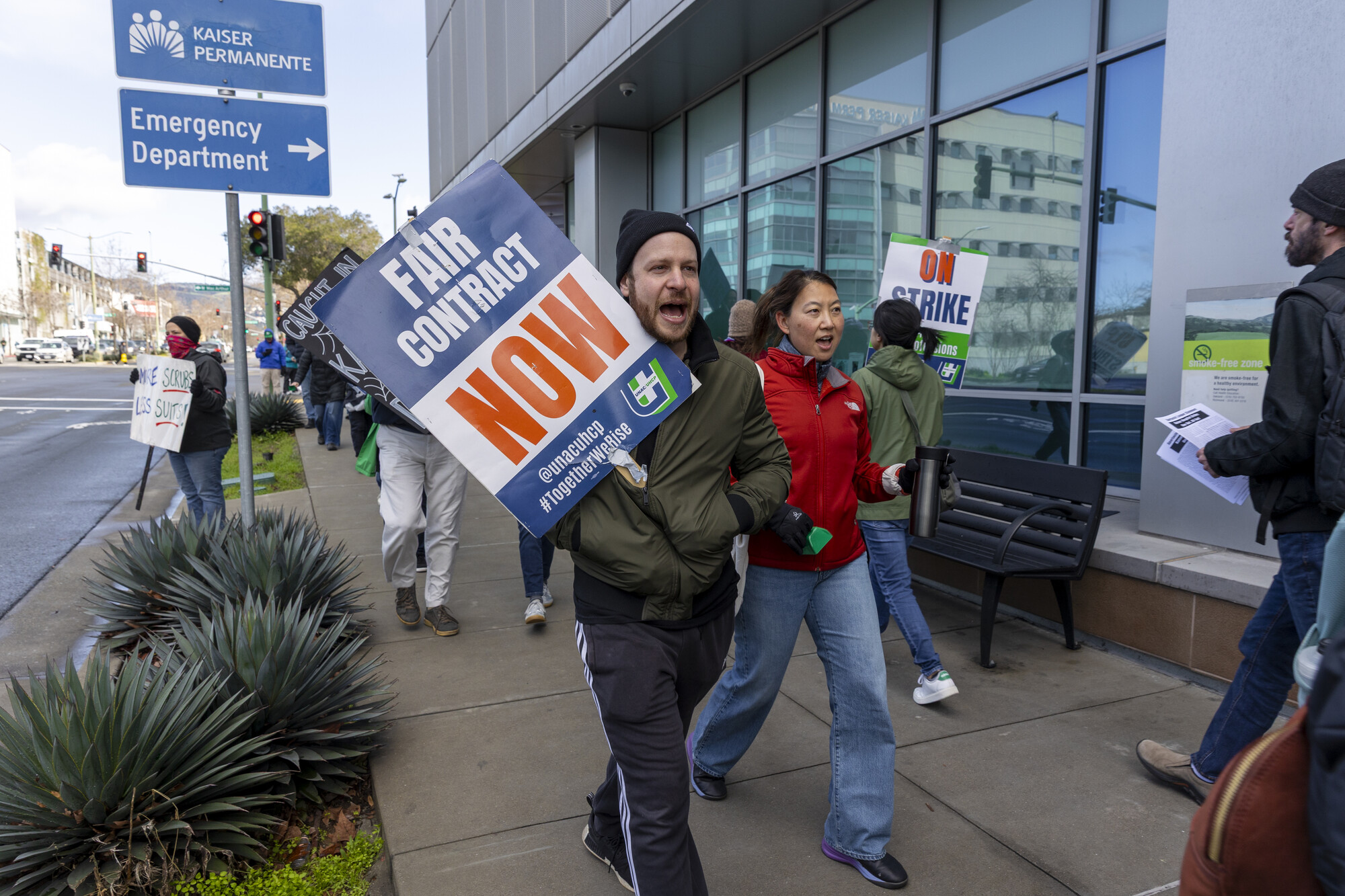
Unlicensed phone operators and algorithms directing patients to inadequate telehealth services. Controversial artificial intelligence technologies increasingly deployed at clinics. Distraught patients who can’t get an appointment with a human for weeks.
Those were some of the alarms raised by Kaiser Permanente clinicians who told the San Francisco Board of Supervisors the healthcare giant has failed to significantly improve its mental health services, even after recent sanctions by state and federal regulators for denying or delaying care.
The hearing Tuesday examined Kaiser’s contract proposals during labor negotiations, which the union said would allow the employer to expand its use of AI tools in mental health care and lay off more therapists who currently provide it.
Experts said these changes could degrade care by giving the company a free pass to outsource patients to companies that use chatbots and squeeze overworked professionals — claims Kaiser denies. The clinicians pleaded with supervisors to pressure their employer to strengthen patient care and support its staff.
“The things that we discussed today are infuriating, concerning and unacceptable,” said Supervisor Chyanne Chen, who called the hearing after multiple constituents, including Kaiser employees, complained about the healthcare company’s approach.
Chen said she’ll introduce a resolution next week calling on the state’s largest health plan to agree to contract language stating it will use AI to help therapists — not replace them, and back off a proposal that would allow it to refer more patients to third-party contractors.
Kaiser executives declined to attend the hearing, a move several supervisors decried as disappointing or even “disrespectful.” The city of San Francisco, San Francisco Unified School District and other public employers paid Kaiser $508 million in health premiums last year to cover more than 39,000 employees and retirees, according to the San Francisco Health Service System.
“Their non-presence suggests to me that the picture that’s being painted by the workers is pretty accurate,” Supervisor Rafael Mandelman said. “We do not want to be subjecting our employees and our retirees to a situation where they can’t actually get the care that they need.”
In a statement, Kaiser said it does not use AI to diagnose patients or make clinical decisions, and that it remains focused on providing timely, high-quality mental health care while reaching a fair agreement with the therapists’ union.
Since 2023, Kaiser has agreed to pay more than $231 million in settlements after investigations into the company’s behavioral treatment access by the U.S. Department of Labor and the California Department of Managed Health Care.
The nonprofit health organization said it has invested more than $2 billion since 2020 to expand its mental health facilities and provider networks, and now consistently meets California law requiring health plans to provide timely access to care. Kaiser, headquartered in Oakland, made a net income of $9.3 billion last year.
During the yearlong contract talks, Kaiser has resisted language stating that the company won’t use AI to replace therapists and proposed making it easier to lay them off, according to the National Union of Healthcare Workers, which represents 2,400 psychologists, licensed clinical social workers and other behavioral health professionals at Kaiser in Northern California.
The union, which staged a one-day strike earlier this year and a 10-week strike in 2022, said the parties are set to start mediation next month.
On Monday, the union filed its latest complaint with the California Department of Managed Health Care alleging that a Kaiser triage system that initially screens patients seeking mental health care violates California law because it relies on automated algorithms and unlicensed clerical staff — instead of licensed clinicians — to recommend care.
“It’s violating patient care standards and putting patients at risk. Artificial intelligence and algorithms don’t capture what trained humans can,” Ilana Marcucci-Morris, a licensed clinical social worker and therapist at Kaiser in Oakland, told supervisors.
Marcucci-Morris said she has seen AI making patient care errors at work.
“This isn’t about genuine innovation. It’s about saving a buck at the expense of patient care and public health. If we don’t stop them now, we won’t stand a chance down the road,” she said.
Kaiser argued that clerical staff who make appointments for patients are trained to escalate an emergency to clinical staff, and its behavioral health e-visit tool helps connect members to care more quickly.
“It is an additional path to getting care — not the only path,” the company’s statement said. “On every screen throughout the e-visit process, the patient is provided a phone number that they can call at any time to talk to a live person.”