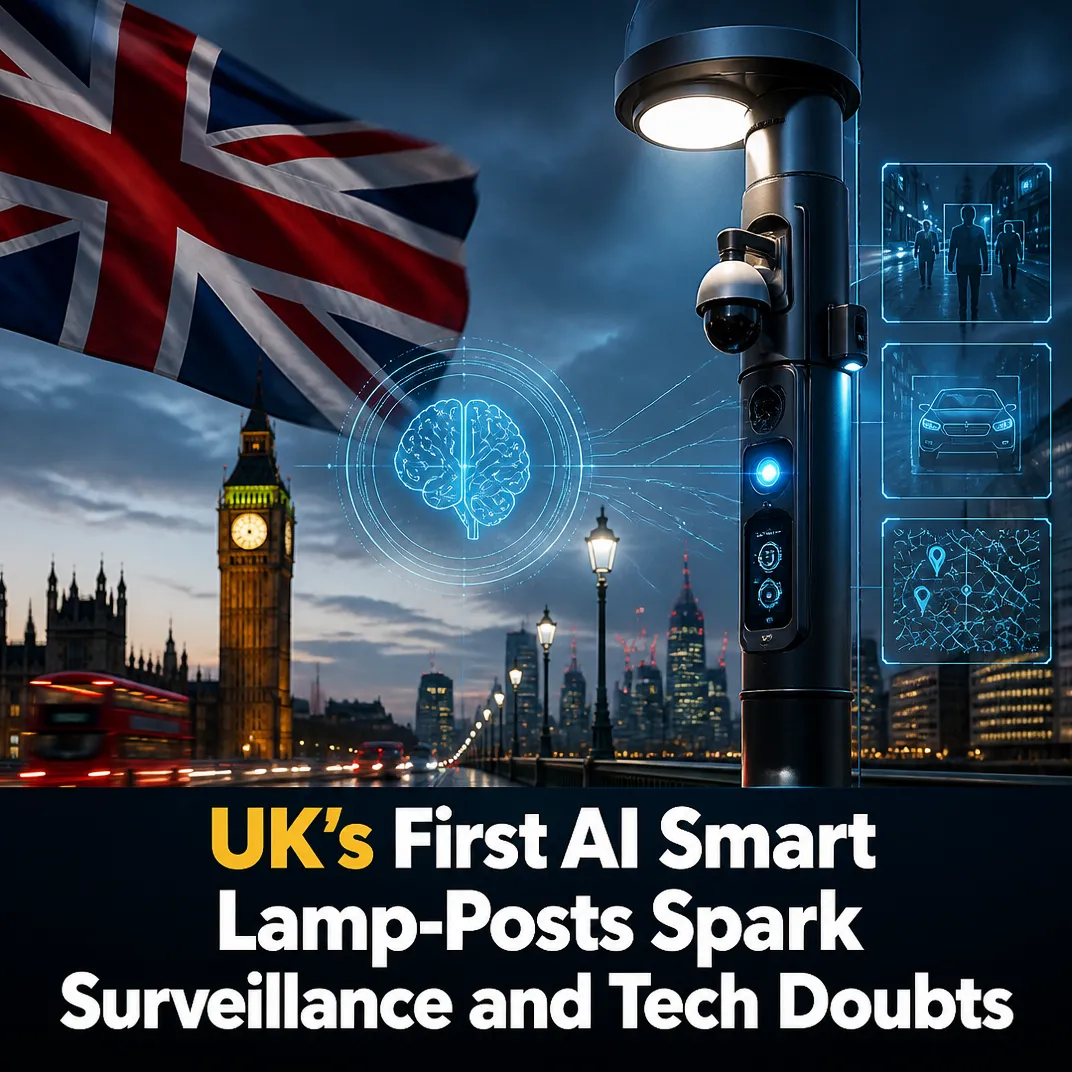
July 28, 2026, (Inside AI) — Warwickshire’s hospital car park now hosts the UK’s first AI-enabled smart lamp-posts, called iLamps, from Conflow Power Group (CPG). These solar-powered units can recognize number plates and faces, and CPG claims they can double as distributed AI data centers. The company has also signed a deal to supply 50,000 iLamps to Nigeria’s Katsina state, with expanded surveillance features.
The iLamps are pitched as tools to fight crime and find missing persons, but only in partnership “with the relevant authority,” CPG chairman Edward Fitzpatrick told the BBC. Yet local authorities and the hospital declined to comment, and residents seem largely unconcerned. Karl, 52, waiting at a bus stop, said: “The town centre is already full of cameras, and it’s fine. You don’t mind them being there unless you’re up to no good.”
This acceptance masks deeper technical and policy fissures. Jasleen Chaggar, senior legal and policy officer at Big Brother Watch, warns that councils are often “sold these tools as magic wands” when there are stark limitations. Professor Rabih Bashroush, director of the Centre for Artificial Intelligence and Data Innovation at the University of East London, dismisses the AI data center claim: “There’s absolutely no chance this will fly: the technology doesn’t work, there’s not enough power, the economics won’t work.” He notes that UK solar generation is “negligible” for such tasks, and that facial recognition hype “has no legs.”
Facial recognition is not just CCTV #
Chaggar stresses a critical distinction: “Facial recognition is not just passively recalling something, unlike CCTV, which you then check after the fact. What facial recognition does is real-time identity check: it’s much more like a fingerprint or DNA. It’s not like a passport—you can’t get another face.” She adds that many systems can later activate hidden functions like aggression detection or suspicious behavior monitoring, often without public knowledge. A London council’s CCTV upgrade already allows embedding such features, which can be “turned on overnight.”
Emotion-detection algorithms are particularly suspect. “A lot of the software is pseudo-scientific,” Chaggar says. “There’s very little evidence to suggest that it’s accurate. If you’re a disabled person who moves differently, you might be flagged and have an intervention.” The Home Office approved police use of facial recognition over a decade ago, and Chaggar argues the public has been “essentially used as guinea pigs for the past 10 years.”
Who owns the data and the dystopia question #
Data ownership remains a minefield. Bashroush recalls a Dutch waste-collection project where the supplier retained data, blocking competitive bidding. “The council that ran the programme was very happy with it, and tried to open the bidding a year later to get a more competitive price. The company said, ‘Sure, but the data is ours.’” That contract failure left the authority powerless. Similar risks loom for smart streetlights harvesting behavioral data.
Retail facial recognition already shows the harm: misidentification can lead to Kafkaesque blacklisting without recourse. Yet public indifference persists. Tejal, 41, a radiologist at the hospital bus stop, said: “I think we have to move on and accept that things change.” Her deeper anxiety is AI’s impact on her children’s future, not privacy. Meanwhile, Karl’s friend Bob, 48, uses a basic phone to stay private, a choice policymakers might call “exclusion.”
The Home Secretary’s earlier statement that “you can’t enjoy any of your liberties in any country if you’re not safe” frames all freedoms as secondary to state protection. This logic, combined with infrastructure that can be upgraded silently, worries Chaggar: “Are you happy to have your political enemies having these capabilities? Because you’re building an infrastructure that is here to stay.” As Sarah, 55, put it: “If you haven’t got anything to hide, I can’t see how it would be a problem. I’m presuming they’re actually lamps as well?”
Technical assessments back the skeptics. A 2021 study on edge AI for smart cities highlights severe power and compute constraints for on-device analytics, while a UK government review of police facial recognition underscores accuracy gaps and legal challenges. The iLamps may illuminate more about our surveillance trajectory than any street.