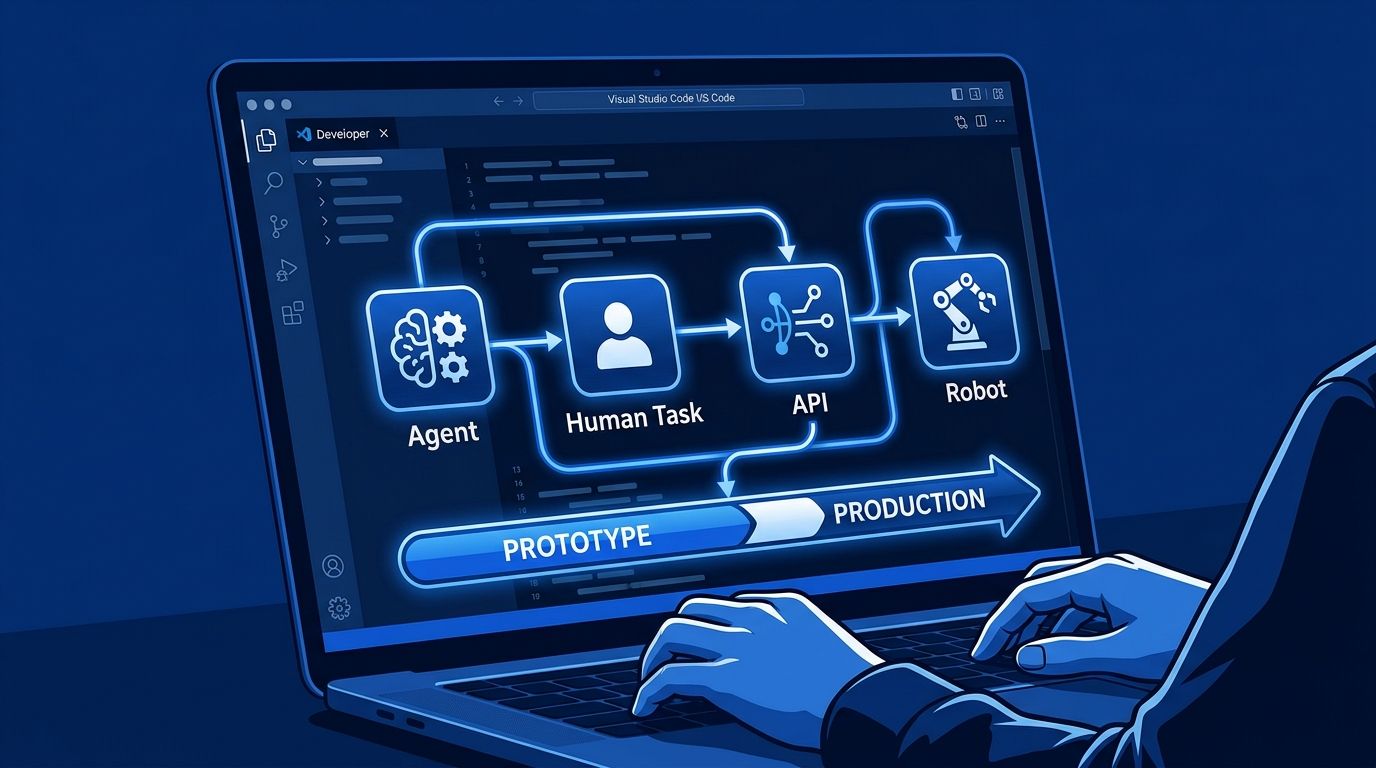
Building the agent is no longer the hard part. Getting it to production is. That single friction point is why 88% of enterprise AI agent pilots stall before they ever reach users — not because the model failed, but because there is no reliable path from “it works in my dev environment” to “it runs reliably at scale with audit logs and governance.” UiPath Maestro Flow, now in public preview, is a direct attack on that gap.
The Gap Nobody Talks About Enough #
The typical agentic build cycle looks like this: spend a week with Claude Code or Cursor, ship a working prototype, then spend the next month rebuilding it on LangGraph or Temporal so it has durable execution and error recovery, then spend another month layering governance and observability on top of that. By the time the original agent finally reaches production, the team has tripled the build cost and is maintaining two separate representations of the same logic.
That redundancy is the core problem. Maestro Flow collapses it. The idea: the .flow
file your coding agent generates in VS Code is the same artifact that runs in production. You do not rebuild anything.
What Maestro Flow Actually Is #
Maestro Flow is an orchestration canvas inside VS Code. You install the UiPath Maestro extension, describe what you want to build in plain English, and your coding agent — Claude Code, Cursor, GitHub Copilot, Codex, Gemini CLI, or Windsurf — discovers available nodes, proposes a plan, and generates a .flow
file. You review it, confirm it, and deploy. The same file goes to production via the UiPath Maestro runtime, which handles durability, fault tolerance, and execution tracing without any additional configuration.
The nodes your agent can wire together include AI agent nodes (which can call MCP servers, built-in tools, connector tools, or RPA workflows), human task nodes for approval gates, script tasks, HTTP request nodes, decision and loop logic, and RPA workflow nodes that trigger UiPath robots. Multi-framework support means you can orchestrate UiPath agents alongside Claude, OpenAI, Gemini, LangChain, and CrewAI agents in a single flow. The governance layer — SSO integration, audit logging, policy gates — is built in, not bolted on.
Getting Started with UiPath Maestro Flow #
Maestro Flow is in public preview with no waitlist. Here is the setup path:
- VS Code 1.110.0 or higher, a UiPath account, and Node.js available on PATH
- Install the UiPath Maestro extension from the VS Code Marketplace
- Run
npm install -g @uipath/cli
and thenuip skills install
- Sign in via the Connect section in the extension (browser redirect, then return to VS Code)
- Create a new
.flow
file withCtrl/Cmd+Alt+N and describe your process to your coding agent
Full setup details are in the UiPath Maestro VS Code documentation. The public preview is live at uipath.com/product/maestro/flow.
The Lock-In Trade-off #
Here is what the press releases leave out: Maestro Flow runs on UiPath’s Automation Cloud. This is not an open runtime you self-host. Your flows are deployed to and executed on UiPath’s infrastructure, which means you are making a platform bet on UiPath, not just adopting a workflow format.
For teams already in the UiPath ecosystem — and there are many enterprise teams in that position — this is a natural extension, not a new commitment. For everyone else, the calculus is harder. [LangGraph](https://www.langchain.com/langgraph) is MIT-licensed, free, and self-hostable; it requires you to build governance yourself, but you own the runtime. Temporal gives you durable execution and is production-proven, but is also not agent-native. If open infrastructure matters to your organization, those are still the right answers.

If your team has been burning weeks per agent prototype on the rebuild-to-production cycle, Maestro Flow is worth evaluating seriously regardless of your current toolchain. The 88% pilot failure rate is not marketing — it is an industry-wide measure of a real problem. Maestro Flow is one credible answer to it. Just go in knowing what you are trading.