Uber’s Legal Redlining Agent has reduced average contract review time by more than 20%, with 91% accuracy in AI-generated decisions, according to the company. Integrated into Microsoft Word, the agent analyzes proposed contract changes, assesses legal risks, and recommends policy-aligned responses using retrieval-augmented generation (RAG), historical lawyer feedback, and deterministic rules. Lawyers retain responsibility for reviewing and approving its recommendations.
The agent identifies edits proposed by external parties, interprets their intent, compares changes with legal policies, and suggests whether to accept, reject, or modify clauses. It also generates comments explaining recommendations and flags changes requiring closer scrutiny. Uber began developing the first generation in early 2024 and piloted it with its Legal team in 2025.
High-level workflow of the Legal Redlining Add-in / Agent (Source: Uber Blog Post) An initial RAG implementation retrieved relevant sections from legal playbooks to guide language model responses. However, the system struggled with semantic retrieval accuracy, negotiation tone, and scenarios not covered by existing examples. Uber subsequently added a feedback loop that captures lawyers’ decisions, reasoning, and final edited text.
This change allowed the agent to retrieve examples of how similar clauses had been handled rather than relying only on whether a previous recommendation was accepted or rejected. At runtime, similarity search and metadata filtering narrow thousands of historical interactions to approximately 20 candidates. A second language model-based filtering stage evaluates their relevance. Exponential decay weighting, with a configurable half-life currently set to 365 days, prioritizes recent decisions while retaining older examples. The implementation also gives domain experts control over language and negotiation style.
Uber Engineering framed the challenge in its LinkedIn post: How can AI help streamline repetitive contract review while keeping lawyers in control?
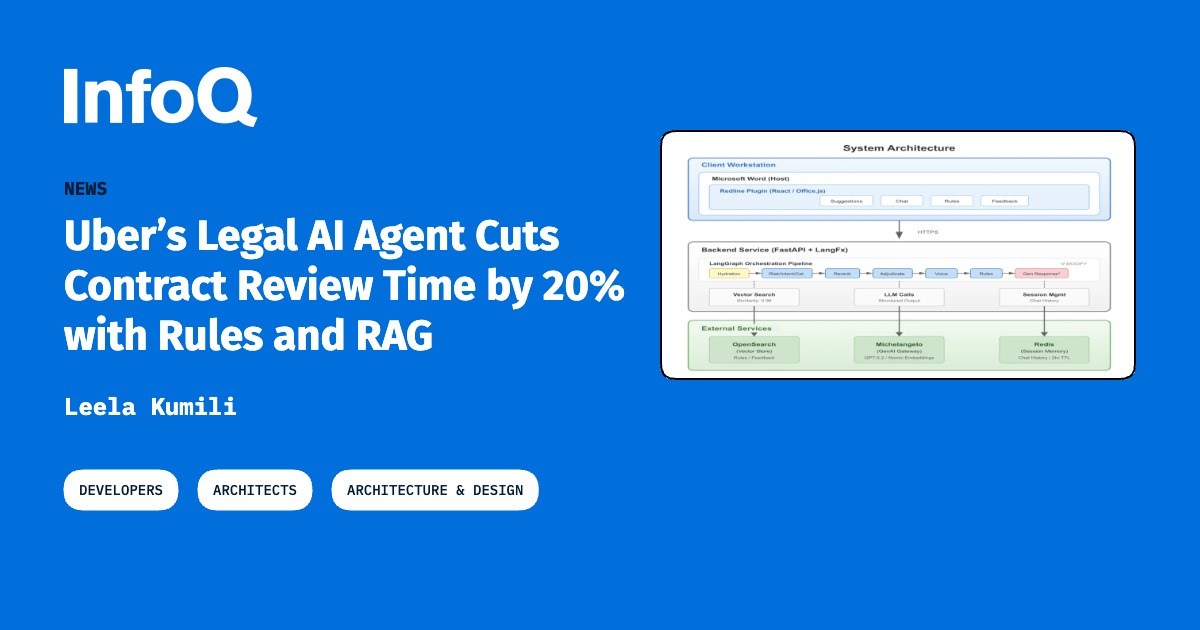
The legal team defines the desired tone and style, while engineers maintain the prompt structure and application workflow. The architecture combines a React and TypeScript Word add-in with a Python backend orchestrated through LangGraph. Parallel workflow nodes handle intent detection, risk assessment, and policy lookup. OpenSearch stores vectorized legal rules and historical feedback, while Redis maintains session state for follow-up questions.
Legal Redlining Agent system architecture (Source: Uber Blog Post) A deterministic rules engine enforces non-negotiable legal requirements and overrides model recommendations when a matching rule applies. Language models handle tasks requiring contextual interpretation, including clause recommendations and negotiation tone. A final verification step checks generated responses against retrieved rules.
Uber is also exploring agentic harnesses, including Claude Code and OpenCode, alongside skills to structure and automate workflows across its agentic AI efforts. The team plans to investigate legal ontologies and knowledge graphs to represent legal concepts and relationships, providing a semantic foundation for more consistent interpretation and reasoning.