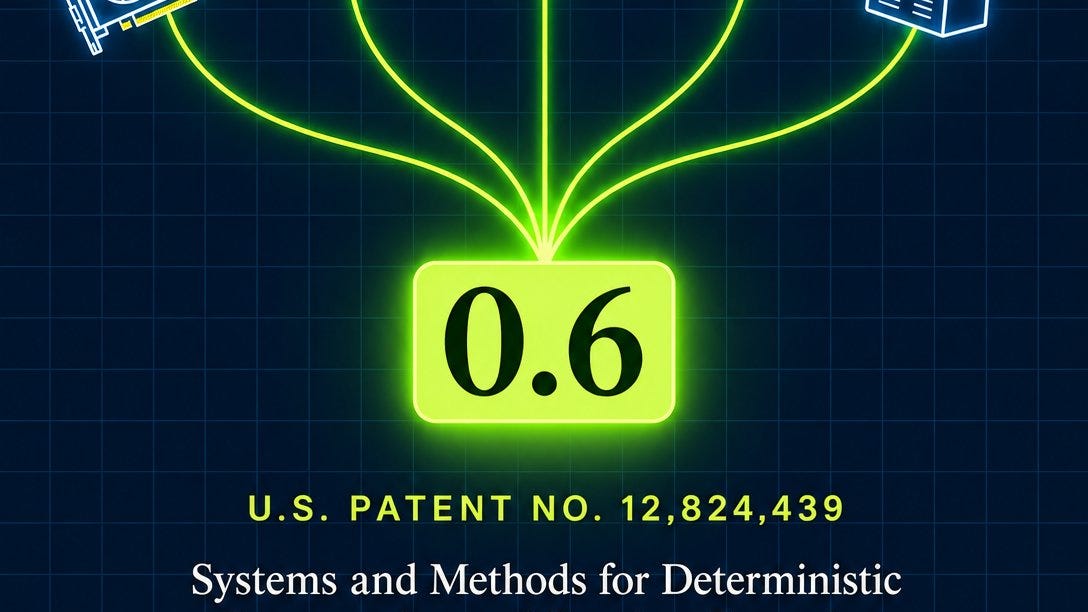
For a long time I’ve described LuxiEdge in one sentence: “a math engine that’s exact.” That was all I could say. Today I can say more. The U.S. Patent and Trademark Office has notified us that U.S. Patent No. 12,824,439, “Systems and Methods for Deterministic Computation and Stateless Execution,” issues on December 8, 2026.
Here’s the problem it solves.
Computers don’t all do math the same way. Ask one to add 0.1 + 0.2 + 0.3 and you get 0.6. Change the order of the additions and you get 0.6000000000000001. Spread that over billions of steps on different chips, an NVIDIA GPU, an Intel or AMD server, an Apple laptop, and the same program gives different answers on different machines.
Most of the time nobody notices. But when the number is a bank’s risk, a person’s genome, an AI’s answer, or the path of a machine that moves, “close enough” means you can’t check anyone’s work. You have to trust it.
What the patent describes, in plain English:
-
Take a math request, the operations and the numbers, and turn it into an exact set of instructions before any chip touches it.
-
Lock the order of every step, so no processor can reshuffle the math for its own convenience.
-
Send those instructions to any processor. Every one of them returns the identical result, bit for bit, and each run stands on its own, with nothing left over from the last job to change the answer.
Built on that core, the claims also cover:
-
Combining steps to cut memory traffic, so exact doesn’t have to mean slow
-
Trig and other math functions
-
Machines that move: motion control and electromechanical devices
-
A fingerprint of the program, plus a cryptographic receipt with every answer, so anyone can verify it
-
Sums that come out identical on CPUs and GPUs
Why it matters: when every machine gets the same answer, you check someone’s work by re-running it, not by taking their word for it.
We’ve already put the engine to work: Haplotastic calls human genomes about 6x faster than GATK best practice on the same machine type (November 23-24, 2026 internal measurement), with byte-identical output run to run. In our own tests, the AI inference engine gave the same 136 answers, token for token, on nine different GPU types.
I’ve run roofing crews, oil fields and an operating company. I invented this because waste bothers me, and a computer that can’t give the same answer twice is waste.
If your business depends on getting the same number twice, let’s talk. luxiedge.com