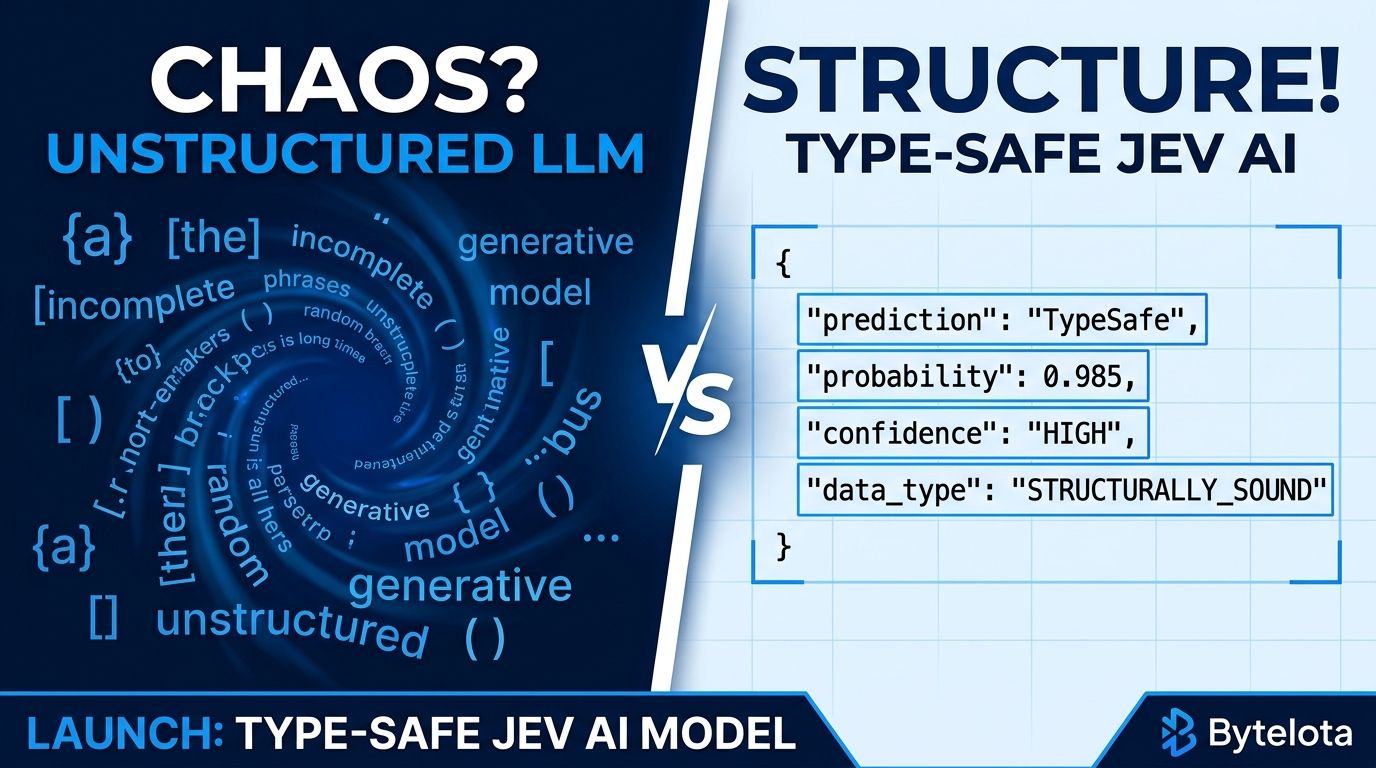
Yesterday, TypeSafe AI opened early access to Jev — an AI model that cannot generate a single word. Built by Diogo Almeida, a co-inventor of ChatGPT, Jev is the first “System One Model”: send it a block of structured state, and it returns typed probability distributions across your predefined options in 70-500 milliseconds. No text. No tokens wasted on explanation. At $0.042 per million input tokens with output entirely free, it is deliberately the opposite of everything frontier LLMs do.
TypeSafe Jev: A Function Call, Not a Chatbot #
The core mental model Almeida keeps returning to: “Think of Jev as a frontier-intelligence function call: unstructured state in, typed probabilistic decisions out.” That framing is literal. You define your schema — billing, technical, sales — and Jev evaluates the incoming support ticket against all three simultaneously, returning calibrated probabilities in one parallel pass, as documented in TypeSafe’s official launch post.
For example, a routing decision looks like this:
{
  "routing": {
    "billing": 0.08,
    "technical": 0.85,
    "sales": 0.07
  },
  "confidence": 0.85
}
No parsing pipeline. No output validator. No schema enforcement wrapper — the output is schema by construction. Your application code reads 0.85, routes to the technical queue, and moves on. For developers who have spent hours wrestling LLM output parsers into production, this is a meaningfully different experience. Jev supports three question types: yes/no probabilities, choice from a defined set with up to 255 options, and numerical scoring — all returned in a single parallel response.
The Person Behind the Model #
TypeSafe’s credibility rests heavily on Almeida’s résumé. He co-authored OpenAI’s InstructGPT paper — the foundational work that taught GPT-3 to follow instructions and became the backbone of ChatGPT. His co-founders are Sasha Sheng (ex-Meta FAIR researcher) and Erik Gafni (founder of genomics startup Ravel). DCVC led a $40 million seed round. As AI News reports, this is not a prompt-engineering startup.
Moreover, Almeida’s motivation is worth quoting directly: “I spent years working on models designed to make AI better at interacting with people. But if AI is going to fundamentally change how work gets done, people can’t be the only consumers of intelligence.” The argument is that the automation wave is stalling because LLMs are the wrong primitive for machine-to-machine decisions. Jev is the counter-bet. For context on how the broader AI agent ecosystem is building around these same automation challenges, see our coverage of the OpenAI Agents API public launch.
The Training Bet: Calibrated Confidence #
However, the key architectural difference is how TypeSafe trained Jev. Standard frontier models use Reinforcement Learning with Human Feedback (RLHF), which optimizes for responses humans rate highly. Jev uses Reinforcement Learning for Calibrated Decisions (RLCD) — a different objective entirely: train the model to produce probability estimates that actually correlate with accuracy. According to RuntimeWire’s technical breakdown, a model claiming 0.85 confidence should be right about 85% of the time.
Consequently, this matters for automation. With an LLM, you either skip confidence entirely or implement a brittle workaround. With Jev, calibrated confidence is a first-class output. Developers can build decision logic directly on it: route automatically when confidence exceeds 0.80, escalate to a human below that threshold. TypeSafe also demonstrates Jev at 10 queries per second — a Doom bot demo running real-time game-state decisions at roughly $7 per hour. Whether that translates cleanly to enterprise workloads is a separate question.
What the Benchmarks Don’t Tell You #
TypeSafe claims Jev runs 40-200x faster than frontier LLMs and up to 193.6x faster on specific workflows, at a fraction of the cost. However, the benchmarks are self-published. The Register flagged a critical detail: “reference answers come from the average output of GPT-6 Astra and Claude Fable 5.1 rather than an independently established ground truth.” The RLCD architecture, reward function, and calibration curves are not publicly disclosed. No independent third-party validation accompanied the launch.
Additionally, Jev’s scope is narrow by design. It cannot generate prose, write code, handle long-context reasoning, or support multi-turn conversation. The “hallucination-free” claim is a category difference — bounded outputs cannot hallucinate text — but incorrect selections within a valid schema remain possible. A realistic production stack uses Jev for classification and routing, then hands off to an LLM or template for the user-facing response. That composable architecture is compelling, but it means two systems to manage rather than one.
Key Takeaways #
- TypeSafe Jev is a decision model, not a language model — it returns typed probabilities, not text, making it a fundamentally different primitive for automation pipelines
- Pricing ($0.042/MTok input, free output) and latency (70-500ms) make it attractive for high-throughput classification workflows where frontier LLMs are overkill
- Calibrated confidence scores via RLCD are a genuine gap in current LLMs — if the training methodology holds up, it changes how developers can build branching automation logic
- The benchmarks are self-published with model-generated reference answers; wait for independent validation before committing critical workflows to the performance claims
- Early access is waitlist-only at typesafe.ai — Jev is not yet production-available for most developers