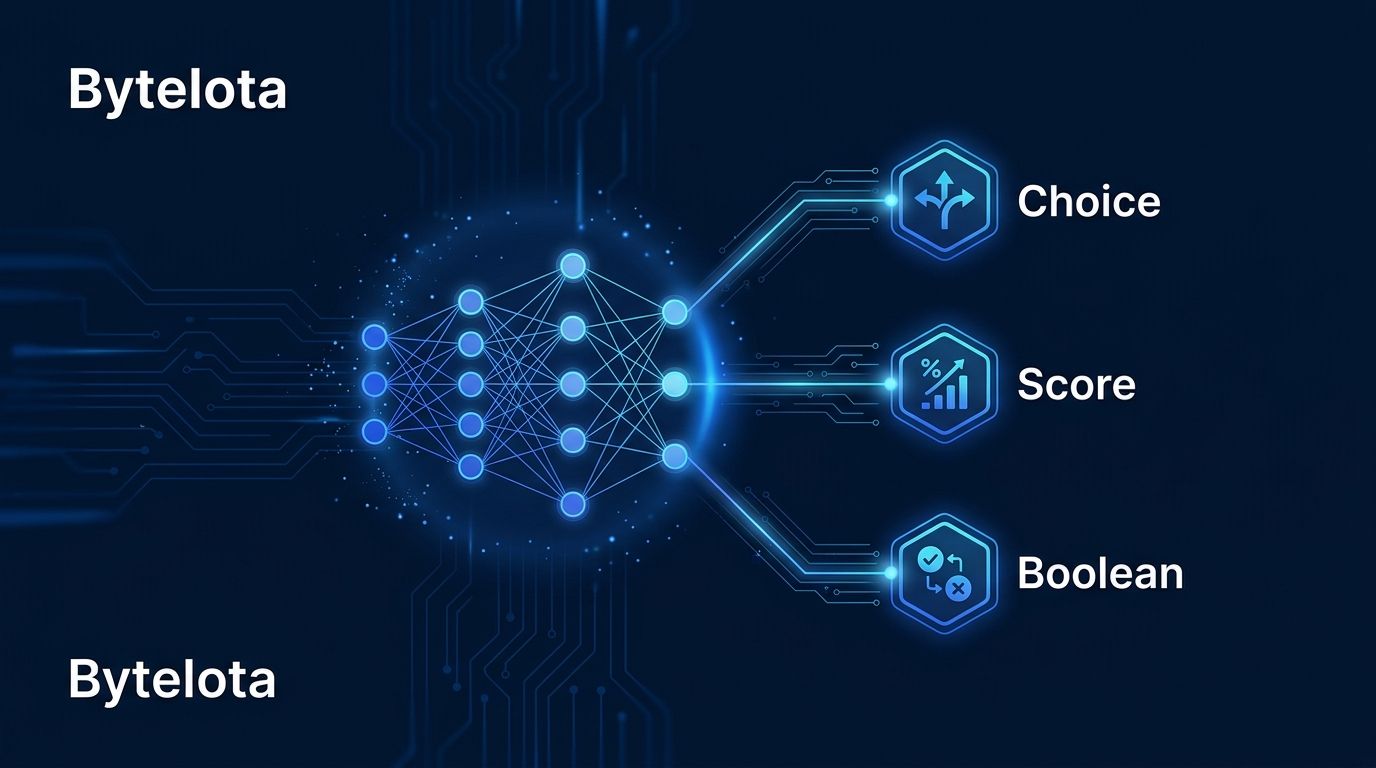
The fastest-adopted model on Vercel’s AI Gateway can’t write a single word. In two weeks, Jev — a “decision model” from TypeSafe AI — reached 35% of Vercel paid teams, nearly double the reach of Claude Sonnet 5.5 at 18.1%. It doesn’t generate text, reason through problems, or write code. It takes program state and a set of typed questions, and returns typed answers with calibrated probabilities in 70–500 milliseconds. That’s the entire product. And developers are trading out whole LLM calls for it.
A Different Kind of Model #
TypeSafe calls Jev a “System One Model” — a category it invented. The framing is a deliberate counterpoint to the chain-of-thought “System Two” reasoning that dominates AI discourse. Jev is not thinking slowly and carefully. It is making fast, constrained, calibrated decisions for code.
The mechanics are simple. You send Jev a state — a string, JSON object, or (as of 1.14) an image — plus a schema of typed questions. It evaluates everything in a single parallel pass and returns three kinds of answers:
- Choice — select one option from up to 255 you define, plus a probability for each
- Score — place the state on an ordered scale (2–10 levels), returns a probability-weighted float
- Noul — a yes/no question that returns a single calibrated probability between 0 and 1
Every answer carries a probability and confidence value. The model is trained with RLCD (Reinforcement Learning for Calibrated Decisions), which rewards honest probability estimates rather than human approval. The practical upshot: Jev’s probabilities are calibrated, meaning a 90% confidence answer should be right about 90% of the time. It also cannot hallucinate — outputs are schema-constrained, so type errors are ruled out by construction, not by prompting.
The founder is Diogo Almeida, a co-creator of ChatGPT and one of the original architects of RLHF at OpenAI. He left in 2024 and spent two years building this. TypeSafe was valued at $7.5 billion just weeks after launch.
The Performance Case #
The numbers are not subtle. Jev costs $0.042 per million input tokens with free output. Frontier LLMs run $0.03–$0.18 per decision on comparable tasks. In direct benchmarking, Jev clocked in 9.1x faster and 2.9x cheaper than GPT-6 Luna. TypeSafe’s own headline claims sit at 40x–200x faster and 40x–400x cheaper than LLMs at scale.
Put it concretely: scoring 50 million product reviews for sentiment and policy violations costs roughly $20 with Jev. With a token-billed LLM at standard rates, you’re looking at thousands. For anything that fits inside a request path — routing, classification, moderation, guardrails — the economics shift dramatically.
What It Looks Like in Code #
Jev is available right now via Vercel AI Gateway — no TypeSafe account needed (TypeSafe d new signups on September 22). Install the SDK and you can call it with a Vercel key:
npm install ai @ai-sdk/typesafe-ai
AI SDK 7 exposes Jev through the experimental_evaluate function. Here’s a support ticket router that classifies department, detects refund requests, and grades severity in a single ~200ms call:
import { experimental_evaluate } from 'ai';
import { typeSafeAi } from '@ai-sdk/typesafe-ai';

const result = await experimental_evaluate({
  model: typeSafeAi.evaluationModel('jev-latest'),
  state: { message: userMessage },
  questions: {
    department: {
      type: 'choice',
      options: ['billing', 'technical', 'account', 'other']
    },
    isRefund: {
      type: 'noul',
      question: 'Is the customer requesting a refund?'
    },
    severity: {
      type: 'score',
      levels: ['low', 'medium', 'high', 'critical']
    },
  }
});

// result.department.value       → 'billing'
// result.department.probability → 0.91
// result.isRefund.probability   → 0.78
// result.severity.value         → 'high'
Three answers. One model call. No parsing, no regex extraction from prose, no hope that the LLM stays on-format. Check the Vercel guide on classifying, routing, and scoring with Jev for more patterns.
Where Developers Are Using It #
The use cases clustering around Jev right now:
- Agent routing — classify intent and difficulty before selecting which LLM (or no LLM) to call next. Jev makes the gate decision; a frontier model handles the actual work.
- Content moderation — one Mastra implementation reported blocking 9 of 9 hostile messages and 0 of 49 legitimate ones at ~0.4 seconds median, four times cheaper than an LLM moderator.
- Guardrails — set a confidence threshold (say, 95%) and let Jev decide whether an action is safe enough to run autonomously or should escalate to human review.
- Evaluation pipelines — replace LLM-as-judge for rubric-based scoring. When the rubric is closed and evidence is in the request, Jev matches LLM judge accuracy at one-fifth the cost and one-tenth the latency.
Know the Limits #
Jev only works when the answer space is predefined. If you need open-ended text, code, or reasoning through an unseen problem, you still need an LLM. TypeSafe is also explicit that Jev 1.14 is not production-ready — image support is experimental and data residency questions for image processing are unresolved (a real blocker for some enterprise teams). For text-only decisions, the path is clearer, but direct TypeSafe API access requires joining a waitlist. InfoQ’s coverage has a solid breakdown of what’s still being worked through.
OpenAI is also reportedly building a competitor, which validates the category but suggests this market is about to get crowded.
Getting Started #
Two paths right now. If you’re on Vercel, the fastest route is AI Gateway: model ID typesafe-ai/jev, called through experimental_evaluate in AI SDK 7, no TypeSafe account required. If you want direct API access, sign up at typesafe.ai and join the waitlist. Cloudflare Workers also supports jev-1.14.0 if you’re running on that edge.
The class of problems Jev targets — routing, classification, scoring, moderation, guardrails — is exactly where developers have been burning LLM tokens for want of something cheaper and faster. The model is still maturing, but the adoption numbers suggest developers have been waiting for exactly this.