Back to Blog A Python library built on Daft for turning robot video into training-ready data, starting with hand tracking and reward scoring as UDFs, with more to come.
by YK SugiIf you're building physical AI, daft-physical-ai gives you ready-made operations for the work that sits between raw robot recordings and a trained model. It's a new open-source Python library built on Daft:
Each operation slots into any pipeline and runs lazily, batched, and distributed, with Daft handling the execution. We're starting with two use cases, hand tracking and reward scoring, with more to come.
Why #
Progress in physical AI comes down to what you can do with your data. Everyone is collecting more of it, but the harder part is turning what you already have into something a model can learn from: annotating frames, scoring episodes, filtering out the runs you shouldn't train on. Today most teams build that plumbing themselves.
We wanted anyone working on physical AI to be able to skip that. Daft already reads LeRobot datasets natively, streaming them straight from Hugging Face, and we recently made it up to 15× faster. daft-physical-ai builds on top, packaging the operations that come after reading frames into UDFs you drop into your own pipeline, so your time goes to the model instead of the plumbing.
Use case 1: hand tracking #
track_hands
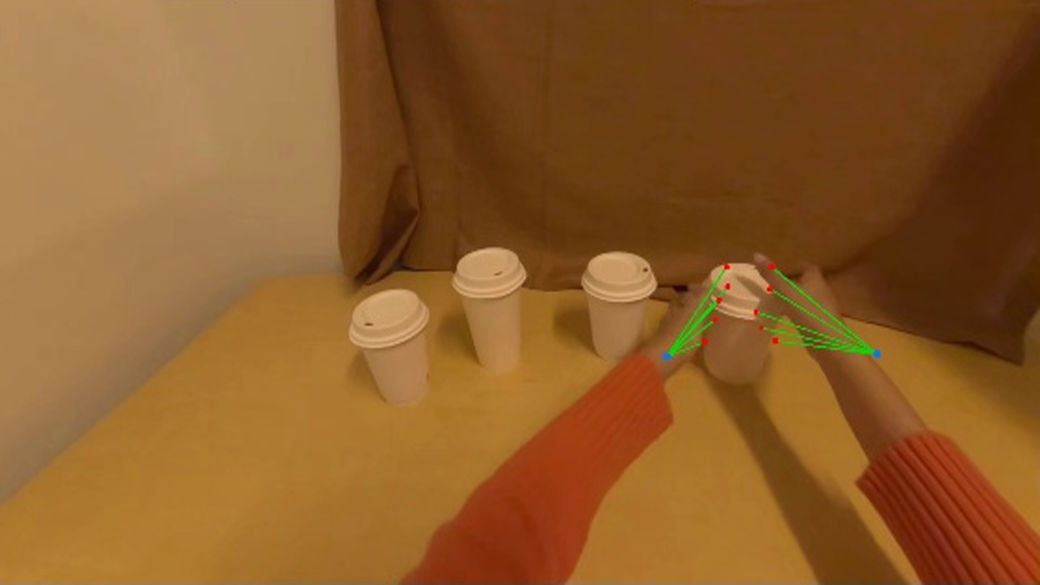
takes a Daft image column and returns a hand-pose column. Pick MediaPipe (CPU, 2D) or WiLoR (GPU, 3D MANO keypoints) - both return the same schema, so the rest of your pipeline doesn't change. Each method installs as an extra: pip install "daft-physical-ai[mediapipe]"
or [wilor]
.
Because it's a lazy, batched Daft UDF, nothing runs until you materialize - and frames annotate in parallel when they do. EgoDex ships ground-truth hand poses, so you can score the predictions right in the pipeline: on the sample above, MediaPipe reaches detect=100%
, PCK@.1/.2/.3 = 49/84/96
.
Use case 2: reward scoring #
score_rewards
scores robot episodes with a reward model (Robometer-4B): per-frame task progress (0-1) plus a success probability, written back as a dataset column. You bring a running Robometer eval server (local GPU or Modal) and point the pipeline at its URL.
A healthy episode climbs toward 1.0; a curve that flatlines near 0 is a failed, stalled, or mislabeled episode.
The scores are ordinary columns, so quality gates are one-liners - here, flagging episodes the model doubts succeeded before they reach BC or RL training:
Try it #
The easiest way to try it is to generate a runnable demo - a notebook walking through one of the use cases above. With uvx
, generating one is a single command:
The package is on PyPI, and the source, examples, and setup details are in the daft-physical-ai repo.