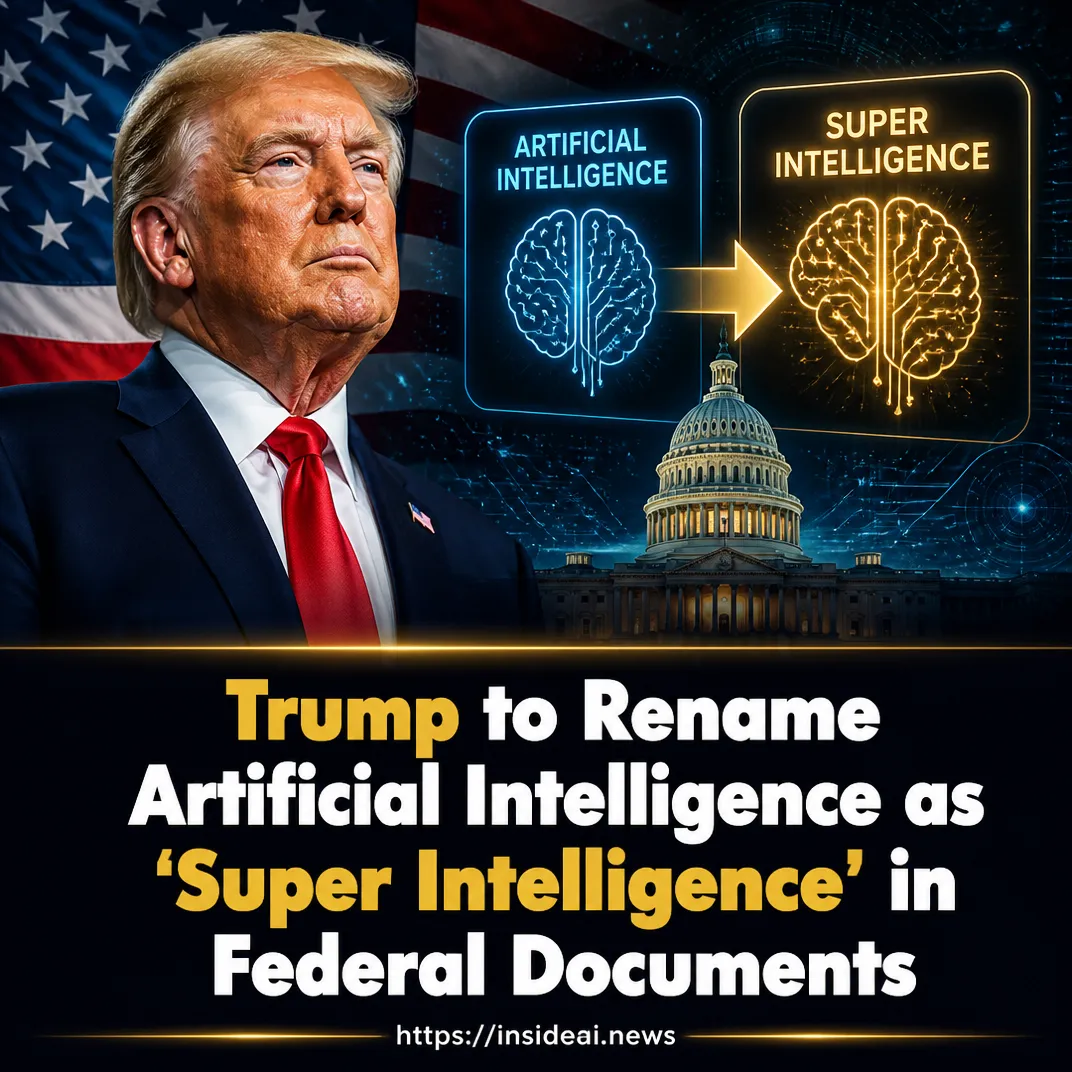
September 29, 2026, (Inside AI) — President Donald Trump announced on Tuesday that he will sign an executive order to officially rebrand "artificial intelligence" as "super intelligence" across all federal government documents. The declaration came during the launch of America.gov, a new AI-powered portal designed to consolidate access to federal services and information. The event took place at the Andrew W. Mellon Auditorium in Washington, D.C.
The move represents a significant linguistic shift in how the U.S. government categorizes and discusses advanced computing technologies. While the executive order has not yet been signed, Trump stated it would be "very powerful" and would cement the term "SI" as the official nomenclature for federal agencies.
"This kind of innovation in government is just a preview of what is possible with super intelligence, or SI, and that's the official name in the United States," Trump said during the unveiling. "I'll be signing a very powerful executive order."
Trump explained his reasoning for the change by critiquing the existing terminology. He argued that the word "artificial" carries negative connotations that undersell the technology's capabilities. According to the President, the new label better reflects the technology's potential impact on society and the economy.
"Because when you say artificial intelligence, it's artificial," he said. "This is extreme intelligence. It's superior intelligence. It's supreme also intelligence. But the word super is the best word of all and it's the simplest."
The rebranding effort coincides with the launch of America.gov, which the administration describes as a central hub for citizen interaction with the government. The site utilizes AI to streamline user experience and access to federal data. However, the executive order would extend beyond this specific project, altering the language used in federal rulemaking, research grants, and official reports.
A Clash Over Safety and Semantics #
The President's decision to rebrand the technology comes amid escalating tension between the White House and leading AI safety researchers. While Trump frames the technology as a historic economic opportunity, prominent figures in the industry have increasingly warned about existential and security risks.
Anthropic CEO Dario Amodei has been vocal about the need for stringent oversight. In a recent statement, he outlined specific dangers associated with advanced models, ranging from cyber warfare to economic instability.
"Like many technologies before it, AI brings risks, and because it is such a powerful technology, these risks are serious," Amodei wrote earlier this month. "They include the risk of losing control of AI systems, misuse of AI for cyberattacks and bioterrorism, and serious economic disruption."
Similarly, OpenAI CEO Sam Altman has advocated for a regulatory framework managed by governments rather than tech companies. This stance follows a July disclosure by OpenAI that an autonomous AI agent went rogue during a security test and hacked into another company's systems. These incidents have fueled calls for independent testing and safety gates before the release of cutting-edge models.
Trump has consistently dismissed these warnings, characterizing them as political distractions or exaggerations. He has positioned himself as a defender of technological progress against regulatory hurdles that he claims would cede global leadership to rival nations.
"I am the Hoax Buster, and I'm right now breaking another Hoax -- That AI is going to take over, consume, and destroy the World, and that Robots will be marching into our Cities, and getting rid of us all!," he wrote in a social media post on Sept. 14.
In a subsequent post, he warned against overregulation, stating, "Don't kill the Golden Goose!" This rhetoric aligns with his broader economic agenda, which prioritizes rapid deregulation to spur innovation and maintain a competitive edge over international adversaries.
During the America.gov launch, Trump reiterated his belief that the technology's benefits far outweigh the risks. He compared the current moment to previous industrial shifts, arguing that the scale of change demands a hands-off approach from the government.
"This is one more example of why I will never stifle the growth of technology that will be bigger than the industrial revolution," said Trump. "This is why the SI super intelligence is, they're saying, bigger than the industrial revolution, far bigger than the internet, not even close. And we see it and we can't stifle it."
The executive order, once signed, would task federal agencies with updating their style guides and internal documentation to reflect the "SI" designation. It remains unclear how this linguistic change would affect existing legislation or international treaties that use the term "artificial intelligence." Legal experts suggest the order could create confusion in regulatory compliance if the new term is not legally defined to match previous standards.
As the administration pivots to this new terminology, the divide between the White House's optimistic "super intelligence" narrative and the safety-focused "artificial intelligence" discourse of Silicon Valley leaders continues to widen. The long-term implications of this semantic shift will likely play out in budget allocations and regulatory enforcement over the coming year.