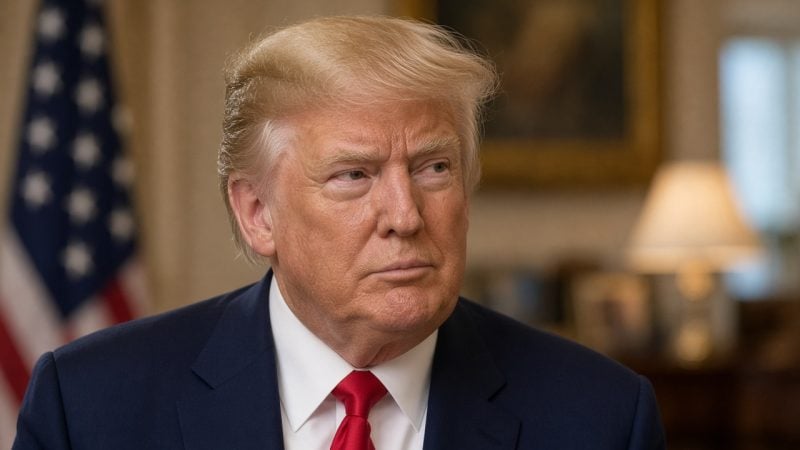
The president announced all US government documents will adopt the new term, urging other nations to follow suit while rejecting international AI regulatory frameworks.
President Trump stood before the 81st United Nations General Assembly on September 22, 2026, and did something no world leader has attempted before: he tried to rename an entire field of technology. Artificial intelligence, he declared, will now be called “super intelligence” in all US government documents. He encouraged every other nation on Earth to do the same.
The reasoning? Trump argued that the word “artificial” implies the technology is somehow fake or inferior. “Super intelligence,” in his view, better captures what the technology actually represents.
A Truth Social poll picked the name #
The rebrand didn’t come from a panel of computer scientists or a Pentagon working group. It came from a public poll on Truth Social, where users were asked to choose between alternatives including “Superior Intelligence” and “Extreme Intelligence.” The winning entry: “super intelligence.”
There’s an irony worth noting. In the field Trump is renaming, “superintelligence” already has a specific meaning. It refers to a hypothetical future AI system that surpasses human cognitive abilities across every domain. Researchers have spent years debating whether such a system is decades away or centuries off. Now the term would apply to everything from ChatGPT to the algorithm that recommends your next Netflix show.
Trump framed the technology as potentially “bigger than the industrial revolution,” positioning it as a generational opportunity that the US is uniquely positioned to lead. He specifically cited American technological supremacy over China in this domain.
Rejecting the ‘globalist scheme’ #
The naming announcement was only part of a broader message. Trump used the UN address to reject international AI regulatory frameworks entirely, calling them a “globalist scheme” designed to control the technology.
AI, tech, and the markets they move—in one daily briefing.
Daily. Free. Join 34,000+ readers across crypto, finance, and policy.
This put the US in direct opposition to at least 22 nations that had been advocating for human oversight of AI systems during the 2026 General Assembly.
Trump compared AI safety concerns to what he called a pattern of “hoaxes,” drawing a parallel to climate change warnings he has long dismissed.
The speech landed just one day before a scheduled meeting with Chinese President Xi Jinping, where AI regulation was expected to be a central topic.
What this actually changes #
The renaming also risks muddying technical discourse. Researchers, academics, and engineers worldwide use “artificial intelligence” as a precisely defined umbrella term with decades of established literature behind it. Introducing “super intelligence” as a synonym, when the field already uses that phrase to describe something far more specific and hypothetical, could create genuine confusion in policy discussions where precision matters.
The term “artificial intelligence” has been in use since 1956, when John McCarthy coined it at a Dartmouth workshop. The UN has not indicated any plans to adopt the new terminology. Neither have major international standards bodies.
Disclosure: This article was edited by Editorial Team. For more information on how we create and review content, see our