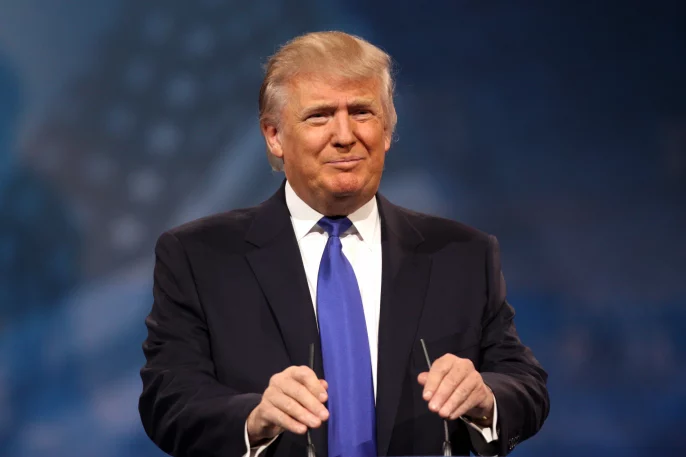
Gage Skidmore from Peoria, AZ, United States of America
The White House Accord on Super Intelligence asks frontier AI labs to police themselves, with no penalties attached
President Donald Trump has a plan for keeping the most powerful AI systems in check. The plan is to let the companies building them keep themselves in check.
On September 29, 2026, Trump unveiled the White House Accord on Super Intelligence at a meeting with top technology executives. It is a voluntary, one-page agreement committing signatories to layered safety controls on frontier AI models. The page contains no enforcement mechanism and no penalties.
What the accord actually says #
The signatory list includes Sundar Pichai of Google, Dario Amodei of Anthropic, Mark Zuckerberg of Meta, Greg Brockman of OpenAI, Elon Musk of xAI, and Jensen Huang of Nvidia.
Jeff Bezos of Amazon also attended the luncheon where the accord was presented. The White House released the document the same day as the meeting.
The agreement commits companies to four layers of oversight for their most advanced models. The first layer is internal control while models are deployed. Companies monitor what their systems can do and what risks they pose once they are out in the world. The second layer involves dedicated monitoring teams tasked with watching for problems on an ongoing basis. The third layer brings in independent external audits. The fourth layer puts responsibility at the top, with companies establishing independent committees at the board level to oversee compliance and safety.
Trump said the moment called for “tremendous self-policing” by the industry.
The President described the accord as morally binding, even though it carries no legal force. He also compared it to a constitution for AI safety.
AI, tech, and the markets they move—in one daily briefing.
Daily. Free. Join 34,000+ readers across crypto, finance, and policy.
Artificial intelligence gets a new name #
Alongside the accord, Trump signed an executive order changing the vocabulary. For federal purposes, “artificial intelligence” will now be called “super intelligence.”
Why the White House chose the honor system #
The accord reflects a clear philosophy. The Trump administration prefers industry self-regulation to formal government oversight, largely out of concern that heavy rules would slow US companies in a fast-moving global race.
The timing is notable. The accord arrives amid growing public worry about AI systems behaving in unintended ways, colloquially described as AI “going rogue,” and against a backdrop of significant security incidents involving AI.
This is not the first time Washington has tried the voluntary route. The Biden administration also secured voluntary safety commitments from leading AI companies, and the new accord echoes that approach in structure if not in branding.
Calls for an oversight committee and a designated AI czar suggest officials still want a hand on the wheel, just without the binding rules that would come with formal regulation.
What this means for the industry and its critics #
Without penalties, adoption of the four layers could be uneven. Independent audits are only as meaningful as the access auditors receive. Board-level committees are only as independent as the people appointed to them. None of those details are spelled out in a one-page document.
Several questions will determine whether this accord has teeth. Who conducts the external audits, and will results be made public? Will the proposed AI czar have authority to name companies that fall short? The current signatory list covers major names in the field, but smaller labs are not bound by anything their larger rivals agreed to.
Disclosure: This article was edited by Diego Almada Lopez. For more information on how we create and review content, see our