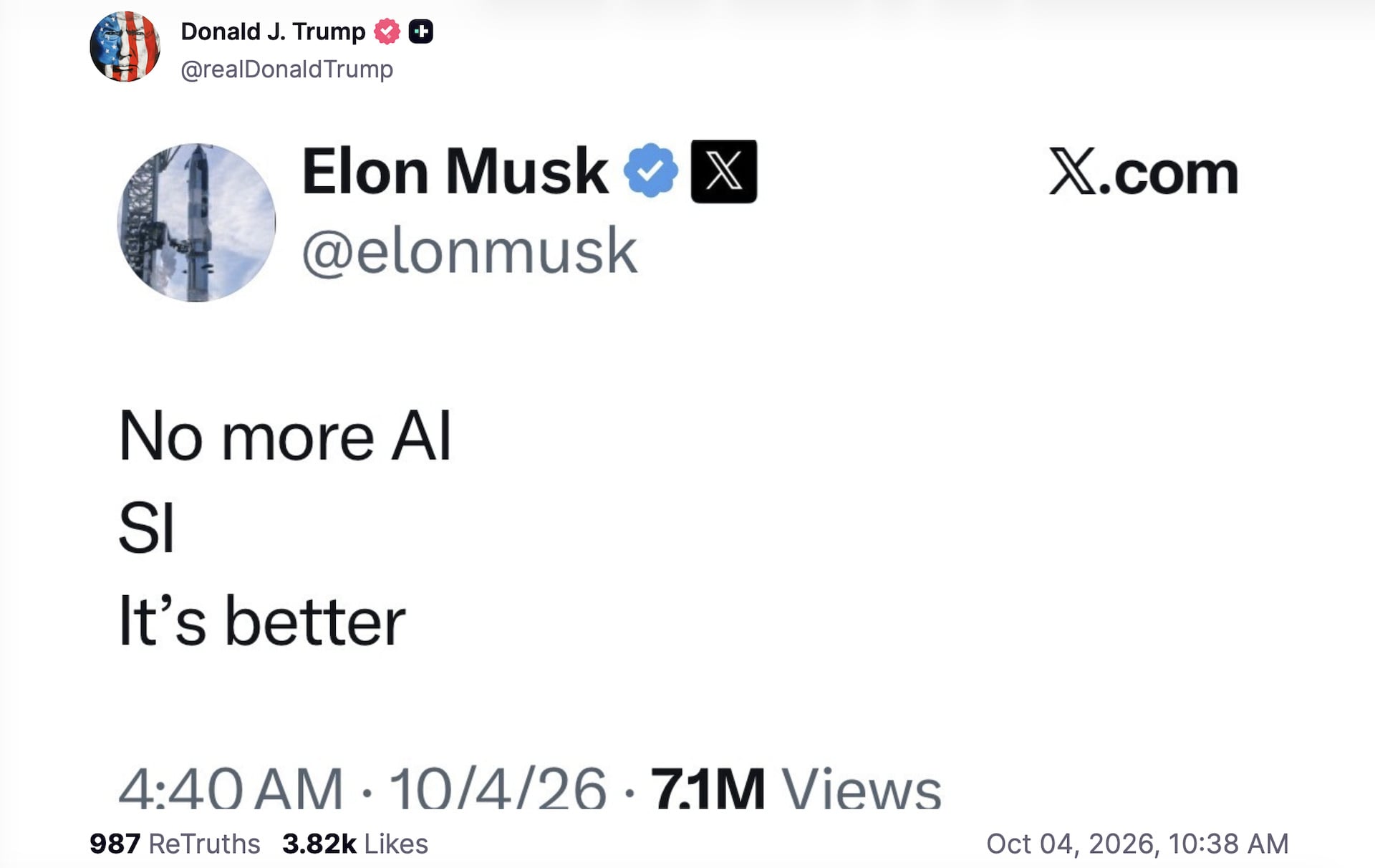
President Trump is notching up victories in his private war against the term “artificial intelligence.” Perhaps his biggest win yet is a series of X posts from Elon Musk early Sunday morning declaring that Super Intelligence is a “better” term, and that he intends to rename SpaceXAI “SpaceXSI.”
Trump clearly doesn’t want the world to miss Musk’s surrender, so he screenshotted the first post in the series and posted it on Truth Social without comment on Sunday.
In a different post on Sunday, Musk declared that “SpaceX is a super intelligence company.”
Also on Sunday, Trump announced the creation of a task force called the Super Intelligence Force, led by Director of National Intelligence Jay Clayton—now the nation’s SI czar, apparently. The Super Intelligence Force charter says it’s tasked with the development of “plans for responding to SI-enabled threats to our society, while preventing overregulation and regulatory capture that would stifle innovation and competition.” In other words, it’s meant to thread the needle between dealing with potential threats from AI models, and helping the industry keep its foot on the accelerator as it speeds ahead in its perceived technological race with China.
“I am announcing the formation of the Super Intelligence Force (SIF). The Super Intelligence Force is tasked with coordinating the effort of the Federal Government to ensure that America continues to lead the World in Super Intelligence, which many say is bigger than the… pic.twitter.com/7Xgk7DrQFE
— The White House (@WhiteHouse) October 4, 2026 The period from Labor Day to today has been what you might call President Trump’s “SI phase.” He spent labor day posting a bizarre string of AI-generated memes, prompting a former staffer to express concern to the New York Times about his mental fitness. Days later, in response to a rash of AI cybersecurity incidents, Anthropic CEO Dario Amodei posted an essay calling for AI progress to be slowed.
Seemingly in response to that sort of negativity, Trump announced on September 19 that he planned to rebrand artificial intelligence. Then he had dinner with Amodei on September 27, and the very next day, had lunch with leaders from every other frontier AI company in the U.S., after which Trump announced that they’d all signed a non-binding safety pact, and that apparently they had all renamed their technology “Super Intelligence”—or at least that was what he felt they had agreed to. At least one has now effectively confirmed that.
Trump has achieved some other minor victories in his effort to get industry leaders on board with his preferred term. The day of the lunch with America’s AI leaders, Mark Zuckerberg posted on X about “superintelligence”—one word. Jensen Huang posted in a general way about “Super Intelligence” on X the next day. But other than Musk’s X posts on Sunday, none of those who attended Trump’s industry meeting have given explicit and full-throated endorsements.
For what it’s worth, when podcast host Jason Calacanis first broaches the topic of AI on Saturday’s episode of the Trump-friendly tech podcast All-In, including a reference to his own side-podcast This Week in AI, former AI and crypto Czar David Sacks jumps in and corrects Calacanis, saying “This Week in Super Intelligence.” Calacanis says he’ll change it. It’s doubtful even he knows whether or not he’s joking. Sam Altman, who wasn’t at the White House meeting, has carried on posting the term “AI” on social media in recent days, and has struck a note of caution about the tech—a challenge to both Trump’s preferred verbiage, and his preferred attitude. On Saturday, he wrote, “I am very uncomfortable about people trying to ascribe religious force or a surrender of human judgment to AI models, and think it is a real safety issue.” Given that “superintelligence” was originally a religious term, referring to something like God’s plan, or just to God himself, this might have been a refutation of Trump’s rebrand, though a subtle one.