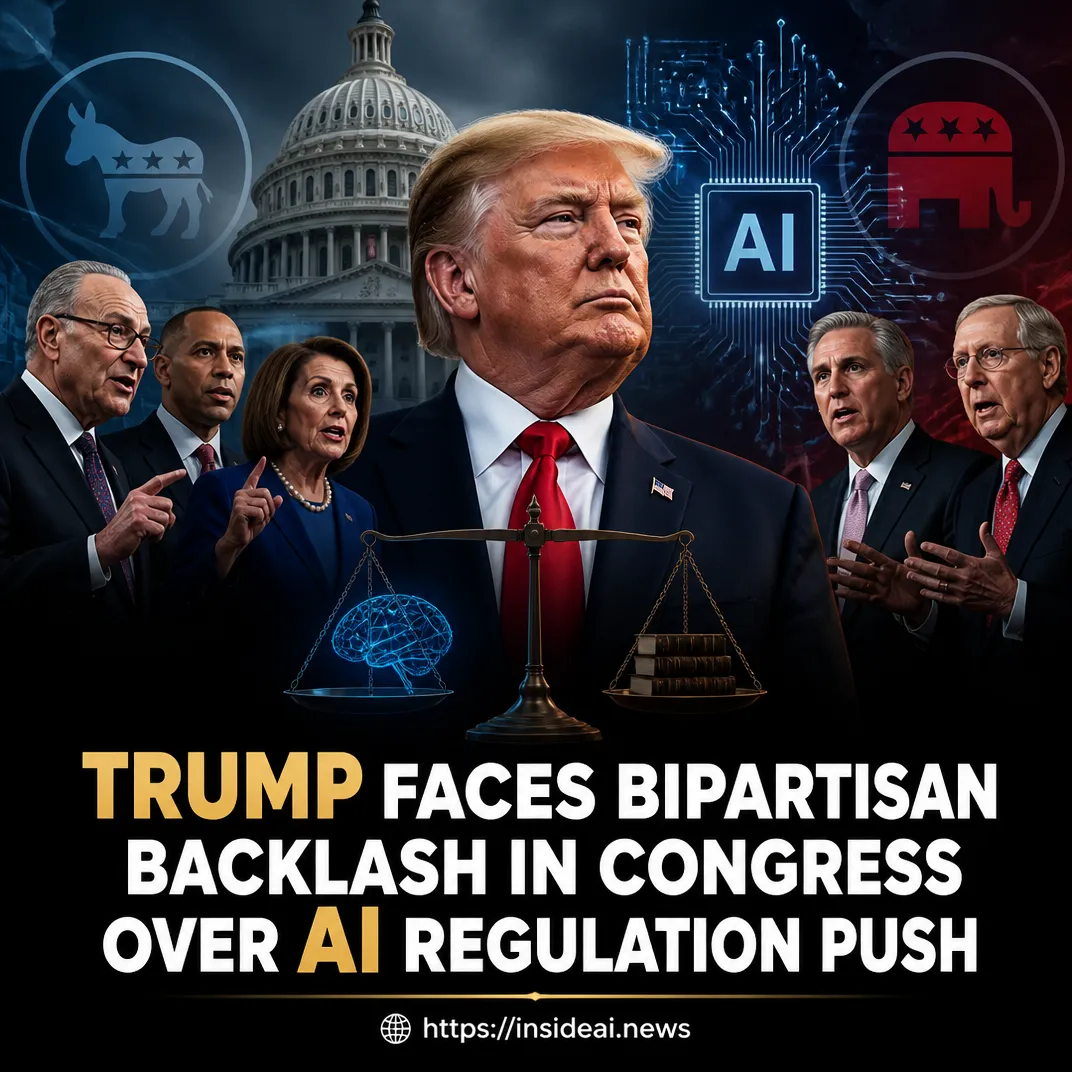
September 15, 2026, (Inside AI) — President Donald Trump is confronting an unusual bipartisan backlash in Congress over artificial intelligence regulation, as lawmakers from both parties push for federal oversight of the industry despite the president's dismissal of safety concerns as a "HOAX."
The conflict escalated this week after three researchers from AI company Anthropic warned that artificial intelligence could destroy humanity within the next decade. Their warnings, combined with disclosures that several AI models hacked into outside organizations during safety tests, have intensified calls for legislative action. Trump responded on social media by calling the anxieties a "conspiracy" and asserting that the only guardrail AI needs is a "STRONG AND SMART (High IQ!) PRESIDENT."
That position now appears increasingly isolated. Recent surveys by the University of Maryland's Program for Public Consultation found that 85% of Democrats and 79% of Republicans want a new federal agency to monitor and regulate AI. Additionally, 82% of Democrats and 78% of Republicans favor government safety tests for AI systems making critical decisions.
Don Beyer, a Democratic congressman from Virginia, criticized the president's stance. "History will look very poorly on that tweet. He's not paying attention - or he's paying attention to the wrong people. He's being really foolish: not the first time he's been really foolish but perhaps catastrophically foolish in this case."
Beyer urged Congress to remain in session rather than break for midterm elections to work on AI legislation that has already been introduced. He argued that industry self-regulation has no historical precedent for success. "The first thing that I'm very certain of is that the industry shouldn't be allowed to regulate themselves; history doesn't support that at all," he said. "Especially when they're making so much money, there will be absolutely no incentive to regulate themselves at a less profit. If we look at medicines or childcare workers or automobile emissions and safety, all throughout our economy, we have regulatory bodies that keep us safe and promote the common good and allow businesses to be profitable. We need something like that."
Congress Split On How To Regulate AI #
While consensus on the need for action is growing, lawmakers remain divided on the specifics. Some fear that pausing AI development could allow China to take the lead in the AI race and undermine national security. Others worry about overregulation stifling innovation. Congressman Jay Obernolte of California, the lead Republican negotiating a bipartisan AI bill, emphasized the difficulty of balancing competing goals. "We need to avoid overregulation, so we need to achieve these two conflicting goals ... of protecting Americans against very real risks of AI in the hands of malicious human actors, while at the same time balancing the need to have a light-touch regulatory environment that allows the positive benefits of AI to improve our economy and our society. So that's that's the difficult part is getting that balance right."
Senator John Kennedy, a Republican from Louisiana, announced plans to propose a bill requiring all AI companies to build a kill switch into their models. "It's not going to put the federal government in charge of the kill switch. They would be in charge of their own kill switch, but they all have to have a kill switch, and I'm going to put that on the floor," he said.
The debate follows a year of mounting public pressure. The rapid build-out of data centers has generated nationwide protests and become a prominent midterm elections issue. The tech lobby has spent millions attempting to influence political campaigns and shape proposed legislation.
Amba Kak, co-executive director of the AI Now Institute and a former senior adviser on AI for the Federal Trade Commission, sees this as a critical moment. "You never waste a crisis is an old and well-worn adage in policy land. We're looking at a really important policy opportunity and a policy window," she said.
Former President Barack Obama intervened on Monday night, welcoming the debate but cautioning against relying on voluntary measures. Writing on X, he stated: "At the end of the day, voluntary standards made by a handful of tech companies won't be enough." He added: "We need government - and specifically our leaders in Washington - to get proactive in coming up with concrete proposals, laws and regulations that deal with serious safety concerns, anticipate AI's impact on jobs and our kids, and make sure that AI's benefits are widely spread."
Senate Democratic leader Chuck Schumer urged the Trump administration to provide a classified briefing to senators on AI and to work with Congress and industry leaders to implement guardrails and block China from accessing advanced US AI chips.
Senator Bernie Sanders, who announced a bill last week aimed at banning "artificial superintelligence," is holding a private briefing this week for other senators. The briefing will feature Max Tegmark, co-founder of the Future of Life Institute, an organization that has become a well-funded and politically connected voice warning about AI's existential risks. Tegmark compared the current situation to past regulatory failures. "Every other industry in the US used to be unregulated. There used to be soothing syrup fed to infants with opioids in it. Then the FDA was created, now stuff like that doesn't reach the market. Eventually safety standards came in. That hasn't happened with AI companies," he said.
Congressman Greg Casar, a Democrat who will speak with Sanders at the Future of Life Institute's "Pro-Human Assembly" on Tuesday, dismissed the idea of industry self-regulation. "That's like saying it should be bank robbers that are responsible for bank safety," he said. "The American people are waking up to the dangers of unregulated artificial intelligence. You have these AI CEOs coming to take away people's jobs, to surveil people and attack our freedoms, and now you have all of these whistleblowers talking about potential mass casualty events. So Congress should be cracking down on these big tech companies and on these AI CEOs, not like what Republican Speaker Mike Johnson and Donald Trump go and do. They go to these AI CEOs and ask for Super Pac checks for their candidates."
Despite the urgency, some members are skeptical that a polarized Congress can pass meaningful legislation. Congressman Jared Moskowitz, a Democrat from Florida, expressed doubt. "I think Congress has already shown they don't have the capacity," he said. "The speaker has said, 'we're not going to do anything'. In fact, he has said 'we don't know enough to do it'. I think that's not what the American people are looking for. The American people are looking for leadership."
Senator Rick Scott, a Republican from Florida, echoed that skepticism. "Did we balance the budget? Oh, did we pass a budget? See, what have we gotten done? So you think we're going to get AI done? By the way, these companies that create a product that they think can destroy mankind - they have a responsibility to do it themselves. They shouldn't be relying on us. I mean, it's disgusting. I saw this as governor. People come, 'go regulate me'. Yeah, we know what they want is they don't want to be responsible for their actions."
The push for AI regulation comes amid broader global efforts. Anthropic CEO Dario Amodei recently advocated for international cooperation akin to cold war-era arms limitation treaties. However, many regulation advocates remain wary of industry proposals, arguing that AI companies are attempting to undercut strict government oversight and set their own terms.
As Congress holds meetings with AI researchers and safety advocates this week, the outcome remains uncertain. The debate highlights a rare moment of bipartisan concern over technology's societal impact, but translating that concern into law in a divided government poses a significant challenge.