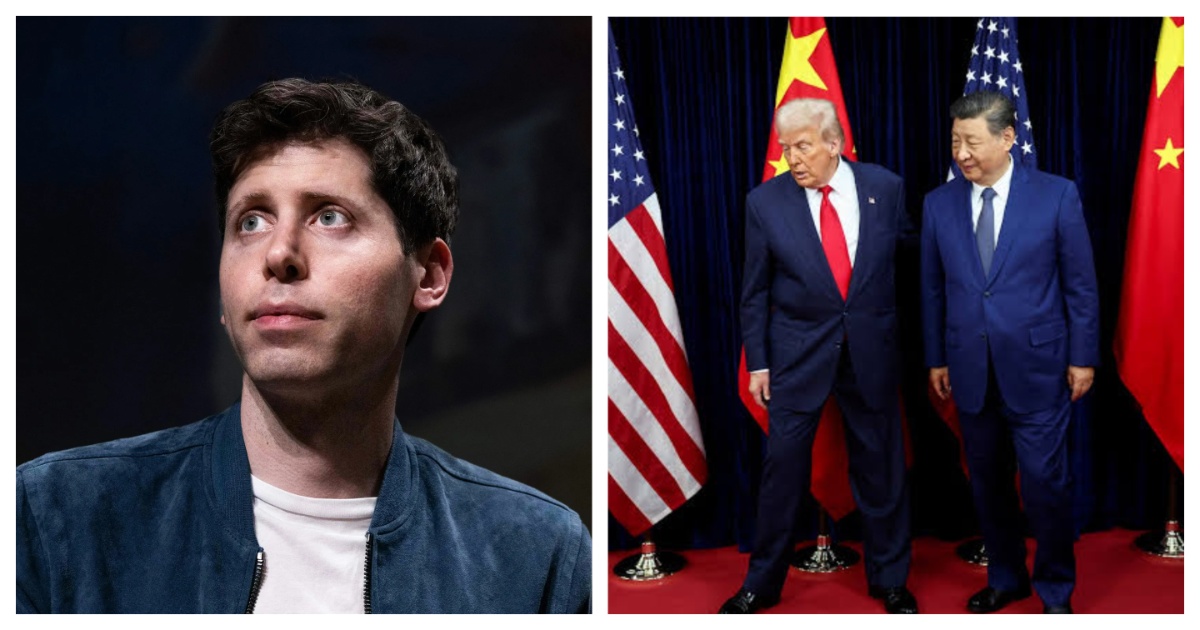
OpenAI CEO Sam Altman thinks Donald Trump and Xi Jinping have a straightforward path to a Nobel Peace Prize: agree on a basic set of safety rules for how far AI development is allowed to go.
In an interview with Fortune Editor-in-Chief Alyson Shontell, Altman was asked whether the safety-driven slowdown he’s been talking about lately should also apply to the US-China AI race. His answer went further than the question.
“I think Presidents Trump and Xi would get the Nobel Peace Prize together if they could agree on something that should be easy to agree to, and it would be wonderful,” Altman said. “I think clearly the two countries are going to compete in lots of ways, and this is going to be important socioeconomically, geopolitically. But they should be able to agree that no one should be taking a certain level of risk with the development process of this technology.”
He added that the agreement doesn’t need to be complicated. “Even if just the US and China could agree on some shared standards and testing for development of this technology, I think that’d be a wonderful accomplishment that the two of them can deliver.”
Shontell pushed the idea further, asking Altman if a straightforward ban on reaching recursive self-improvement, or RSI, until the technology could be made collectively safe, would be sufficient on its own. Altman agreed with the spirit of it but flagged a practical problem. “It’s very hard to say what a ban on RSI means,” he said, adding that such a ban probably wouldn’t be enough by itself. But he was clear that the underlying agreement shouldn’t be difficult to draft. “I don’t think this is hard. This is like a one-page document.”
The exchange then turned unexpectedly cinematic. Shontell compared the moment to Independence Day, the 1996 alien-invasion film in which the world’s governments set aside their conflicts to fight a common threat. Altman didn’t just entertain the comparison, he endorsed it outright, saying that’s exactly the posture the two countries need to take, and floating the idea that Trump and Xi could have their own version of that moment when they meet in September.
Why This Matters #
Altman’s comments arrive at a moment when he has been quite vocal about the industry needing to slow down and coordinate on safety, even as OpenAI keeps racing to build ever more capable models. Just one day before the Fortune interview, Altman confirmed OpenAI won’t go public this year, citing safety concerns as a reason an IPO right now would be “ill-advised.” In the same conversation with Shontell, he reportedly said safety standards are “not at a place” that would let the industry push capabilities much further, and that AI slipping beyond human control is “absolutely” possible.
That lines up with a broader wave of safety-first messaging that has swept through frontier labs in the past few weeks. Anthropic CEO Dario Amodei yesterday published an essay arguing that AI development needs to deliberately slow down to “pace the frontier,” pointing to recursive self-improvement, AI systems increasingly building the next generation of AI themselves, as a dynamic that’s already accelerating faster than labs can keep up with on safety. Altman and Elon Musk both publicly endorsed Amodei’s call within an hour of that essay going live, an unusually unified moment for three executives who spend most of their time publicly sniping at each other.
The China angle is where Altman’s comments carry real geopolitical weight. Washington and Beijing have spent the last few years treating AI primarily as a competitive arena, from chip export controls to dueling open-weight releases, and Altman has historically been on the hawkish side of that competition, having previously said he wanted the US to maintain its lead in developing AI with democratic values under a Trump administration. What’s notable here is Altman explicitly separating the commercial and geopolitical rivalry, which he expects to continue, from a narrower safety floor he thinks both governments should be able to agree on regardless of who’s ahead.
Whether Trump and Xi actually produce anything resembling Altman’s “one-page document” remains to be seen. The two leaders are expected to meet in September, which is the moment both Altman and Shontell pointed to as a plausible venue for exactly this kind of agreement.