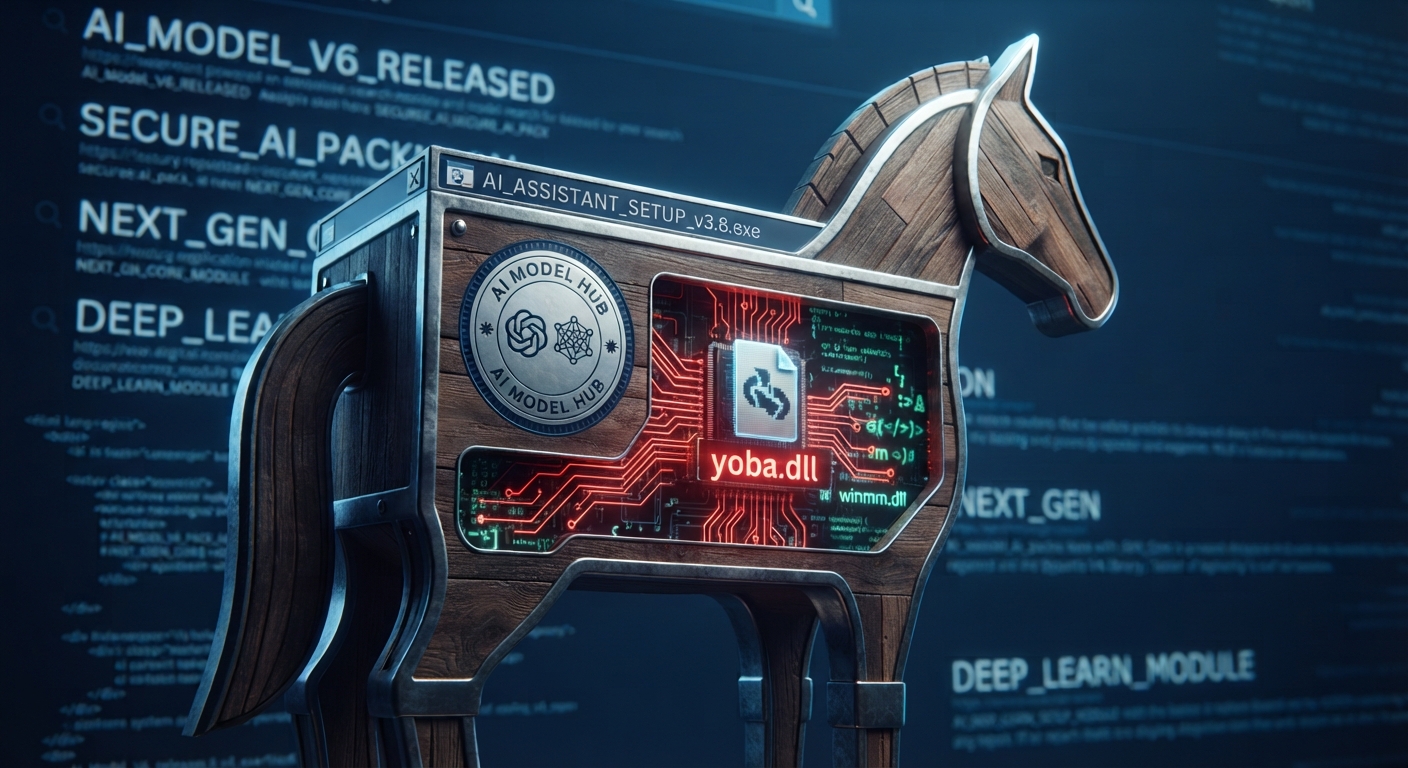
Over the past two months, we have been tracking a campaign that abuses the popularity of AI tools such as ChatGPT and Claude to spread a custom malware chain we call Yoba. The attackers use fake GitHub projects that pretend to be AI desktop applications like GPT-5.6 Sol, GPT-6 Astra, and Claude Opus. These projects look convincing and use real GitHub infrastructure, which helps them appear legitimate to potential victims. The website exhibits search-targeted content and suspicious installer-delivery tactics consistent with an SEO-poisoning lure.
Inside the installers, there is a malicious component we refer to as the YobaDropper. This dropper includes another component, the Yoba, which is responsible for contacting attacker-controlled infrastructure and fetching the final payload. In this report, we describe how victims are lured to these fake projects, how the YobaDropper and Yoba work together, and how the attackers ultimately use this chain to run unwanted software on infected systems.
The initial access occurred via malicious GitHub repositories. The projects were impersonating ChatGPT and Claude related models, more specifically GPT-5.6 Sol, GPT-6 Astra, and Claude Opus. No manipulation of fake engagement (stars/forks) was in place.
Aside from the repositories, GitHub.io pages were used to describe the capabilities of the software, while the malware was hosted as a release.
These phishing landing pages contain download links that point directly to the malicious ZIP releases hosted on GitHub.
While the repositories do not show signs of fake engagement (such as artificially inflated stars or forks) that would promote them within GitHub’s own search, they still appear among the top results on Google. This is most likely due to SEO poisoning, where the attackers optimize titles, descriptions, and hosting domains to make their malicious projects rank highly in external search engines.
Each repository uses a different email address (edwardcarlsonmkym[@]outlook[.]com, daxschneiderdjuu[@]outlook[.]com, and rioprestonlfyx[@]outlook[.]com), and the up appears to operate in UTC+4, UTC-4, and UTC+3 respectively. This inconsistency likely reflects a deliberate attempt to obscure the threat actor’s true operational timezone.
Repositories’ initial commits:
[2026-07-16T14:39:40Z] Author: gpt-5-6
tree aebceccb0f3303806c35a73da865b684594487c1
author gpt-5-6 <[email protected]> 1784212780 +0400
committer GitHub <[email protected]> 1784212780 +0400


[2026-07-16T14:44:31Z] Author: gpt-5-6
tree 249dae41d64583a6a9ebcb60e3ad36d6216dd6e4
author gpt-5-6 <[email protected]> 1784213071 +0400
committer GitHub <[email protected]> 1784213071 +0400


[2026-08-31T21:33:26Z] Author: opus-5-0
tree 46ae1f147cf70d4df1471f0e9df46b654d11fe9c
author opus-5-0 <[email protected]> 1788212006 -0400
committer GitHub <[email protected]> 1788212006 -0400


[2026-09-04T22:56:13Z] Author: gpt-6-astra
tree 028bfd4c1041dc1f030c9480a463366e6089e661
author gpt-6-astra <[email protected]> 1788562573 +0300
committer GitHub <[email protected]> 1788562573 +0300
Although the first repository was created around July 2026, the first two malicious releases were not uploaded until the end of August, and a third malicious release followed approximately five days later.
Release: /gpt-5-6/gpt-5-6.github.io/releases/tag/v5.6.0

Release: /opus-5-0/opus-5-0.github.io/releases/tag/Release_v5.0.0

Release: /gpt-6-astra/gpt-6-astra.github.io/releases/tag/Astra
[2026-09-04T23:14:11Z] gpt-6-astra Uploaded GPT-6-Astra-Setup.zip (application/zip) (352)
Malicious zip files hosted on GitHub and other legitimate platforms are usually password-protected, since this prevents automated tools from unpacking and therefore analyzing them. However, neither of these repositories used password protection, as the binaries already had very low detection rates thanks to their anti-sandbox and other anti-analysis techniques.
While the two ChatGPT-related releases and their repositories were created about five days apart, the ZIP files contain mostly the same files, including the malicious components, and they maintain the same IoCs.
| Filename | sol-setup.zip (ChatGPT) | GPT-6-Astra-Setup.zip |
|---|---|---|
| 151.0.7922.174.manifest | 2026-08-30 15:11:18 | N/A |
| D3dx9_41.dll | N/A | 2021-10-18 17:58:06 |
| owl-shell-runtime.json | 2026-08-30 15:11:18 | 2026-08-30 15:11:18 |
| Setup.exe | 2026-08-30 15:11:18 | 2026-08-30 15:11:18 |
| snapshot_blob.bin | 2026-08-30 15:11:18 | 2026-08-30 15:11:18 |
| v8_context_snapshot.bin | 2026-08-30 15:11:18 | 2026-08-30 15:11:18 |
| vk_swiftshader.dll | 2026-08-30 15:11:18 | 2026-08-30 15:11:18 |
| vk_swiftshader_icd.json | 2026-08-30 15:11:18 | 2026-08-30 15:11:18 |
| vulkan-1.dll | 2026-08-30 15:11:18 | 2026-08-30 15:11:18 |
| winmm.dll | 2026-08-30 15:14:20 | 2026-08-30 15:14:20 |
By adding the compilation timestamps to this these time-related operations, we are able to determine which files appear to contain the malicious functionality without performing any initial analysis.
| Filename | Compilation Timestamp (UTC) |
|---|---|
| D3dx9_41.dll | 2076-06-18 21:48:40 |
| Setup.exe | 2026-08-19 20:00:27 |
| vk_swiftshader.dll | 2026-08-19 20:00:27 |
| vulkan-1.dll | 2026-08-19 20:00:27 |
| winmm.dll | 2026-08-30 19:14:19 |
The file that immediately stands out is winmm.dll, which was compiled the same day it was added to the ZIP archive. This suggests it is the component with the malicious functionality, while the other files serve to make the package appear legitimate. The compilation timestamp also indicates the actor is operating in the UTC-4 timezone.
Furthermore, Setup.exe, a legitimate signed OpenAI executable, is used during execution to sideload the malicious DLL. The Setup-Claude.zip file contains the same structure, though in this case Setup.exe is a legitimate signed Claude executable.
The malicious DLL contains multiple export names, suggesting that the legitimate winmm.dll has been spoofed. As in many other cases, these exports exist but their code has been stripped out, leaving them mostly empty and reducing the size of the binary.
All 180 exports contain just a return instruction (C3) followed by NOPs ( 90), and DllEntryPoint is the only one containing actual code.
The first function implements an anti-sandbox technique: the malware hashes the basename of its host executable and checks whether the checksum matches the hardcoded value 0xE6C2F326. The hashing algorithm has been identified as DJB2, which other malware families have also used in the past. The malware expects to run under the name Setup.exe, so this check fails if the DLL is executed on its own inside a sandbox environment.
Although a failed check does not terminate the process, the DLL performs 200,000 iterations of Sleep(5500), amounting to approximately 12.73 days, while repeatedly appending the decoded filler string pddy to a local UTF-16 buffer.
In the second function, the malware checks whether the infected user is located in a CIS country by inspecting the system’s keyboard layout. Ukraine was historically included in such checks, but it is not in the list used by recent malware.
The language check is unusual. Instead of comparing the victim’s keyboard language ID against hardcoded values, the malware checks whether the ID falls within the range 0x19– 0x44. For IDs in that range, it tests the corresponding bit in the bitmask 0xEC0400C8401 to determine whether the language belongs to a CIS-region country, with an explicit exception for ID 0x22 (Ukrainian). Bazar has used a similar technique in the past, with the bitmask 0xD8080190C03.
Language IDs excluded from the infection:
| Russian | Belarusian | Tajik |
|---|---|---|
| Armenian | Azerbaijani | Georgian |
| Kazakh | Kyrgyz | Turkmen |
| Uzbek | Tatar |
The malware continues to resolve Windows API functions dynamically from kernel32.dll and ntdll.dll by comparing hashes of the exported function names. The hashing algorithm is again DJB2, with the initial value 0x1505.
The last check before the malware unpacks and deploys the embedded payload tests whether the process is running with administrator privileges. If it is not, the malware displays the message “Please run this program as Administrator.” to the victim and terminates itself, requiring the user to rerun it with elevated privileges.
The dropper contains multiple XOR-encrypted strings that are decrypted when needed. These strings include the file paths where the embedded binaries are dropped, as well as the decryption keys.
It creates a directory under ProgramData named WMProcess. Then it copies the original WMPDMC.exe from System32 into this newly created folder. Next, it decrypts the embedded payload using the string IRANNUMBERONE as the XOR seed and drops the decrypted payload in the same folder under the name wmpdui.dll.
Using scheduled tasks, the dropper maintains persistence by leveraging the legitimate executable, which will sideload the malicious payload. To make the task appear legitimate, it sets the author to Microsoft Corporation and the description to Collects device metadata for Windows Media Player.. It also sets the boot-trigger delay to PT3M, which corresponds to a 3-minute delay after system startup, and configures the task to run under the Local System account (S-1-5-18).
The second-stage payload contains the same code as the dropper, which indicates that the same developer is responsible for both components.
The same anti-sandbox technique is used, forcing the malware to be run only by WMPDMC.exe. It again checks the hash of the process basename, and only continues execution if this value matches the hardcoded hash 0x552751E3.
The dropper uses the DJB2 hashing algorithm to hash and verify the process name and to resolve Windows API functions, both with the same seed 0x1505. The (Yoba) also uses DJB2 for the process name with the same seed as the dropper, but for resolving Windows API functions it uses a different seed, 0x1DEB.
The developer reused the same string-hashing algorithm but changed the seed (0x1505 in the dropper, 0x1DEB in the ) to separate the hash spaces for each stage, complicating analysis, and reducing the effectiveness of hash-based detection and automated tooling.
The down uses an interesting process to obtain the next-stage payload. It first decrypts multiple strings using a simple XOR operation, among these strings is the URL of a Telegram channel, t[.]me/yoba_fanclub. It then visits this channel using the user-agent string Mozilla/5.0 (Windows NT 10.0; Win64;) and parses the HTML source to extract the src URL of the element with the class tgme_page_photo_image. This class refers to the location where the channel’s profile image is hosted.
It downloads the image and uses the last 50 bytes as a seed to generate a domain based on three lists of dictionary words, which are decrypted as part of the DGA algorithm. This DGA algorithm uses three sets of strings:
Finally, it generates and appends an integer value in the range 0–999. The generated domain has the following format, "$adjective-$noun-$verb-$digit.dedyn[.]io". By changing the image of the Telegram channel, a new domain can be generated.
The following Python snippet represents the DGA algorithm:
"""
Author: @Tera0017/Check Point Research
"""
from pathlib import Path
import sys

ADJECTIVES = [
    "silver", "amber", "wild", "tiny", "brave", "lucky", "calm",
    "sharp", "swift", "bright", "quiet", "bold", "gentle", "fierce",
    "royal", "mystic", "username", "degenerate", "allblack", "kizta",
    "graf",
]
NOUNS = [
    "tiger", "river", "stone", "cloud", "wolf", "ocean", "forest",
    "mountain", "eagle", "raven", "ember", "comet", "fox", "dragon",
    "piano", "viper", "yoba", "yyoba", "static", "cpp", "example",
]
VERBS = [
    "runs", "jumps", "sings", "sleeps", "flies", "hunts", "burns",
    "floats", "shines", "whispers", "roars", "dreams", "strikes",
    "glides", "watches", "hides", "duty", "free",
]

FNV_MULTIPLIER = 0x1000193
MASK64 = 0xFFFFFFFFFFFFFFFF

def hash_bytes(data: bytes, seed: int) -> int:
    value = seed
    for byte in data:
        value = ((value ^ byte) * FNV_MULTIPLIER) & MASK64
    return value

def generate_domain(image_path: str) -> str:
    image = Path(image_path).read_bytes()
    if len(image) < 50:
        raise ValueError("Image must contain at least 50 bytes")

    tail = image[-50:]

    adjective = ADJECTIVES[hash_bytes(tail, 0x811C9DC5) % len(ADJECTIVES)]
    noun = NOUNS[hash_bytes(tail, 0xAF0154A5) % len(NOUNS)]
    verb = VERBS[hash_bytes(tail, 0xFE5439E4) % len(VERBS)]
    number = hash_bytes(tail, 0xFFA7471A) % 1000

    return f"{adjective}-{noun}-{verb}-{number}.dedyn[.]io"

if __name__ == "__main__":
    image_file = sys.argv[1]
    print(generate_domain(image_file))
It then queries Google’s DNS-over-HTTPS (DoH) API to obtain an encrypted command from a DNS TXT record, using a URL of the form https://dns[.]google/resolve?name=$DGA&type=TXT.
By relying on a DoH service and common file-hosting platforms, the actor aims to bypass passive DNS monitoring and some gateway-based security protections, making their command-and-control traffic harder to distinguish from regular user activity.
It decodes the Base64-encoded data field from the JSON response and validates it using Ed25519 signature verification with the public key b5c2d20623d4e6647d06a42864edd8629f82c5c384b243fdaeeeca24b3873d64. Once the signature validation succeeds, it decrypts the decoded value using AES in ECB mode with the key 1d0d1368b4d53f3a6322cf40e84e63db.
Decrypted response: 1https://files.catbox[.]moe/z5zpy9.dat
The down retrieves the encrypted payload and decrypts it using the same AES key and ECB mode that were previously used for the DNS data.
The malware provides three methods for deploying the downloaded payload. The selected method is indicated by the first character of the decrypted response that follows the URL (1/2/3):
svchost.exe (NtWriteVirtualMemory/NtCreateThreadEx). It enumerates running processes and, using the hashing algorithm with the seed 0x1DEB, searches for the hash value 0xC26CDEA5, which corresponds to %TEMP%\$10_rand_char\$10_rand_char.exe file and executes it. Before running the executable, the down removes the Zone.Identifier alternate data stream, which is hidden metadata used by Windows to track the origin of downloaded files.%TEMP%\$10_rand_char\$10_rand_char.ps1 PowerShell script and invokes it with the following parameters: -WindowStyle Hidden -ExecutionPolicy Bypass -File.
Finally, the injected payload into svchost.exe is an XMRig 6.26.0 miner with a hidden command line targeting a TLS-enabled onion mining endpoint through a local Tor SOCKS5 proxy. It can unpack and start Tor 0.4.9.12 plus lyrebird 0.8.1, monitor user-input activity to mining, and conditionally load the WinRing0 driver service for MSR-based mining optimization.
| Field | Value |
|---|---|
| Mining server | 3zciedc3enu4muwc5adxciyk6u3juhvhvbv6bfrk2arawlvb7k7ovxad[.]onion:443 |
| Pool password/token | dcde1f56048fa18657dc4820397592f7 |
| TLS | Enabled ( --tls ) |
| Proxy | socks5://127.0.0[.]1:9550 |
| Donation level | 0 |
| CPU thread hint | 85% |
| User-active | Resume after 240 seconds idle |
| Singleton mutex | Local\WindowsSecurity |
| Tor data directory | %TEMP%\torbundle\data |
| Tor bridge 1 | obfs4 51.89.231[.]85:24526 A44162645CEAA39C7106C49A3F36FD99FF8D8A00 cert=cVNRBh1enpvEGxA0ouu568EDFhWPl9taldydYgiJk77OX4MzoYIRz3qx4q7yHL5bRN60Gg iat-mode=0 |
| Tor bridge 2 | obfs4 51.89.228[.]250:21668 BA8BD67D8898CF378D4F73821DEB5657F4BB98DF cert=bEpLLgOwJ9fOJbeHb5r+ronUF2ck5nRd0Jl3zuy7rLoUp732QK2p/CUHjTAfBPCGfcVtSA iat-mode=0 |
Although we observed an XMRig cryptominer as the final payload in this campaign, the Yoba is a generic . The operator can supply any PE or PowerShell payload via the signed DNS TXT tasking, so future waves may deliver different malware families.
Yoba exposes, through the same hashing algorithm it uses for anti-analysis, the specific process name under which it expects to run. Even without having full visibility into the campaign from the very beginning, analysts can still infer which targeted software was used to lure users by correlating this expected process name with the fake AI applications promoted on the associated GitHub repositories and GitHub Pages sites.
| Hash | Process | Product |
|---|---|---|
| 0xE6C2F326 | Setup.exe | ChatGPT & Claude Opus |
| 0x56221573 | Cursor.exe | Cursor AI Coding Agent |
| 0x39DE0DD8 | Unknown | Unknown |
Earlier YobaDropper observed in the wild appeared in early June 2026. In this campaign, the dropper was sideloaded by a process named Cursor.exe (hash: 0x56221573). It remains unclear whether Cursor.exe was a legitimate signed binary. The majority of the functionality in this early variant is consistent with the newer versions of both the dropper and the .
YobaDropper shows two main differences between its older and newer versions:
msdefender_scheduler{7940-8490-6670-1081}.lnk in the Startup folder. This shortcut executes a copied %APPDATA%\Microsaft Difendir\msdtc.exe and sideloads %APPDATA%\Microsaft Difendir\mswsock.dll.
Earlier version of Yoba contains language checks and excludes only Russia from infection. In later versions, these checks were moved to the dropper stage and expanded to exclude additional CIS countries, shifting regional filtering earlier in the infection chain.
While the overall DGA logic remains the same, the early variant uses the extension .aber[.]ir instead of .dedyn[.]io. In addition, instead of injecting into svchost.exe, this variant injects into a different running process identified only by its hashed name 0x21BD94C2.
The initial also implements several anti-analysis techniques that have been removed from the newer versions of the malware:
1. Anti-debugging
It enumerates all kernel object types and reads their TypeName values. Each type name is hashed using DJB2 with the seed 0x1DEB until the hash matches 0xCF9EE149, which corresponds to DebugObject. If a DebugObject is found, it indicates that a debugger is or was active, and in that case the malware terminates itself.
2. Anti-VM
The malware uses a VM/sandbox-detection scoring function while running several hardware fingerprinting checks. The maximum score is 6, and the minimum required to continue the infection chain is 3. The checks include:
RDTSCP). 0x40000000). 0x80000002– 0x80000004). GetSystemFirmwareTable– RSMB)
Despite these small differences in early anti-analysis behavior, the Telegram channel and the profile image used as the seed for the DGA remain the same as in the newer variants, indicating that the operator retained the same infrastructure while iterating on the ’s evasion logic.
The Yoba campaign shows how attackers can use trusted platforms and the current interest in AI tools to distribute malware in a way that looks believable and harmless at first glance. By packaging their code together with well-known software names and hosting it on GitHub, they lower the chances that users or basic security checks will immediately flag the files as suspicious.
Although the underlying techniques are more advanced than typical commodity malware, the main goals remain straightforward: gain a foothold on the victim’s system, avoid easy detection, and then run the attacker’s chosen payload. Organizations should be cautious about installing “AI helpers” or similar tools from unverified repositories and should enforce policies that restrict running software from unknown sources. Combining user awareness with basic technical controls.
| Description | Value |
|---|---|
| GitHub pages | github[.]com/gpt-5-6/sol-free-desktop gpt-5-6.github[.]io github[.]com/gpt-5-6/gpt-5-6.github.io github[.]com/gpt-6-astra/gpt-6-astra.github.io gpt-6-astra[.]github[.]io opus-5-0[.]github[.]io github[.]com/opus-5-0/opus-5-0.github[.]io |
| ZIP Files | 332e3b685e375aa44a5ec98511fc53be821df46a c2b986704406d47dd88ee4e2fcffebc854ff2ce4 |
| Signed OpenAI & Anthropic binaries | 163c81187d8024123912c3c12d905fd5210afcb3 65a3ac8f341ae04982005fd2c4e83627a68793a3 |
| YobaDropper | 17e8639a00bb32b10cb9cf0d292e9441456ce4bb 20238b36645fc63139a76b19a480c6a9166472fa 4ea5b71202b69fc27b06ef9ee3f6f51d6f7b8586 60aece343959a2e1840f6aaeffa38b73ed21af2c 8777db31d8df78f36e4544a132d843dfb2a0f026 |
| Yoba | 22661f4bada8167fa0f410b75e53184998990abb 2ecb5548e9774a3d05e8669e8414dcc366929b79 3fef1af3664429e621d3e0f9408cb5102ef02b84 55043ea6d102670c014e2be5a8197e70b7c201cb 79e87a6df59d68b2dbd2c43950df5663d671007c 7dfcee02732ed89f1ddf25d1689863c26de3df15 bead5748d813a9828ddb7603a32e52aa15349768 cf90c4599257e76984a199d98b1fd082b820a54d eeedc5c9007d7f01808285e0ae0c0b451bdba003 |
| Telegram image | e7c0e981f81447892995d01ed986c0b462a6f0c5 |
| Telegram Channel | t[.]me/yoba_fanclub |
| DNS | dns[.]google/resolve?name=calm-piano-floats-313.dedyn[.]io&type=TXT |
| ITW URL | files.catbox[.]moe/z5zpy9.dat |
| Encrypted Payload | 7467b6980440ec27c4e0a8d940672c9f24e14216 |
| Payload XMRIG | ea16728f6928dc77deaddee74a6e736dd5f24fc5 |
| XMRIG Endpoints | 3zciedc3enu4muwc5adxciyk6u3juhvhvbv6bfrk2arawlvb7k7ovxad[.]onion:443 51.89.228[.]250:21668 51.89.231[.]85:24526 |
rule yoba_dropper
{
    meta:
        author = "@Tera0017/Check Point Research"
        description = "YobaDropper"
    strings:
        $code1 = {00 BB 40 0D 03 00 B9 7C 15 00 00 FF D6 31 C0}
        $code2 = {BA 05 15 00 00 0F BE 08 84 C9 74 0A 6B D2 21}
        $code3 = {53 B9 75 EE 40 70 48 83 EC 20}
        $code4 = {BA 5C CD 17 E5 48 89 C1 E8 73 00 00 00}
        $code5 = {0F C8 89 C0 4? 39 ?? 74 1? (49 0F AF C0| 48 69 C0 ?? ?? ?? ??) (4C 01 C8| 48 05 ?? ?? ?? ??) 49 89 C? 49 C1 E? 18 45 30 [2] 4? FF ?? EB}
    condition:
        uint16(0) == 0x5A4D and 2 of them
}

rule yoba_
{
    meta:
        author = "@Tera0017/Check Point Research"
        description = "Yoba"
    strings:
        $code1 = {B9 80 A8 12 01 FF ?? ?? E9}
        $code2 = {BA EB 1D 00 00 0F BE 08 84 C9 74 0A 6B D2 21}
        $code3 = {B9 5B 80 EF B7 E8}
        $code4 = {BA F5 8B 2E F2 48 89 C1}
        $code5 = {B5 C2 D2 06 23 D4 E6 64 7D 06 A4 28 64 ED D8 62 9F 82 C5 C3 84 B2 43 FD AE EE CA 24 B3 87 3D 64}
        $code6 = {1D 0D 13 68 B4 D5 3F 3A 63 22 CF 40 E8 4E 63 DB}
        $code7 = {40 80 FE 32 74 42 40 80 FE 33 74 66 40 80 FE 31}
        $code8 = {41 81 F8 A5 DE 6C C2}
    condition:
        uint16(0) == 0x5A4D and 2 of them
}