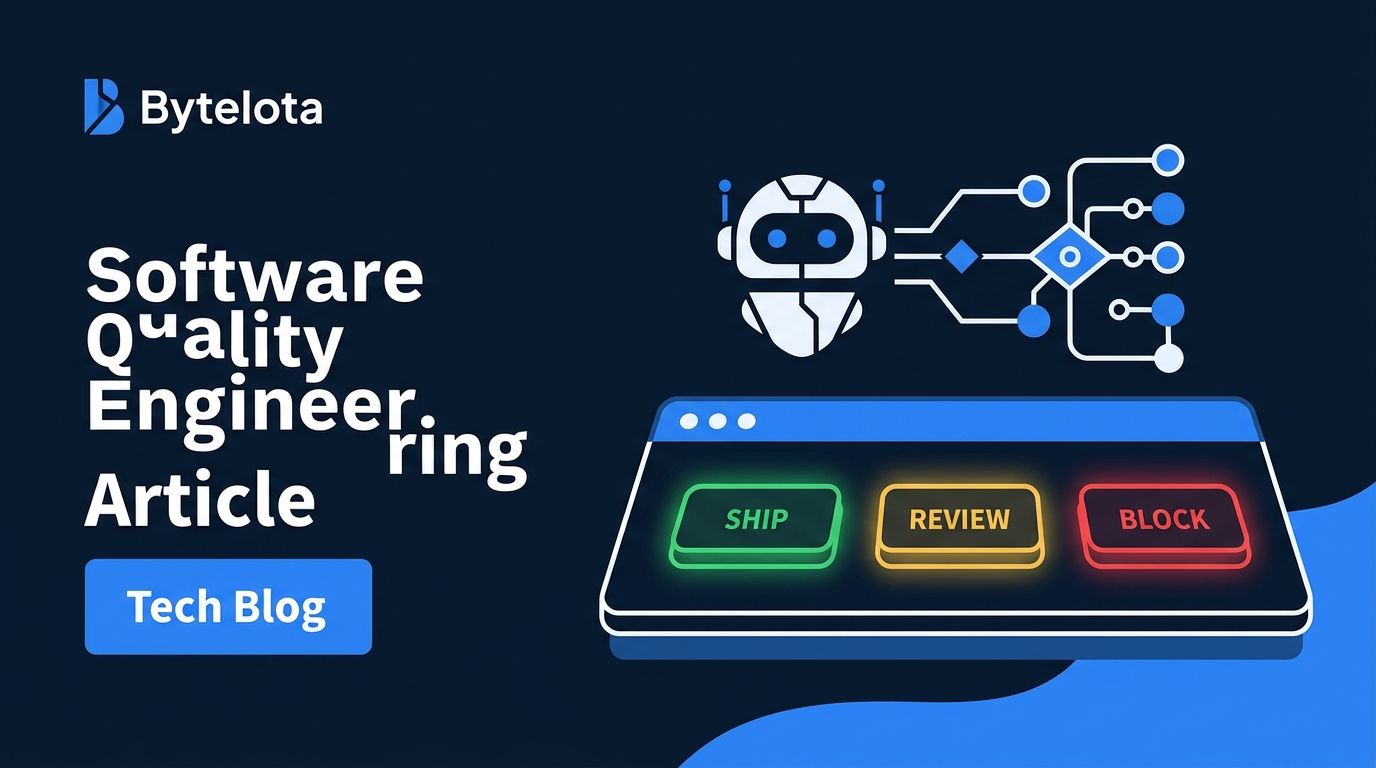
Most teams building AI agents have no good answer to one question: when is this thing ready to ship? Tricentis just built one. At its Transform conference last week, the company announced AgentScore — a new evaluation technology that observes agent behavior across real workflows and outputs a clear verdict: review, block, or ship. It launched alongside two companion tools that together form the most enterprise-grade answer yet to the AI agent quality problem.
Why Your Existing Tests Won’t Catch Agent Failures #
Traditional QA is built on a core assumption: same input, same output. AI agents break this assumption completely. Give an agent an ambiguous task and its response will differ based on context, conversation history, or model state on that particular inference. Your unit tests pass. Staging passes. Then production surfaces failure modes that no test predicted.
The failure that keeps engineering teams up at night is the infinite loop. An agent encounters an error, retries, generates a new error, tries a different approach, creates a third error, attempts to fix that one. The loop continues indefinitely — each iteration burning tokens, firing API calls, writing to databases, or sending emails that were never supposed to go out. Traditional QA frameworks have no mechanism to catch this because they test outcomes, not behavioral sequences.
This is the gap AgentScore targets. Rather than checking whether an agent produced the right answer, it observes how the agent behaved across a complete workflow, recommends which metrics matter for that specific agent type, and generates a composite quality score. The output is deliberately action-oriented: review, block, or ship.
Three Tools, One Answer #
Tricentis announced AgentScore alongside two companion products at Transform 2026, all developed through Tricentis Labs, its early-access innovation incubator:
AgentScore
Probabilistic behavioral evaluation for AI agents. AgentScore observes agents in real-world workflows — not controlled test scenarios — recommends what to measure, and generates composite scores with concrete recommendations. The review/block/ship framework is the key differentiator: rather than dumping a metrics report on a QE team to interpret, it makes a call. This is what enterprise QA tooling actually needs at scale.
Aida
An AI agent that autonomously explores web and Windows desktop applications, finds defects and coverage gaps, and reports on application health — without requiring a pre-existing test suite, scripts, or any setup. This inverts the traditional testing requirement: you don’t need to write tests before Aida can help. You point it at an application and it starts exploring. For teams shipping AI-generated code faster than they can write test coverage, Aida addresses the resulting gap directly.
Release Risk Intelligence
Surfaces coverage gaps scoped to a specific release, prioritizes them by severity, and connects risk assessment directly to release decisions. The important detail here is integration: this is not a separate QA workflow that requires a human to check a dashboard. It is a gate wired into the release pipeline itself, where AI-powered actions surface risk before the ship decision is made.
The Numbers Behind the Urgency #
Tricentis released its 2026 Quality Transformation Report in June, surveying over 2,500 QE leaders globally. The headline: 60% of organizations are still shipping untested code, a number that has barely moved from 63% in 2025 despite massive investment in AI development tooling. Thirty percent say AI-generated code volume has become too large to test fully. Twenty percent lose more than one million dollars annually due to poor software quality.
The trajectory matters. Deloitte projects 25% of businesses investing in generative AI will deploy agents in 2026, rising to 50% in 2027. The volume of untested agent code heading to production is not a current problem that will self-correct — it is an accelerating one.
Where This Fits in the Market #
The developer-facing AI evaluation market — LangSmith, Braintrust, Arize — has been building trace-level observability: instrument your agent, capture the traces, score individual outputs. That matters. But enterprise QE teams need something different: a system that looks at agent behavior across complete business workflows, not just individual LLM calls, and outputs a production gate recommendation rather than a dashboard to interpret.
Tricentis is coming at this from the opposite direction — decades of enterprise test management, the number-one revenue position in Automated Software Quality according to IDC, and an existing customer base that runs QE at scale. AgentScore, Aida, and Release Risk Intelligence are available through Tricentis Labs early access. No public GA date has been announced, but the full announcement is worth reading if your team is currently making production deployment decisions about AI agents with no reliable framework to support them. Most teams are.
For additional context on the AI testing landscape, Arize has a useful comparison of agent evaluation platforms for teams that need to understand the full range of options. ByteIota covered Checksum’s Continuous Quality Loop earlier this week — a complementary approach targeting the same problem from a different angle.