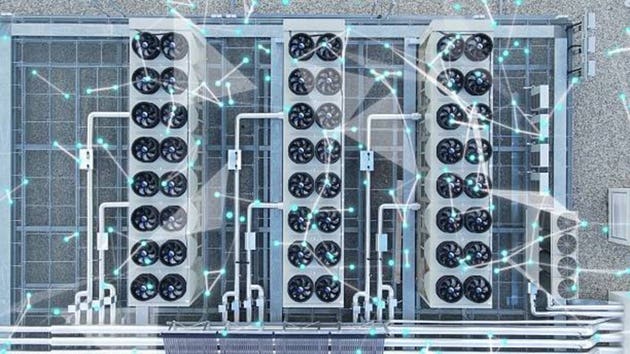
Trane Technologies and Eaton introduced a joint reference design on August 17 that coordinates medium-voltage power distribution with cooling for NVIDIA DSX-aligned AI data centers. The companies estimate that the approach can improve combined energy efficiency by up to 15%, reduce installation costs by up to 30%, and cut copper use by up to 80% versus conventional low-voltage designs, while cautioning that the figures are projected benefits rather than deployment results.
Trane Technologies and Eaton announced a coordinated power-and-cooling reference design on August 17 for high-density AI data centers built around NVIDIA's DSX architecture. The companies say the design links Trane's thermal-management systems with Eaton's medium-voltage electrical systems so operators can plan the two layers together instead of engineering them as separate projects.
What the companies introduced
The design is included in the Trane Continuum Rubin DSX and Eaton Beam Rubin DSX platforms. Eaton's equipment supplies power distribution for the Trane platform, while controls are intended to let the electrical and cooling systems exchange operational signals and respond to changing loads. The companies describe the result as a repeatable reference architecture spanning power and thermal infrastructure rather than a single piece of hardware.
Trane and Eaton estimate that the medium-voltage approach can improve combined energy efficiency by up to 15%, reduce installation costs by up to 30%, and cut copper use by as much as 80% compared with conventional low-voltage designs. Those figures are forward-looking company estimates, not independently measured results from a named production deployment. The announcement does not provide site-level testing data, a customer rollout, or a timetable for commercial installations.
Why coordinated design matters
AI facilities concentrate large electrical loads and heat output into a limited footprint. Treating power distribution and cooling as one design problem can reduce duplicated engineering, surface capacity constraints earlier, and give operators a clearer view of how much grid power remains available for compute after facility overhead. The architecture is also designed to accommodate emerging liquid-cooling and direct-current systems as those approaches mature.
For infrastructure teams, the practical value will depend on evidence beyond the reference design. Useful validation would include measured energy use, installation cost, copper requirements, commissioning time, and reliability from comparable live sites. Until such data is published, the announced percentages are best used as design targets rather than guaranteed savings.
Key Points #
- 1Trane and Eaton introduced a joint NVIDIA DSX-aligned reference design that coordinates medium-voltage power distribution with data-center cooling.
- 2The companies estimate gains of up to 15% in combined energy efficiency, up to 30% lower installation costs, and up to 80% less copper than conventional low-voltage designs.
- 3The announcement provides projected design benefits but no named deployment, site-level measurements, or commercial-installation timetable.
Scoring Rationale #
The collaboration offers a concrete reference architecture for a major AI-infrastructure bottleneck and publishes material efficiency, cost, and copper-use targets. Impact is moderated because the benefits are forward-looking company estimates without a named production deployment or independent performance validation.
Sources #
Primary source and supporting public references used for this report.
Practice interview problems based on real data
1,625 SQL & Python problems across 15 industry datasets — the exact type of data you work with.