To defend an anti-AI Pope from claims a machine helped write his words, his camp reached for an unlikely tool: AI. An Australian firm has certified Pope Leo XIV’s writings as human-made, using a suite of the very detectors the technology has spawned.
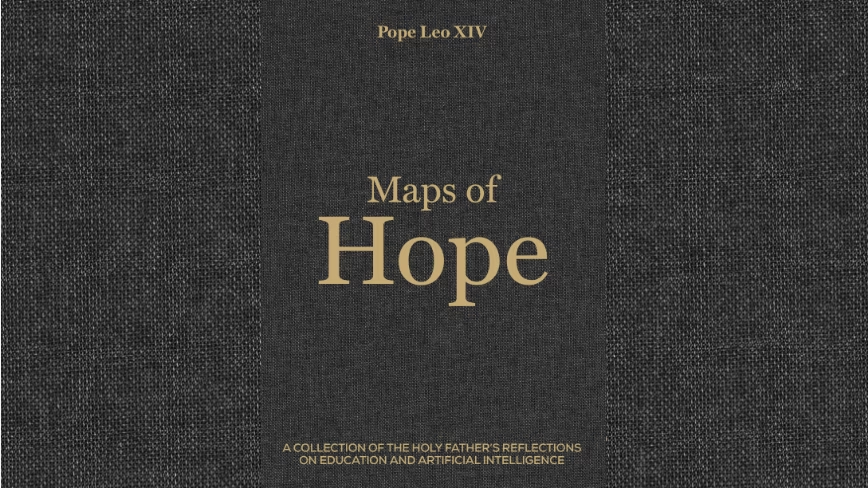
Pope Leo XIV has made AI one of his defining themes. His first encyclical, Magnifica Humanitas, published in May, warned that the technology could come to dominate humanity. Now a collection of his reflections on education and AI, Maps of Hope, has been certified as human-authored.
The awkward backdrop #
The certification follows an uncomfortable episode. Soon after the encyclical appeared, AI researcher Linch Zhang argued in a widely shared analysis that parts of it carried the fingerprints of AI. He pointed to the heavy use of em dashes, the word “genuinely,” and rhetorical triads, and suggested the likely culprit was Anthropic’s Claude.
The detector Pangram flagged some passages. The Verge asked the obvious question: did the Pope use AI to write about the dangers of AI? Zhang stressed it was probably Vatican officials, not Leo himself. The Vatican never confirmed the claim, and it was never proven.
Enter the human-certifiers #
That is the context for the new stamp of approval. Proudly Human is led by Australia’s former chief scientist, Alan Finkel. It verified Maps of Hope as human-authored and awarded it the company’s trust mark. The book was produced by the Australian Catholic University with the Vatican’s Dicastery for Culture and Education. It carries a foreword by Cardinal José Tolentino de Mendonça.
Finkel frames the certification as the whole point of the venture. “With the Pope’s attention squarely on the question of AI and human authorship, it tells you this isn’t a niche debate anymore,” he said. “It’s the defining question of our time.”
The process is part paperwork, part machine. Authors verify their identity and sign a declaration that AI did not write the first draft, or any sentences. Proudly Human then runs the text through what Finkel called “a suite of four or five” AI detectors, plus its own averaging algorithm. It judged the collection “basically purely human.” To vouch for the human, in other words, it leans on the machine.
A ‘fundamental right’ #
Finkel’s pitch is that, without laws forcing writers to disclose AI use, readers deserve to know who, or what, produced a text. “I actually think it’s a fundamental right,” he said. That holds especially for religious figures, he argued, where a congregation expects the genuine wisdom of the person giving the sermon.
It taps a growing appetite for proof that a person, not a program, did the work. The catch is that AI detection is not settled science. Detectors disagree with one another, and they misfire.
The trouble with detectors #
The Atlantic has warned that over-trusting tools like Pangram risks turning accusations into a witch hunt. Some human writers get flagged simply because AI learned to write like them. A certificate, then, is only as reliable as the detectors behind it, and those detectors remain fallible.
The episode still captures where the fight over AI is heading. As machine-written text floods the web, provenance is becoming the currency of trust, and a business. Proudly Human pitches its stamp as the organic or fair-trade label for human writing. That the test case is the Pope, and the referee is an AI-detection tool, only sharpens the point.
Get the TNW newsletter #
Get the most important tech news in your inbox each week.