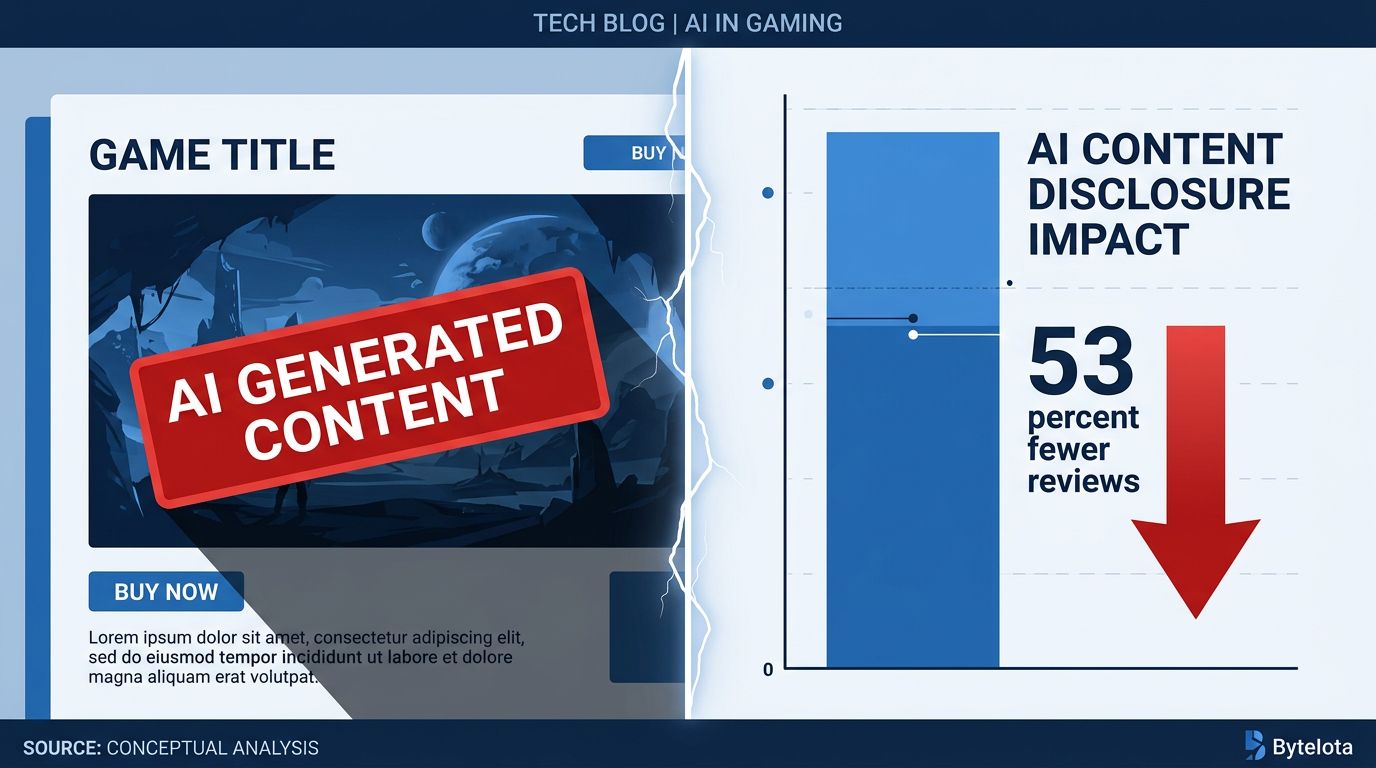
Tim Sweeney, CEO of Epic Games, called Steam’s AI disclosure requirement “really irresponsible of Valve” last week. His argument is that the label creates a “Scarlet Letter of AI” — a mark that fires up a “hater community trying to kill the game.” He says it makes things “much, much, much harder” for developers. He’s not entirely wrong about the consequences. He’s entirely wrong about the cause.
What Steam Actually Requires #
First, let’s be clear about what Valve is actually doing — because Sweeney’s framing suggests something more aggressive than the reality. Valve’s updated AI disclosure policy from January 2026 draws a clean line: AI-powered coding tools and internal workflow automation do not require disclosure. What does require disclosure is AI-generated content that ends up inside the game, on the store page, or in marketing materials. If an AI generated the art, the audio, or the text that players see and hear, that gets disclosed.
That distinction is not a “Scarlet Letter.” It’s a label telling players what they’re buying. And the fact that Valve drew the line at player-facing content — not internal developer tooling — is exactly the right call.
What the Data Actually Shows #
Here’s where Sweeney’s argument runs into a wall. A December 2025 study from Game Oracle, led by researcher Ross Burton, PhD, analyzed 9,879 commercial Steam games released between January and October 2025. The finding everyone has been quoting: Steam AI disclosure games receive about 52.6% fewer reviews than comparable non-AI titles, averaging just 4 reviews in their first month compared to 7 for non-AI games.
Sweeney wants you to read this as: “the label is hurting games.” But the study goes deeper. The penalty falls hardest on experienced studios — developers with track records, established audiences, and the marketing budgets to actually reach players. For small indie developers with no prior releases and no marketing reach, the Steam AI disclosure barely moves the needle. Those games were already going to struggle for other reasons.
What this data actually reveals is that informed consumers are making decisions accordingly. The players who already had expectations of a studio looked at the AI disclosure and updated their confidence in the product. That’s not a bug in Valve’s policy. That’s consumer trust working exactly as intended.
The Contradiction at the Center of Sweeney’s Argument #
There’s a detail worth sitting with: Sweeney made these comments at the same event where Epic announced that Unreal Engine 6 will embed Claude and Gemini directly into the game-building workflow. Level assembly, character setup, rigging, crash analysis — all of it AI-assisted, built into the engine. Unreal Engine 5.8 already ships an experimental MCP plugin connecting LLMs to core engine systems.
So Epic is building AI into the foundation of game development at scale, while simultaneously arguing that developers shouldn’t have to tell anyone. The commercial logic here is not subtle: if Steam AI disclosure hurts game sales, it also slows adoption of the engine that depends on AI being normalized. Sweeney isn’t just defending indie developers. He’s defending Epic’s roadmap.
The 85% Problem #
The GDC 2026 State of the Game Industry report found that 52% of game developers think generative AI is having a negative impact on their industry — up from 30% the prior year. Quantic Foundry research found that 85% of gamers hold negative attitudes toward AI in games, with 63% selecting the most negative available response.
These numbers predate Steam’s AI disclosure policy. Consumers arrived at this position on their own, based on what they experienced. AI was used to cut costs on assets that visibly suffered for it. Entire games shipped that looked like test outputs. That history is why the Steam AI disclosure tag carries commercial weight — not because Valve decided to manufacture distrust out of thin air.
The Right Answer Is Not Less Transparency #
The solution to the generative AI stigma isn’t hiding AI use — it’s using AI in ways that hold up to scrutiny. The Finals is the example everyone keeps pointing to: a live-service shooter that used AI extensively for world-building and NPC dialogue, disclosed it, and has been commercially successful. The difference between The Finals and the studios that tanked wasn’t the Steam AI tag. It was the quality of what was shipped.
AI transparency regulation is arriving regardless. California’s AB 853 and SB 53 took effect January 2026. The EU AI Act’s transparency provisions hit in August 2026. Steam’s AI disclosure policy is ahead of the curve, not out of step with it. When the rest of the software industry has to answer the same questions about AI disclosure, the game industry will have already run the experiment.
The results from that experiment are clear: consumers care. A 53% commercial penalty is not a data artifact — it’s a signal. Shooting the messenger, in this case Valve, doesn’t change what the signal means. It just delays having to deal with it.