Staff Community Manager
5 min read
Welcome to This Week in Neo4j, your fix for news from the world of graph databases!
Every Aura instance now ships with a hosted MCP server built in – so Claude Desktop, Cursor and other AI clients can query your graph with zero setup, just OAuth login and schema/read/read-write tools you control.
Also in this edition: Semvec, a memory engine giving multi-agent systems constant-cost semantic memory; skill distillation in NAMS, turning a scoped slice of agent memory into a portable, loadable SKILL.md package; and a debugging story from GraphAcademy’s new blog.
The Neo4j Discord just got a Server Tag – and we’re celebrating with a Graph Wizard Plushy Contest. Join us on Discord, head to #adopt-tag, grab the tag, and you’re entered. We’ll pick winners at random every week through the end of September. And while you’re there, check out our Dorm Room Plushy use case too.
Happy Graphing,
Alexander Erdl
COMING UP!
Livestream:Architecting Trusted Agents: Turning Knowledge Graphs into Secure Policy Engineson September 15Conferences: Find us atStep, San Franciscoon August 26-27,SwampUp, NYCon September 1-3,Commit Your Code, Planoon September 3-4,Agentsnexus, Bengaluruon September 4-5,Agentcon, Londonon September 8,Devopsdays, Portlandon September 8-10,Percona Live, Amsterdamon September 9-10,AGNTCon + MCPCon, Tokyoon September 10-11,Datacon, Calgaryon September 11 &Big Data, Parison September 15-16Meetup: Meet us inMalmö, SE,San Francisco, US&Berlin, DEon August 25,Tokyo, JPon August 26,Tokyo, JPon August 27,Pune, INon August 29,Bangkok, THon September 1,Bengaluru, INon September 3 &Tokyo, JPon September 12All Neo4j Events:Webinars and More
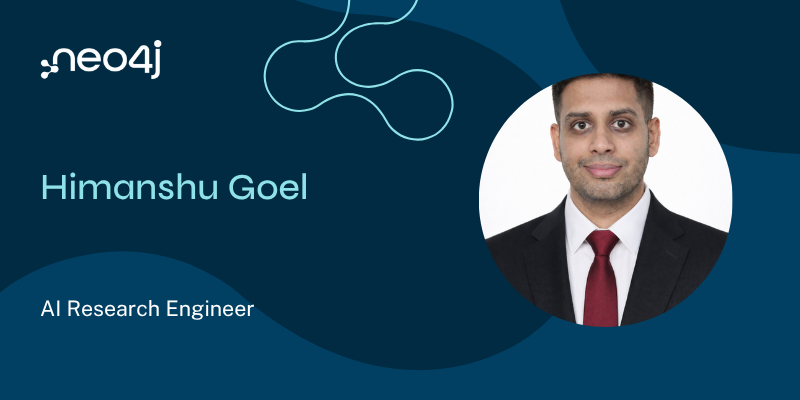
**FEATURED COMMUNITY MEMBER: **[Himanshu Goel](https://www.linkedin.com/in/himanshugoel9725/)

[Himanshu Goel](https://www.linkedin.com/in/himanshugoel9725/)
Himanshu is an AI Research Engineer and Data Scientist with six years of experience building and deploying production-grade AI, machine learning, and Generative AI systems across finance and healthcare.
Connect with him on LinkedIn. He has one of the first confirmed sessions at NODES 2026 “Graph-Powered Temporal Validity: Preventing RAG Systems from Citing Dead Regulations”, where he will demonstrate how Neo4j knowledge graphs solve architectural blind spots by modeling regulatory documents as temporal entities with explicit superseding relationships, effective dates, and sunset clauses.
AGENT MEMORY: Constant-cost semantic memory for multi-agent systems
Michael Neuberger shares a deep technical walkthrough of Semvec, a memory engine that gives agents persistent semantic memory at constant per-turn token cost, with Neo4j as the shared store for both domain data and conversational state. Built around a healthcare multi-agent scenario, it covers shared cluster memory, drift detection across specialities, cross-shift handover, and consensus voting – all bridged to the graph via a single INVESTIGATED relationship.
MCP: Introducing MCP for Aura: Hosted MCP, built into every Aura instance
Neo4j is rolling out a hosted MCP server built directly into every Aura instance, so AI clients like Claude Desktop or Cursor can query a graph with zero setup – no local server, no credential juggling, just OAuth login through the Aura Console. Jonathan Giffard and Asad Ali give us the details: It ships with schema, read, and read-write tools, letting you control exactly how much access an AI client gets to your production graph.
SKILLS: From Agent Memory to Portable Skills
William Lyon breaks down skill distillation in NAMS (Neo4j Agent Memory Service) – the process of turning a scoped slice of an agent’s memory graph into a portable, evidence-backed SKILL.md package that a fresh agent can load and run instead of starting cold. It digs into the AIP (Agent Instruction Protocol) research behind representing skills as typed graphs rather than prose, plus the governance loop that catches and repairs drift when the underlying memory changes.
CYPHER: Writing Cypher Queries That Don’t Lose Your Data
GraphAcademy has just launched a blog and Kemi Elizabeth Ojogbede shared a relatable debugging story – three fake test users, one of whom mysteriously vanishes from query results – that turns into a clear lesson on why chained MATCH
patterns silently exclude unconnected nodes. She walks through fixing it with list comprehensions and COUNT {}
subqueries instead of OPTIONAL MATCH
, with a nice payoff: the data that goes missing is usually the data that needs attention most (new users, stalled learners, disconnected records).
STARTUPS: Subimage
SubImage’s founder told theCUBE at GraphTalk why his startup exists: attackers think in graphs, defenders think in lists. By mapping cloud, identity, and device data into one graph, SubImage gives security teams — and their AI agents – an attacker’s-eye view of exposure, permissions, and attack paths, turning alert floods into clear priorities. It grew out of Cartography, an open-source tool from co-founder Alex Chantavy.
CONTINUOUS LEARNING
GraphAcademy: Use Neo4j temporal types to filter, compute, and searchdate-based dataLearn on Your Schedule: Go deeper into graph intelligence on Neo4j’sOn-Demand webinar libraryWorkshops: Join our virtual classrooms workshopsfrom Fundamentals to GenAI** New Webinar**: Scale Karpathy’s LLM Wiki with Neo4j GraphRAG –Americas,Europe, Middle East & Africa,Asia Pacific
POST OF THE WEEK: Tom Dörr
Osintgraph maps Instagram social networks by gathering public profiles, followers, and posts into Neo4j, supporting investigation with an AI agent for natural language queries.
— Tom Dörr (
[@tom-doerr.bsky.social])[9. August 2026 um 18:01] Please share it if you like it!