Dr. Sid Devarakonda, medical director of the thoracic oncology clinical and research program at Providence Swedish Cancer Institute, studies why lung cancers develop and resist treatment. Much of his research involves analyzing DNA and RNA from tumors to investigate observations from the clinic. A patient’s unexpected response to a treatment, for example, can become a question to pursue in the data.
In collaboration with our Asta team, Devarakonda began testing Theorizer, an AI agent that combines findings from scientific papers to propose explanations for observations such as a tumor’s unexplained growth. When he reviewed its first set of theories, Devarakonda recognized ideas he had developed through years of research. The next day, he recalled thinking, “Wait a second, this is exactly what I think. And it took me 15 years to think like this.”
Today, we’re launching Theorizer in Asta, our platform of AI agents for scientific research, and open-sourcing the code so researchers can examine how it generates theories and adapt the methods to their own work. Through Asta’s web interface, we cover token costs up to a limit; those who prefer to work on their own machines can run our open library and pay for tokens as needed.
Theorizer links each of its proposed explanations to evidence from published studies and describes where they might apply. For nearly a year, scientists have been helping us develop it by testing its theories in their own research.
To share more about Theorizer, Ai2 is hosting a webinar for scientists on Thursday, December 10 at 10am PT. Register here to learn how AI can connect findings into new theories using Theorizer, walk through a real example from cancer research, and explore what it will take for AI to reliably contribute to the scientific process.
Investigating lung cancer
Devarakonda used Theorizer to investigate “driver-negative” lung adenocarcinoma, the most common subtype of lung cancer. Most lung adenocarcinomas have one of several genetic alterations that activate the RAS pathway, a chain of signals that promotes cell growth. But in roughly 20% to 30% of cases, even comprehensive sequencing does not reveal a recognized driver alteration. To understand what keeps the cells multiplying, Devarakonda asked Theorizer, “What’s happening in these tumors?”
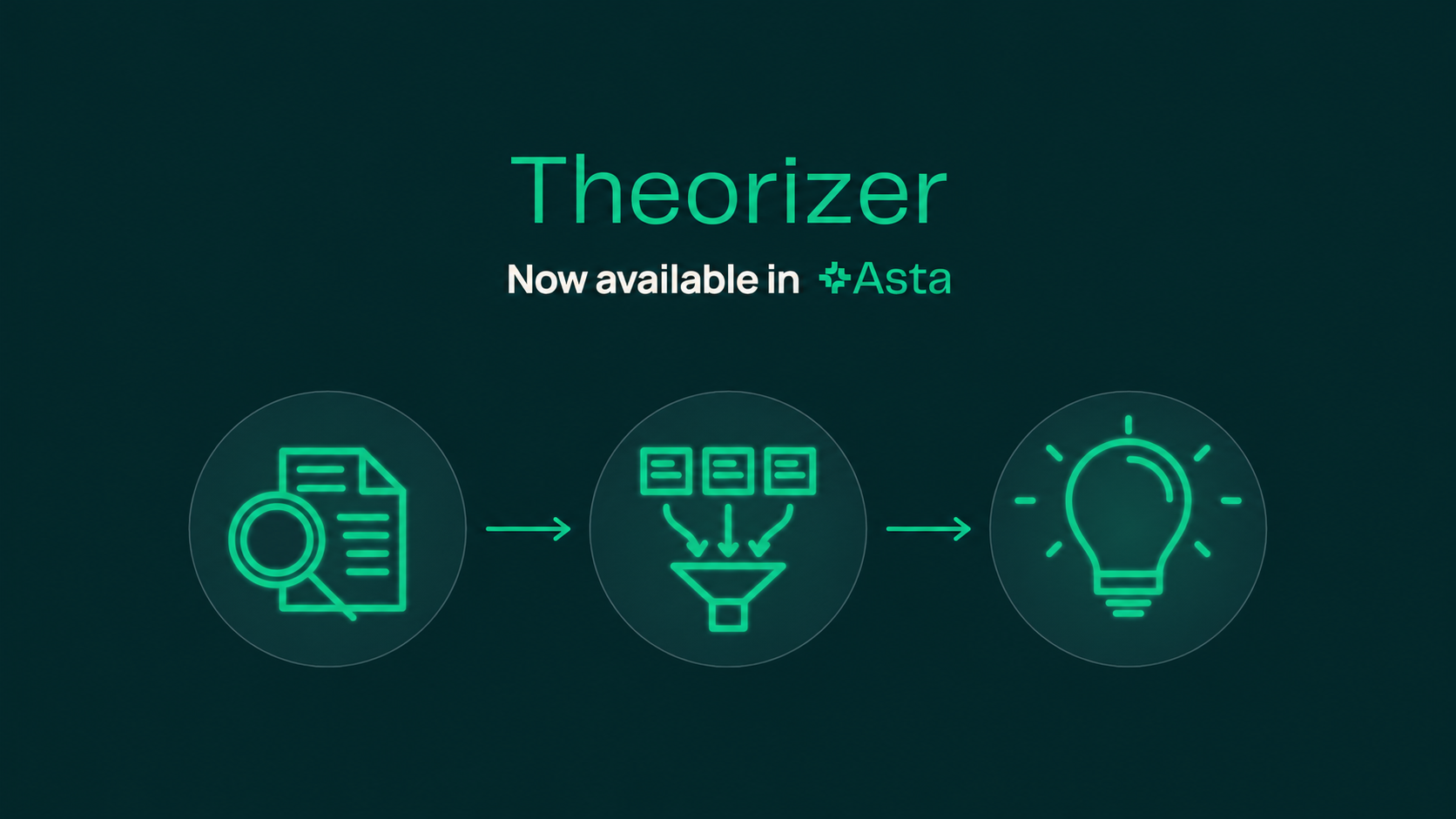
Theorizer searches the research literature in response to a user’s question, then creates a template specifying what to extract from each paper. For a question about how lung cancers grow, that might include which genes a study examined, how researchers measured their activity, and what happened when the researchers altered those genes. Theorizer compares the extracted findings to generate theories, linking claims to the papers behind them. Researchers can inspect the cited studies to assess the support for a theory and whether the studies examined comparable conditions. The tool also flags claims it considers new, but a search can miss earlier work and the model can misjudge originality; researchers still need to check a claim against the wider literature.
After several iterations, Theorizer helped Devarakonda formulate three hypotheses for how lung adenocarcinoma tumors could grow without a recognized driver. One was that an undetected genetic change was activating RAS signaling. Another was that a different mechanism allowed the cells to divide without relying on RAS. A third was that some tumors had acquired characteristics of another cell type and no longer behaved like typical lung adenocarcinomas. Theorizer helped turn his broad question about unexplained tumor growth into specific hypotheses he could investigate in molecular data.
Devarakonda and the Asta team investigated these theories with AutoDiscovery, which writes and runs code to test hypotheses against datasets. Devarakonda used The Cancer Genome Atlas, a public collection of molecular data from tumors, to compare genetic changes, gene activity, and protein measurements in cancers with and without recognized drivers. He also examined data from laboratory-grown cancer cells to identify genes needed for growth or survival.
AutoDiscovery suggested that disruption of the DREAM complex, a group of proteins that normally keeps cell division in check, might help explain the tumors’ growth. Devarakonda had not initially focused on this mechanism. Working with the Asta team, he compared RAS activity with how strongly genes normally controlled by the complex were switched on.
Follow-up work with data from laboratory-grown cancer cells gave Devarakonda preliminary support for the hypothesis that some cancers with low RAS activity may depend on CDK2, a protein involved in cell division. If those cells depend on CDK2, blocking the protein could offer a way to slow or stop their growth.
While these findings still require experimental validation, Devarakonda’s longer-term goal is to identify ideas that could be tested in clinical trials. He compares working with tools like Theorizer to wearing Iron Man’s suit: “The suit is fantastic, but you still need somebody inside it because it’s a question of allocating resources and making sense of what’s being done.” Studying brain cell function
Jérôme Lecoq, an associate investigator at the Allen Institute, develops neural recording methods for studying brain activity in mice. He works on OpenScope, a shared experimental platform through which researchers propose neuroscience studies for the Allen Institute to carry out. The resulting datasets are shared openly with researchers around the world.
Lecoq evaluated an early version of Theorizer on VIP interneurons, brain cells that suppress the activity of other neurons. Their targets include inhibitory cells that normally dampen activity in the surrounding circuit. Suppressing those cells can allow nearby neurons to respond more strongly.
Theorizer returned 50 candidate theories about VIP interneurons, compared with the one or two Lecoq had expected.
One theory from Theorizer proposed that VIP interneurons help adjust the strength of the brain’s response to visual input depending on what the animal is attending to. The central idea had already been proposed in the literature, but Theorizer connected computational work with experimental findings in an account that matched Lecoq’s own view of these cells’ role.
The value was in bringing different strands of evidence together, giving Lecoq a literature-based explanation he could assess against his own understanding of the cells.
Co-developing Theorizer with Lecoq gave the Asta team a way to review the tool’s theories against the evidence and standards of neuroscience. He asked for experimental measurements to be easy to examine and for claims to retain the conditions in which the experiments were conducted.
“[W]hen you state a theory in biology, you’re extremely careful in how you frame it,” Lecoq says. “Like, you say in this context, in this particular behavior, we see this as true, but in other behavior it might be the complete opposite.”
An anomaly in Peru’s climate data
At the International Potato Center (CIP) in Peru, Piero Palacios, a data scientist and statistical specialist, develops tools to help researchers analyze complex datasets. Henry Juarez, CIP’s systems and data management officer, works on agricultural data and research into the conservation of native potato varieties.
Palacios and Juarez wanted to extend the dew-point record in PISCO, a dataset that uses weather-station observations to estimate climate conditions across Peru. A longer record would supply missing inputs for agricultural models, including those used to approximate crop water requirements.
PISCO’s dew-point records end in 2016, while its minimum-temperature records continue through 2020. Palacios and Juarez used the overlapping historical data to estimate dew point for the missing four years, but some reconstructed values exceeded 35°C – implausibly high daily dew points for the affected areas – and clustered in November.
Palacios and Juarez used Theorizer to generate possible explanations for the unusually high November dew points. One proposed explanation was a rise in humidity as the Amazon shifts from dry to wet conditions. Testing that seasonal explanation against their data ruled it out for the study area, but it prompted Palacios and Juarez to investigate how the original climate record had been constructed.
“Having a specific, falsifiable mechanism on the table is what drove us to measure the November spike by distance from the stations in the historical record,” Palacios and Juarez say. “That was an analysis we had no particular reason to run while the anomaly was merely unexplained, and it is the analysis that produced the actual answer.”
Palacios and Juarez traced the implausible values to how the original dataset estimated conditions far from weather stations. Asta Paper Finder, our tool for searching the research literature, also located published work documenting similar problems. Palacios and Juarez are seeking independent station observations to validate their reconstruction; the source record’s own November spike remains an open question.
Here, Theorizer’s contribution was a testable explanation that led the researchers to an analysis they had not considered. Even though that explanation was wrong, testing it helped them trace the implausible values to their source.
Vilma Hualla, a data management specialist at CIP, studies the diversity of native potato varieties in the Andes. She and her colleagues are examining historical records and household surveys spanning a century in Paucartambo, in Peru’s Cusco region.
Hualla used AutoDiscovery to compare the varieties recorded in the six periods. In most transitions, more varieties entered the records than left them, but the transition from 1941–60 to 1961–80 was an exception: more varieties disappeared from the records than appeared for the first time.
“I think it makes us think a little more about what happened in that period, and look for more information to help us describe it and analyze whether it had an effect on all the other periods,” Hualla says, speaking in Spanish.
Hualla then used Theorizer to generate explanations for the drop in recorded varieties, drawing on relevant literature and reviewing which hypotheses to pursue or reject. In their draft report, Hualla and her colleagues discuss Peru’s 1969 agrarian reform and the associated shift toward commercial production as one possible cause of a decline in native varieties. They also consider whether differences in the historical sources could account for an apparent loss of varieties in the records.
Theorizer helped Hualla move from identifying a pattern to considering explanations for it, giving her team directions for further research while the cause remains unresolved.
Hualla and colleagues’ report also describes how farmers acquire varieties through seed exchanges within and between communities, cautioning that conservation programs could disrupt these exchanges if they overlook the networks that sustain local crop diversity.
Try Theorizer on your hardest research problems: a question you’re stuck on, a result you can’t yet explain, an unexpected pattern in your data, or a finding that conflicts with the literature. It draws on published research to propose explanations and links its claims to the supporting papers. Theorizer can miss relevant studies and misjudge originality. A theory that appears new within the papers it analyzed may already exist elsewhere in the literature. Researchers still need to examine the evidence and decide which ideas warrant testing.
We want to hear about the research problems you’re stuck on; those problems guide what we build next. Several scientists told us their best evidence sits in internal reports or other sources they can't send to commercial AI labs. That’s one reason we’ve started releasing small open-weight models for specific scientific tasks, such as AstaBrief, which writes cited reports and can run on your own servers.
Try Theorizer in Asta with a question from your own research. Explore the code to examine and adapt the methods, or read our technical paper for details on how it works. Subscribe to receive monthly updates about the latest Ai2 news.