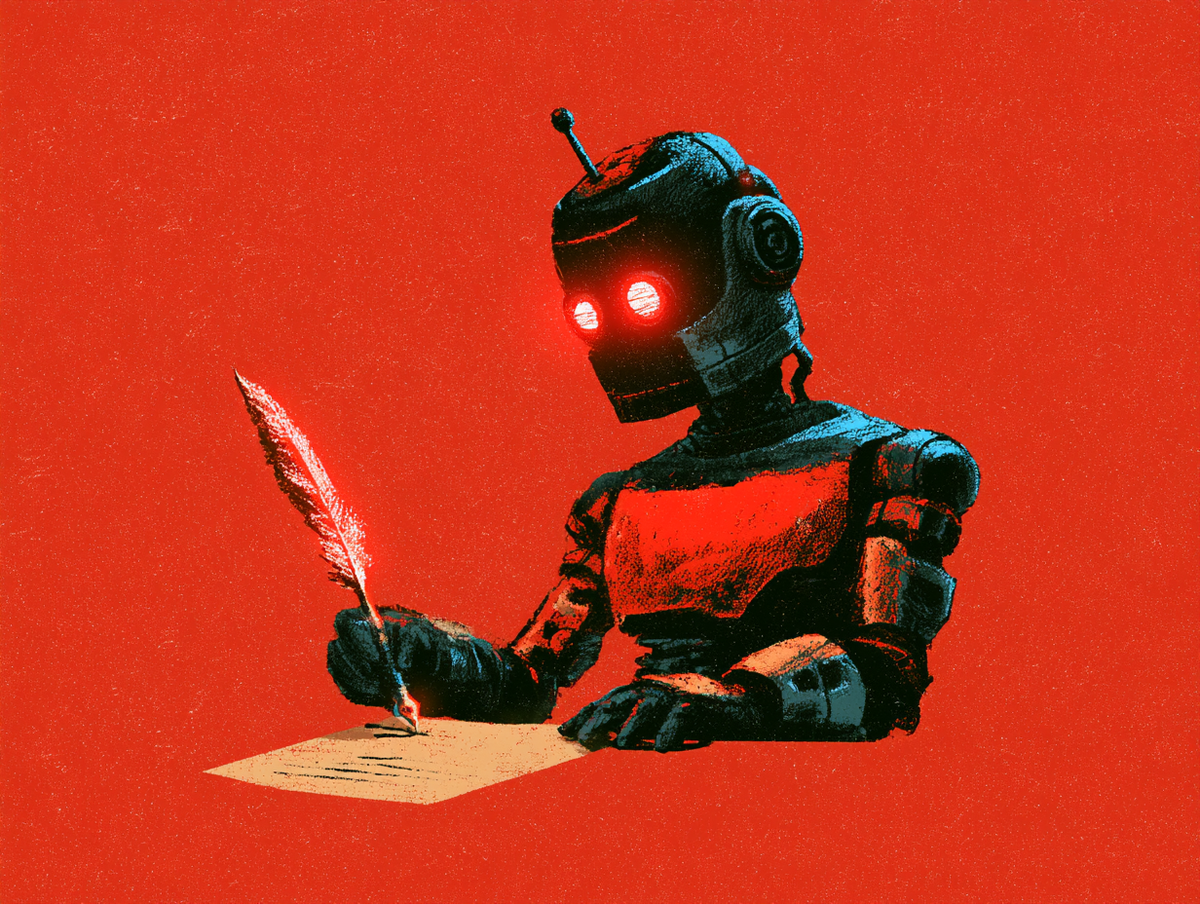
A number of interesting parts in this interview of Tim O’Reilly — including kicking off with the distinction between actual open source and all the current buzz (again) around open weights — but the ending bit about AI and writing stands out:
Steven Levy:When I edit this interview I will boil down our long conversation to a shorter one, but I won’t use AI to do it. And of course, the writing in the introduction will be all mine. It’s actually our policy.Tim O'Reilly:I think that's a legacy thing that's going to go. My ability to have a thought partner in AI when I'm writing is very powerful.SL:AI does your writing for you?TO:No, no. I use it for brainstorming, and sort of just functional writing. When I interview somebody for an hour, I go to AI and say, “Turn it into something I can use.” I don't have the time to write up all those interviews.
I’ve already said (and written) my piece about using AI to write. To quickly summarize: quality aside, I personally don’t see the point because most of what I get out of writing is from the process itself. From thinking to choosing what words to use — and just as importantly, what words not to use. It’s a bit like having a robot run a marathon for you. What’s the point?
But I also say that as someone who loves writing. Many people do not, and so I also think using AI is fine for certain types of low-stakes writing, like many types of email. But if you’re actually putting your name to something more substantive, forget the audience, you’re just sort of cheating yourself.
Anyway, what I really want to remark on here is the idea of using AI to brainstorm. In the past, I may have written this off as well. But actually, with the rise of the very good AI voice technology — namely, GPT-Voice — I actually have found going back and forth with AI quite useful in helping to think through some ideas. And actually, it’s less about the content coming from the AI, it’s just the fact that I'm having a conversation and it’s drawing ideas out of my brain.
I’ve long found that some of my best ideas to write about come out of conversations. And while it’s obviously great to have those with people, people aren’t always immediately available to have a conversation with you. And again, if I’m being honest, it’s less about what the other person is saying and more that the chat is fleshing out my own ideas. In a way, I’m sort of “using” the human on the other end. Why not use an AI for that?
Again, I’ve found it quite interesting these past few weeks. These conversations with AI have spurred some ideas in my brain that I’m not sure I would otherwise have had. And to me, it's the actual speaking that's key to that. Saying things out loud forces your mind into places – at least it does for me.
SL:Aren’t you worried that AI will eventually supplant human writing?TO:AI is literally a medium, in the same way that written words are a medium, or paint or music is a medium. When I talk to an AI or design art with it, I get something different out of it than you do, in the same way that Michelangelo and Van Gogh got completely different things out of paint. The idea that you can't write with AI will seem as curious as the idea that you can't make a good portrait or landscape with a camera. There will be people who are masters at expressing their ideas by summoning words from LLMs. People used to ride horses. Now, few do. We're in the early days.
I’m honestly not sure if I agree or disagree with this. I think I mainly agree but it’s also still a bit hard to see now. Because so much of what I see as the output still seems to mostly follow the same general patterns. I do expect that will change as models continue to improve, but perhaps I’m just not good at prompting when it comes to producing output that could pass as good writing.
On the flip side, I think the people who view any kind of AI-aided creation as an abomination are sort of silly. AI is a tool. The latest in a string of technological tools which will never end. What people inherently actually don’t like is the way this tool came about — by ingesting much of the internet. That is, words written by humans. Yet, in a way, humanity has done something similar throughout history, from cave painting on down, but this new level of “learning” has been done at a scale that no human can match. And, in fact, without other humans on the receiving end. It feels unnatural because it is unnatural, but that also depends on what your definition of “natural” is.
One more thing: when asked if open source can break the Big AI hold:
I don't predict the future. But I will say the world is proceeding the way that I hoped it would. What if the big frontier models end up like mainframes or supercomputers—aimed at really hard problems, which are not actually the thing that gets diffused throughout society?
Lost in all the aforementioned open weight debates is the notion that the frontier models may end up being overkill on a number of fronts — including, importantly, price and performance. Beyond some of the "open" players catching up on the latter, the real takeaway of this particular era may be the realization that we don’t need the absolute frontier for many tasks. And, in fact, more nimble, tailored models may be better suited for certain – maybe even most? – jobs.
The question there is whether the best of those come from — are distilled from — the frontier. And who gets to distill...
Previously, on
Spyglass
...