The Study · Economics
On 22 February 2025, Pieter Levels started prompting an AI flight game into existence in public. Seventeen days later he posted that fly.pieter.com had reached $1M in annualized revenue, and the screenshot has been load-bearing for the vibe-coding gold rush ever since.
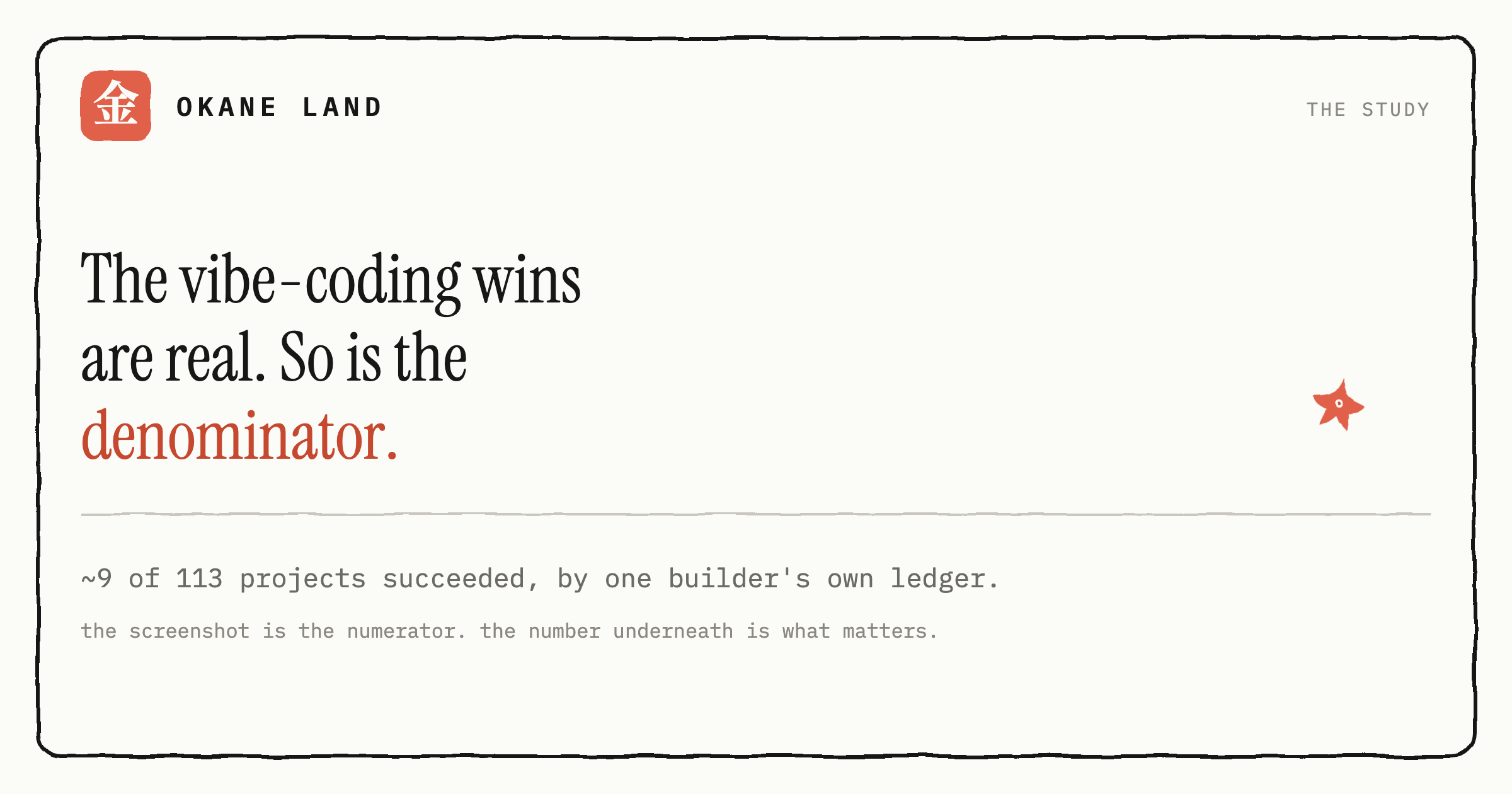
The same builder maintains a much quieter page: a public ledger of roughly 113 projects, with about 9 marked a success, and a plain note that most of what he made never earned money. Both pages are true. This piece is about reading them together, because the screenshots always travel alone.
The short version #
The wins are real, self-reported, and everywhere: acquisitions, $1M-ARR screenshots, launch threads. What you never see posted next to them is the denominator, the count of everything the same builders shipped that made nothing.The loudest “ARR” numbers are annualized spikes. ARR is often just one good month multiplied by twelve, and when that month was a one-time viral surge, the annual figure describes a moment that already passed.The two biggest “vibe-coding” exits sold shovels, not gold. Base44 (about $80M from Wix) and Anything ($100M valuation) are platforms builders use to vibe-code. That is a real business, and it is not the same as a solo product built with those tools succeeding.The one builder who published his own hit rate is the anchor to trust. Pieter Levels’ public ledger tracks around 113 projects with about 9 marked a success, in his words most never made money. That fraction, not any single screenshot, is the shape of the thing. We did not build a dataset, audit anyone’s revenue, or measure an outcome distribution, because no public, representative registry of vibe-coded launches exists. This is a curated review of what people posted publicly, set against the one denominator a builder published about himself. Every figure is self-reported and dated where we could date it.
The success stories, itemized #
Set out plainly, the public wins look overwhelming:
| Case | Reported outcome | What it actually is |
|---|---|---|
| Cal AI | 15M+ downloads, $30M+ revenue, acquired by MyFitnessPal | A product; revenue self-reported, acquisition confirmed |
| Base44 | ~$80M cash from Wix, ~6-month-old company | A vibe-coding platform (shovels) |
| Anything | $2M ARR in two weeks, $100M valuation | A vibe-coding platform (shovels) |
| fly.pieter.com | ”$1M ARR in 17 days” | A product; annualized spike, composition unverified |
| Bryce Edwards’ app | ~$11k in 30 days | A product; self-reported, no recurring breakdown |
Every row is real in the sense that someone credible posted it. The work of reading it correctly is in the third column, and in the rows that were never posted at all.
What “ARR” is hiding #
Annual Recurring Revenue is a projection: this month’s recurring revenue, times twelve. It is a fair estimate when revenue is steady and recurring. It is misleading when the month was a one-time surge, because there is nothing recurring to annualize.
The cleanest illustration is Pieter Levels’ own fly.pieter.com, an AI flight game that he reports hit “$1M ARR in just 17 days” after starting on 22 February 2025. That $1M is the confirmed, self-reported headline. The widely repeated breakdown, that the monthly figure was mostly advertising slots and one-time sales of in-game jets rather than subscriptions, comes from posts we could not re-open, so we flag it as reported and unverified rather than stating it as fact. But the mechanism is the lesson regardless: annualizing a spike made of one-time payments produces a number that describes a fortnight, not a year. When you see “$1M ARR in X days,” the days are doing more work than the dollars.
Read the acquisition fine print: tool versus product #
The two largest exits in the “vibe-coding” conversation are the ones to read most carefully, because they are not what the framing implies.
Base44, a solo-founded platform that lets people build apps by prompting, was reportedly bought by Wix for around $80M in cash when it was roughly six months old, with a reported $189k profit in May and about 250,000 users. Anything, another platform in the same space, reportedly reached a $100M valuation. Both are genuine successes and both are shovel sellers: they make money when builders use them to vibe-code, whether or not any of those builders’ apps succeed. That is arguably the most reliable business in a gold rush, and it is a different claim from “a person built a product by vibe coding and sold it.” Cal AI and fly.pieter are the product cases; Base44 and Anything are the platform cases. Filing them in the same drawer is how the success rate of vibe coding gets quietly overstated.
The denominator nobody screenshots #
Here is the number that reframes all of the above, and the reason it is trustworthy is that the builder published it about his own work.
Pieter Levels, one of the most successful indie builders alive, keeps a public ledger of his projects. It tracks on the order of 113 of them, with roughly 9 marked a success, and he says plainly that most of what he made never succeeded or made money. Sit with that ratio. This is not a struggling beginner; it is a builder with multiple genuine hits, telling you that the base rate underneath those hits is a long column of things that went nowhere. Every screenshot you have admired is drawn from someone’s version of that same column, cropped to the winning row.
That is what survivorship bias looks like in one plain table, and it is the correct frame for reading every figure in this piece. The wins are real. They are also the visible top of a fraction whose bottom is almost never posted, and the liveness floor we measured separately, where at least one in nine showcased launches is already offline, is a small window onto that denominator.
What we could not establish #
The limits, stated plainly. There is no public registry of vibe-coded launches, so the true success rate is unknown and this piece does not estimate one. Every revenue figure here is self-reported and unaudited; the acquisitions are confirmed by outlets, but the revenue described inside them is not. Several of the most-quoted specifics, including the composition of fly.pieter’s peak month and any figure for its revenue afterward, rest on posts we could not re-open, and we have labeled them as such rather than launder them into fact.
What survives all of that caution is the shape. The outcomes people post are real and are selected for being postable. The loudest annual figures are often a single month wearing a year’s clothing. The biggest exits sold the tools, not the output. And the one builder generous enough to publish his own denominator put it at roughly 9 in 113. If you are measuring your own build against the highlight reel, measure it against that fraction instead, the same way our build-in-public revenue study and our one-person-business economics keep insisting: the screenshot is the numerator, and the number that matters is the one underneath it.
One email, when there's something worth sending
Get the research in your inbox. #
No fixed schedule, no filler. You get an email when we've tested something, run the numbers, or found a tool worth your time.
Free. Double opt-in, unsubscribe in one click.
What does your denominator look like? Compare notes in the forum ↗
Sources & how we researched this #
- Pieter Levels (levels.io), public project ledger (read 2026-08-09): tracks roughly 113 projects with about 9 marked a success, and states in his own words that most things he made never succeeded or made money. The survivorship denominator, confirmed on his own page. levels.io
- fly.pieter.com: levels.io reports the game reached "$1M ARR in just 17 days," started 22 Feb 2025. Confirmed on levels.io. The widely repeated $87k MRR composition (ad slots plus one-time jet sales) and any later revenue figure come from X posts we could not re-open (HTTP 402), so they are REPORTED and unverified.
- Cal AI: founder-reported 15M+ downloads and $30M+ in annual revenue; acquired by MyFitnessPal, deal reported closed December 2025 and announced 2 March 2026, terms undisclosed. Acquisition confirmed by outlet coverage; the revenue figure is self-reported.
- Base44 sold to Wix for a reported $80M cash: solo founder Maor Shlomo, company about six months old, a reported $189k profit in May and about 250k users. Base44 is a vibe-coding PLATFORM, not a solo vibe-coded product. Source: TechCrunch coverage (republished on Yahoo Finance, 18 Jun 2025).
- Anything: reported $2M ARR in two weeks at a $100M valuation. Also a vibe-coding platform (a tool builders use), not a product built with one. REPORTED.
- Bryce Edwards: self-reported about $11,000 in 30 days from a vibe-coded AI personality-analysis app, posted on Indie Hackers. No breakdown of one-time versus recurring given. REPORTED.