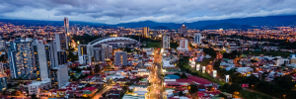
As Latin America (LATAM) embraces the age of AI, Wi-Fi and other wireless solutions that operate on unlicensed spectrum without requiring a government-issued license are critical to building the infrastructure these AI-driven applications demand. Cisco recently joined the Latin America Spectrum Management Conference (Figure 1) in San José, Costa Rica, to showcase how its 6 GHz Wi-Fi technology will improve connectivity in high-density events and outdoor venues. Our demonstration also showed that LATAM is quickly adopting the ecosystem to take advantage of 6 GHz connectivity, with up to 40% of end user devices connecting to the band during the event. They experienced high data transfer rates, low latency, and strong uplink and downlink performance throughout the venue.
Figure 1. The America Spectrum Management Conference in San José, Costa Rica
The 6 GHz band represents the most significant expansion of wireless capacity for unlicensed spectrum in the last two decades, a vital resource for the current and upcoming generations of Wi-Fi 6E and Wi-Fi 7. By allocating the full 1200 MHz of spectrum for unlicensed use, Costa Rica has positioned itself alongside global leaders using Wi-Fi 6E and Wi-Fi 7 efficiently. This move is more than a technical update. It’s a foundational policy decision that ensures the country can support the growing density of connected devices in homes, offices, and industrial locations, as well as increasing connectivity needs related to AI and broadband. Recent rulings by Superintendencia de Telecomunicaciones (SUTEL), Costa Rica’s telecommunications regulatory authority, have finalized the framework for standard power (SP) devices and the accreditation of automated frequency coordination (AFC) systems. This has cleared the path for high-performance outdoor network standards that were previously focused only on indoor environments.
The deployment of the entire 6 GHz band is essential to avoid the congestion that occurs when too many devices compete for limited space in legacy frequency bands. By providing a massive, clean range of spectrum for indoor and outdoor unlicensed use, Costa Rica has ensured that its wireless infrastructure will remain resilient and capable of handling future data demands. This approach provides the necessary certainty to support long-term technology investment and signals that the nation is ready to support digital services like advanced automation and remote high-definition collaboration.
Technical excellence: IW9167E point-to-point innovation
The event was hosted by SUTEL with the support of the Inter-American Telecommunication Commission (CITEL) and was held alongside the Comisión Técnica Regional de Telecomunicaciones (COMTELCA) Radiocommunications Committee. More than 15 countries from the LATAM region were represented, including local regulators and ministries as well as industries and other interested parties.
A technical demonstration provided by Cisco involved high-performance standalone SP 6 GHz Cisco Catalyst IW9167E Heavy Duty Access Points, designed specifically for mission-critical environments, complex outdoor settings, and heavy industries like mining, ports, transportation, energy, and manufacturing. The demo focused on a point-to-point use case to demonstrate SP capabilities in the 6 GHz band, showcasing the equipment’s readiness for high-speed outdoor networks.
The hardware setup consisted of two IW9167E units paired with IW-ANT-PNL515-NS antennas, which has proven highly effective for the 6 GHz band (Figure 2). The demo was configured with a massive 320 MHz channel in the 6 GHz band; the units were placed outdoors, 20 meters between each other, with a line of sight and an antenna height of 2.5 meters. Even in a non-ideal environment characterized by nearby walls, metal structures, and close floor levels, the system maintained a consistent TCP upstream and downstream throughput of approximately 2 Gbps. This was achieved using a simple local configuration with a small server on one end and a laptop client on the other, both limited by a 2.5 Gbps port, proving the robustness of Cisco Ultra-Reliable Wireless Backhaul (URWB) technology.
Figure 2. Setup of the point-to-point Cisco Catalyst IW9167E Heavy Duty Access Point with IW-ANT-PNL515-NS antennas
The success of this backhaul demo has sparked significant interest among operators and government agencies in Costa Rica that are eager for high-capacity outdoor wireless solutions.
The Cisco Catalyst IW9167 Series provides reliable wireless connectivity for mission-critical applications in a state-of-the-art platform (Figure 3). It can operate in Wi-Fi 6, Workgroup Bridge (WGB), and URWB mode.
Figure 3. Point-to-point Cisco Catalyst IW9167E Heavy Duty Access Point TCP upstream and downstream performance
Transforming the user experience with Wi-Fi 7
In addition to the specialized point-to-point backhaul demonstration, Cisco provided Wi-Fi 7 service that powered the two-day conference room for over 400 connected devices. With a group of Cisco Wireless 9172I and Cisco Wireless 9176I Access Points we established a robust tri-band wireless low-power indoor Wi-Fi 7 environment.
The Wi-Fi service was configured with two distinct networks: one with the legacy bands 2.4 GHz and 5 GHz and a second dedicated exclusively to the full 6 GHz band. This dual-network approach provided a clear demonstration of the efficiency gains provided by the new 6 GHz spectrum, highlighting the capabilities and characteristics of this new standard. Notably, the high data transfer rates and low-latency connection performance were achieved without the need to utilize Multi-Link Operation (MLO).
The results of this live deployment were highly significant, marking it as one of the first events in LATAM to successfully enable Wi-Fi 7 and achieve a remarkably high adoption of 6 GHz devices (Figure 4). During the event, 38% of connected devices utilized the 6 GHz band, reaching more than 100 simultaneous connections, a notable performance milestone for this region.
Figure 4. The two-day event percentage of users connected to both networks using legacy and 6 GHz band
Speed tests throughout the conference area showed outstanding results for the 6 GHz band (Figure 5). On 160 MHz channels, throughput reached between 600 and 800 Mbps—even with the venue’s 750 Mbps gateway limit. Notably, these speeds held for both downlink and uplink, a key differentiator for AI-driven technologies.
Figure 5. Speed test samples using the 6 GHz band in two different devices and at different times
The Cisco Wireless 9172I and 9176I used at the event are enterprise-class, indoor Wi-Fi 7 (802.11be) access points engineered to deliver high-density connectivity and massive throughput for next-generation wireless networks. Built on tri-band radio architectures supporting 2.4 GHz, 5 GHz, and 6 GHz spectrum, both models provide advanced Wi-Fi 7 capabilities.
Showcasing Cisco wireless and regional collaboration
The full 6 GHz license-exempt spectrum will soon serve as a vital, expansive highway for connectivity in LATAM, enabling significantly faster and more reliable connections for critical communications. Implementing unlicensed operations across the full 6 GHz band provides a stable and reliable foundation for long-term technical assurance for networking infrastructure. By utilizing standardized high-power operational capabilities, countries in LATAM can deploy robust, far-reaching connectivity solutions that mirror the impressive performance results shown in this point-to-point demo, supporting both essential public services and businesses.
The smooth Wi-Fi 7 service and the impressive person-to-person demo results resonated deeply with the Latin American countries in attendance, including regulators and ministries. The strong engagement from 6 GHz-capable devices proved that the LATAM ecosystem is ready for the transition to the newest Wi-Fi standards. This positions Cisco at the forefront of wireless innovation in the region, with SUTEL now set to oversee the availability of future 6 GHz equipment.
Our showcase at the Latin America Spectrum Management Conference would not have been possible without phenomenal cross-team collaboration (Figure 6). Key leadership and technical guidance were provided by Humberto La Roche (SP CTO), while Alice Masini (IIoT PM) and Kunal Bhagchandani (IIoT TME) managed equipment preparation and shipment logistics. Local deployment was coordinated by Ariel Szternberg (SE Costa Rica) and expertly executed by Randall Vega (SE Costa Rica) and Anthony Garcia (SE Costa Rica), while Adriana Servin (GA LATAM) and Guadalupe Asis (Compliance LATAM) navigated the SUTEL administrative process to secure experimental certificates.
Many thanks to the contributors and attendees.
Figure 6. Juan Pablo Rocha, CTO, Wireless; Randall Vega, SE Costa Rica; and Anthony Garcia, SE Costa Rica, at the event
Wi-Fi for the future-proofed workplace: Secure, intelligent, and assured
Get More from Cisco Networking
Customer stories, technical demos and more await!
Check out our Networking video channel
Multidomain Architecture
Learn how to integrate your networking domains and get more out of an enterprise-wide, intent-based network.
Discover multidomain integration