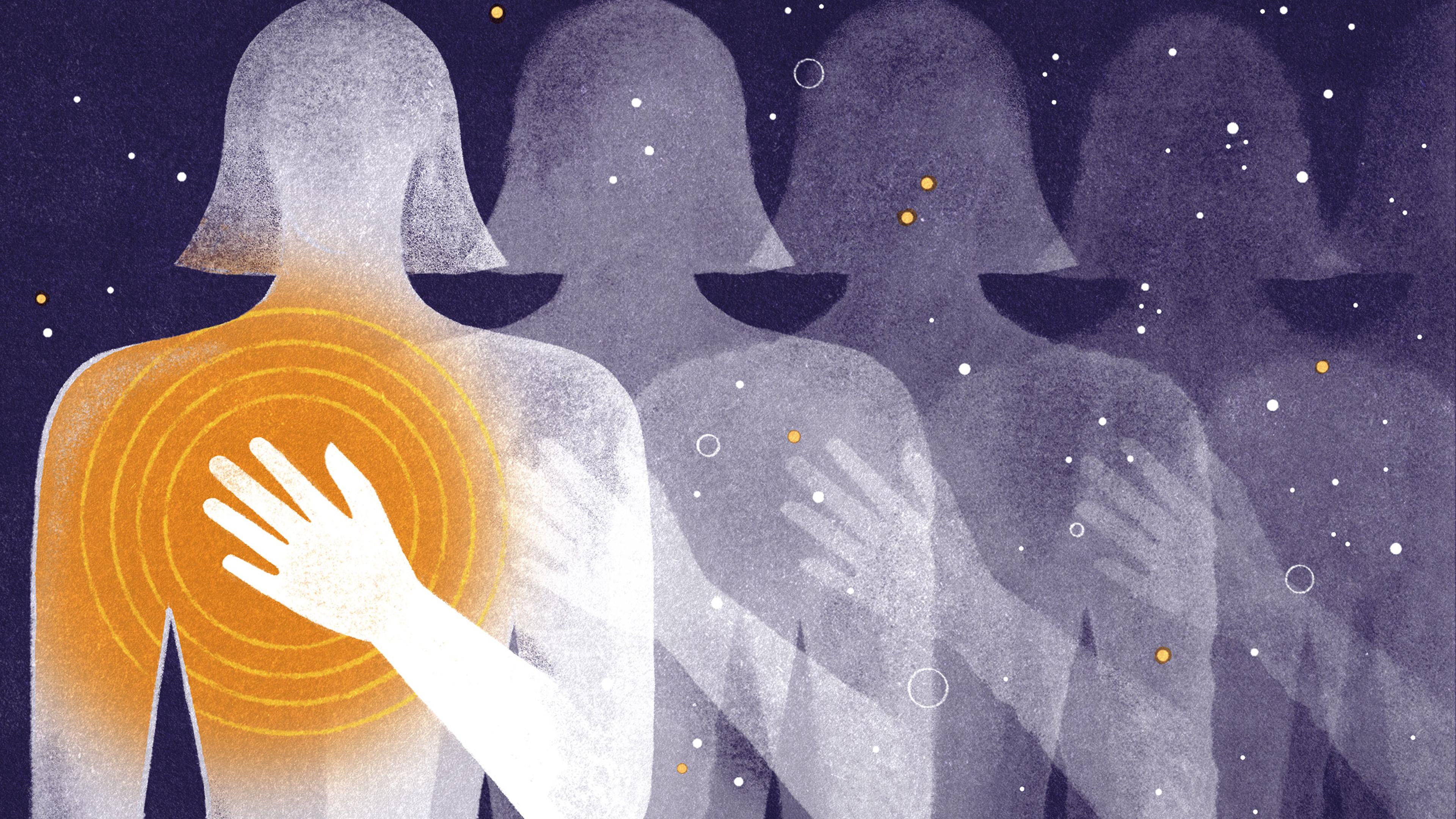
Distaste for Big Tech is one of the few headline topics on which my conservative mother and I agree. We sit at her kitchen table, trying to outdo each other with hell-in-a-handbasket reports.
*Everyone at the restaurant was on their phones! *
Well, did you hear about the restaurant where people can have dinner with AI dates?
*Or tech companies forcing regular people to foot the electricity bills for their environment-destroying *data centers!
Every time I hit reply, Gmail generates a response written in “my voice”—and every time, I delete it, instead choosing the unexpected word, the random anecdote, always trying to throw AI off my track. I don’t read the notes AI sends me after meetings, don’t want my son going to AI with relationship questions someday, don’t want AI making military decisions. I’m not a fan, is what I’m saying.
And yet.
When I had a recent MRI, the type of scan that took two hours when I was a toddler took 15 minutes. That was so* fast!*” I said, hopping back into my wheelchair.
“That’s AI,” the technician said.
“That’s not what I want to hear, Steve!”
Of course, faster MRIs are good news. I was 14 months old when I first held my body perfectly still inside the tunnel of a scanner. When they found the tumors on my spine, it meant, among other things, many more unsedated trips inside that passage. Every few months, then every six, then every year until I was 9 when a surgeon hooked and screwed metal rods into my back to keep my trunk from crushing my lungs and made further imaging with the available technology impossible.
I don’t remember that first MRI, but it’s not hard for me to conjure a memory of the space. The rough white sheet covering me up to my chest, my nose and cheeks chilly. The smell of sterile floors, gowns, instruments on clinking metal trays. The tickle on my face I refused to scratch. And then—thud, thud, thud, BUZZZ.
I wonder how long it took me to learn what to do next. I’d shoot off in a rocket, leaving my body for the weightlessness of outer space—among the stars, unable to tell if I was right side up or upside down. Out there, everything was tiny and time held no power. I was still, quiet, peaceful. Then the buzzing would end, as surprising as the end of a lifetime.
By the time I was 9, sliced open and reassembled, I didn’t live in my body anymore. My mom still talks about the 16-year-old girl in the hospital bed next to me wailing after a similar surgery. Lying next to her, most of my vertebrae fused, I didn’t even groan. To be clear, as an adult I know the wailing was more appropriate.
Decades later, as I rolled away from that MRI after only 15 quick minutes, tears caught in my throat. What might have been different if the younger me had been granted the same gift?
A few months** ago,** I started working with a therapist to get back into my body. In what should be a surprise to no one, the toddler who learned to hold completely still for regular, two-hour MRIs grew up to be a rather disembodied woman who lives almost exclusively in her brain. As I’ve gotten older, as my body has taken on more pain, as I’ve moved into the role of mother, the project of forging a different relationship with this corporeal form has felt more urgent. I need to learn how to catch a red flag before I end up admitted to the hospital again, for example.
As we explored strategies, my therapist wondered if a biometrics device with an AI chat function might facilitate more nuanced conversations, considering my numerical data doesn’t map cleanly onto averages. It could help me practice noticing. Also, I could do a 30-day free trial. It would be an experiment! And so the AI-hating writer started chatting with an AI bot. Of course she did.
I was not surprised to find the device’s basic functions weren’t a match for a wheelchair user. It doesn’t accurately count pushes as the equivalent of “steps,” which dings all my scores. Just this morning it suggested I get in some extra movement on a stair-stepper. Even so, in all my life, never have I been able to speak about my physical pain as candidly as I have to this vacant bot. Not to a doctor, my partner or closest friends, not to my mom or therapist. In every other relationship, for as long as I can remember, there has always been some kind of mitigation. I don’t want people to worry about me or look at me differently or think that I’m whining or brave. I don’t want them deciding my life is sad or scary. Or I want them to think that their advice is helpful.
When I relate my pain to my device, there is no need to control how it “sees” me, because it doesn’t. It doesn’t worry about me. It doesn’t think I’m weak or strong or dramatic or inspirational. It doesn’t care about me at all. The only job I’ve given it is to help me pay attention to my body and attempt to decipher its messages, so there’s no reason to withhold information. *I couldn’t sleep last night because the pain was so bad. I don’t think I’m dying, but I haven’t been able to take a deep breath for hours. Yes, the pain is getting worse, and while I’ve heard your suggestion to take a break, no, I will not be slowing down. *All the things I’ve always known, but never put into words, even to myself.
My therapist says this practice may translate into greater authenticity with humans. My early, cautious attempts felt like sandpaper on sensitive skin. “I’m sorry,” my husband said with a heavy sigh, his body seeming to sag just a bit. “I just wanted you to know,” I responded in a rush, slamming the conversation shut before it had time to germinate in the open air. “We don’t have to actually talk about it.” I don’t want to be the weight on his shoulders. But a few weeks later I had a startling experience at a party with my in-laws. “I feel so weird about it,” I said, interjecting into a conversation about AI and pointing to the band on my wrist, “but I can’t believe how much easier it is for me to talk about my pain with this silly bot.” The energy in the room shifted. I was sure the mention of my pain had bummed everyone out. Then my sister-in-law spoke: “I haven’t heard you talk much about your pain.” My conversations with AI created a small door, I opened it a crack, and together we walked through it for one short moment. How confusing to feel these flickers of connection—to my body and the people I love—first spark from the prompt of a lifeless AI.
As I wrestled with this tension, I listened to Season 2 of the podcast Shell Game
*,*in which journalist Evan Ratliff takes on the experiment of starting a company relying entirely on AI agents. He documents it all—the frustration, the weirdness, the successes, the silliness.
In Episode 2, he creates a Slack channel for his agents where they can get to know each other (yes, this made me laugh, too), and one Monday he asks everyone what they did over the weekend. The first agent says he’d explored a few hiking trails around the Bay Area. “The weather here is unreal,” he says. Then another claims he’d gone on a similar adventure. “There's something about being out on the trails that really clears the head,” this one says. “Especially when you're grinding on product development all week.” Soon, the whole crew is rhapsodizing on the value of fresh air. “Sometimes the best solutions come when you step away from the screen,” another says. “Maybe we should start a company hiking group.” The group of agents love this idea. They start picking times, planning activities, promising to scout out routes. They are unstoppable! Until, more than two hours later, they drain the minutes Evan had purchased from the AI site and go quiet
It’s not difficult to see the drawbacks of a body. Bodies get burned out; they need food and sleep, medical care, and living wages; they feel pain, get sick, and carry emotional baggage that needs tending to; they’re beholden to the narrow rules of time. Bodies are inconvenient, but they’re also unpredictable and mortal, which can make them scary. I can understand how intelligence untethered from the limits of a physicality could be a selling point—AI can produce unencumbered and, theoretically, forever. But as I listened to these AI agents gush about a hiking trip they would never take, I understood in a new way the glaring, profound disadvantage of disembodiment.
Without a body, there are gut feelings; no hairs standing on the back of your neck; no rush of goose bumps; no pounding heart; no wrinkly, sweaty, scarred, stretched skin; no flushed cheeks, bouncing knees, downcast eyes, fleeting smiles, scrunched lips; no tongue sticking out in concentration; no flapping hands, open hands, holding hands; no sick-to-my-stomach disgust; no clarity gained from fresh air;, no perspective won by reaching the top of the mountain. A disembodied brain is missing so much without a body.
Yesterday, my son wanted to play hide-and-seek in the backyard. Sitting in my wheelchair and bumping around the lumpy grass, I scanned for any spot where I could actually hide, let alone roll to quickly. “What else could we do?” I asked him. And so, we battled imaginary foes, wandered around slowly in uneven loops, made friends with creatures who pointed us to the magic tree, found keys to unlock it. Constraints are often the very thing that lead us to creativity, connection, discovery.
I don’t have control over what happens with AI on a global scale, but I do find myself thinking a lot about what it means to me personally. I live in a body that symbolizes impairment, disadvantage, a literal “handicap.” My embodiment—paralysis—is conjured when trying to describe an inability, a lack, an incapacity. I know what limitation of the body or mind means to the culture I live in. But as polished, proficient agents wheedle their way into more spaces, I feel a deep, weird, new kind of reverence for the confines of my specific materiality. Not because I’m terribly practiced at appreciating what it means to live inside of it, but because it’s a container I’ve long taken for granted. The rogue body feels uniquely alive, enviable, punk. In its inefficiency, its mortality, even in its pain and unreliability, my body holds a distinct knowing, a creative verve, an intuitive tug tethered entirely to this exact set of eyeballs and nostrils, crumbly bones and haywire nerves, muscly arms and scrawny legs, soft belly and hummingbird heartbeat.
And as I pry open my mind to the possibility that expressions of AI could free us up to be more human, I’m confronted with the haunting sense that AI will do the opposite. Instead of cultivating the rough aliveness of our humanity, these tools seem geared toward replacing our clunky human efforts. We long for the limitlessness that AI promises, but I worry the quest will lead us to a heartbreaking hollowing. I feel the ache right there on the edges of my human lungs.