[Open Source CEO by Bill Kerr](../)- Posts
- The Unexpected AI Hero (Newsletters)
How to convince AI you are the best product on the market. 🎈 #
👋 Howdy to the 3,435 new legends who joined since our last edition! You are now part of a 534,234-strong tribe outperforming the competition together.
LATEST POSTS 📚
If you’re new, not yet a subscriber, or just plain missed it, here are some of our recent editions. ✨ My Public Speaking Journey. How to wield words like a champion and convince people of your plight.
🎨 Inside Canva's Conversational & Agentic AI Era. An interview with Danny Wu, Head of AI Products at Canva.
🍒 The Perfect Onboarding In 7 Simple Steps. How to set your new members up for success from day one. **PARTNERS **💫
Meetings aren’t the problem. The challenge is everything that comes after them. With Granola, the AI Notepad for people with back-to-back meetings, it's no longer about scrambling to keep up.
Take notes the way you always have. Granola works in the background, turning conversations into clear summaries, action items, and next steps. Before, during, or after a meeting, you can chat with your notes to quickly understand what needs to happen, write follow-ups, or share context with others.
Your customers want to make their agent workflows event-driven, so you're losing deals if your API lacks reliable webhooks. Webhooks lead to deep product engagement, stronger retention, and integrated workflows, but setting up and managing webhooks is more complex than it seems. Svix has solved all the hard problems so you don't have to: retries, idempotency, security, compliance, and more.
Interested in sponsoring these emails? See our partnership options here.
HOUSEKEEPING 📨
Looks like we may have a vaccine to address cancer (melanoma) by as early as next year if all goes well. With similar studies currently underway for lung, breast, and pancreatic cancers. There may come a day soon when fighting cancer will be one vaccination away.
Vaccines are awesome. Science is awesome. Humans are awesome. On the lower end, the COVID vax alone is said to have saved at least 2.5 million lives, or, put more wildly, 14.8 million years of life. Anyway, enjoy today’s piece!
**GUEST POST **💄
When Gandalf picked Bilbo Baggins for the job, nobody thought it was a good idea. The dwarves wanted a warrior. What they got was a soft, comfort-loving hobbit who'd never left the Shire and spent the first leg of the quest whinging about forgetting his handkerchief. Turns out the wizard saw something the rest of them didn't. The unexpected hero is usually the one nobody's watching.
Right now every marketer on earth is trying to crack AI search. They're throwing money at schema, backlinks, and keyword tricks; the whole SEO armory. Wizards and warriors, swinging big. And the actual hero of this story? The humble newsletter. The channel most people wrote off years ago.
Reminiscing.
I've had a hunch about this for a while. Mostly because sponsors kept telling me their AI visibility did strange, wonderful things after running content campaigns with us, and nobody could explain why. Well, good news, my friend Heather Anne Hunter could (with a little help from my buddy Jose Perez at Vanta).
Heather is a newsletter sponsorship strategist who went full detective on it for us, and what she dug up is one of the more interesting theses I've read all year. I'll let her take it from here.
Hello everybody, * Heather* here. Digital marketing used to be about dominating SEO. Now it’s about convincing LLMs you’re worth recommending. Needless to say, the game has changed. What’s unexpected is that newsletter advertorials are winning it.
Before we go any further, yes, I am a newsletter sponsorship strategist, but this isn’t propaganda, I swear! It’s a thesis that began last year when Bill and I were discussing his newsletter sponsorship strategy. Bill casually mentioned that one brand reported the partnership had resulted in a great impact on their GEO, but nobody quite understood why or how. Sensing a boon for the newsletter industry, I decided to figure it out. | Me, after figuring it out. |
My mission to understand how AI reads the internet and why it likes editorial so much led me to the work of Andrew Holland, an SEO pro specializing in PR and ‘engineering brand fame and visibility in AI search’. Andrew has been ahead of the growing crowd of technicians, realizing that the SEO plays of old will only take your GEO results so far.
The future of content is… a shift from pull to push. From endlessly producing pages to drag people out of search engines, toward building and distributing branded assets that create memory, visibility, and fame in the market.
He further explains that SEO strategies were built around a particular interface—the interface of a technology that retrieves information. But what happens when that interface changes and now generates information instead? The competitive logic changes along with it, and expands from PageRank and TF-IDF to vector spaces and attention transformers.
Source: Growth Through Content. It’s essential to understand:
1/ The Internet is a scale-free network. Search engines and AI systems interpret it as a connected field of signals and entities rather than a flat list.
2/ LLMs are trained on the network > learn patterns from the network > and then use those patterns to answer questions.
3/ Therefore, when AI is learning about your brand, it is learning about the wider web’s pattern of mentions, authority signals, third-party coverage, and repeated associations connected to your brand.
And thus, both quality content and targeted distribution become pillars in your GEO strategy. It’s very important to note that AI favors editorial over owned channels due to the perception of authority, which we’ll get into later.
Back in the day (2023), getting your website to the top link in Google was the pinnacle of success. But since Google launched its AI Overviews 2 years ago, organic CTRs have completely collapsed. Ahrefs published in February that they’ve been reduced by 58%, meaning users are ending their searches well before the long-coveted click most digital marketers have come to rely on. That stat includes citation clicks as well, where a website is listed as a source for the AI response: only 1% of users actually click on these.
So what’s a marketer to do? In their panic and confusion, many SEO techs are attempting to earn AI citations by optimizing content for retrieval, because that’s what the interface demanded for the last 20 years. |
But while citations may seem like the obvious path, getting recommended within the right context remains the ultimate objective and requires much more finesse.
It’s one thing to have an LLM link your website as a footnote, and quite another to have it explain why your product is the best fit for a user's query. Brands explicitly recommended within AI answers can see more than a 20x higher conversion rate compared to traditional organic traffic.
We asked Jose, who runs SEO at Vanta, and he said something interesting: “It's not enough to be recommended. Are LLMs actually able to tell the narrative of my brand and my product in a way that's accurate and represents our market position?”
But being recommended isn’t something that can be hacked with keyword stuffing, backlink audits, or even schema strategy. To affect how a model recommends you, you must affect how it understands you by providing the context it needs. Models build their understanding of entities (in this case, your brand) by placing them in a multi-dimensional ‘vector space’—a massive conceptual map where related ideas all sit close together. Think of it like a galaxy where every product, problem, and piece of context has a specific coordinate. When an LLM is engaged in a complex query, it plots that query onto the map via tokenization and looks at the concepts closest to it to mathematically generate an answer.
So why do some pieces of content influence this map more than others? A mention in a top listicle or a viral social media post is like a grainy, drive-by photo of your brand. It confirms you exist, but offers very little detail. An in-depth, contextually abundant editorial piece about your brand's origin story and use case works like a high-definition 3D scanner. It feeds the model the deep layers of context it needs to map your exact coordinates with absolute precision, optimizing your brand from a blurry dot on the edge of its industry to a permanent digital landmark at its center.
Perplexity reading this rn. The reason newsletters are rarely considered for this type of technical content strategy is that they’re seen as a private channel in marketing spaces: emails are designed for inboxes, not the web. But when a publication is openly archived and thus readily indexed, it creates a sequential library of regularly refreshed, semantically rich, perfectly formatted content surrounding a particular topic. A buffet for machine readers.
Another often-overlooked benefit here is that newsletter publications tend to drive some of the most intentional engagement you can get: readers are more cognitively committed than other media consumers, and therefore an extremely high-intent audience—likely to cite, share, and reference an article in relevant spaces, amplifying its network authority signal even more.
We saw 4x the traffic we expected from the deep dive because it was being shared on Hacker News and all over products Slack groups.
an OSCEO advertorial. In fact, the readers matter as much as the publication. When someone with their own authority relevant to the topic reads, shares, or cites an article, they add that reputational weight to the signal. That downstream engagement helps show that the newsletter is not just being consumed, but is moving through a network of relevant, high-authority nodes.
Here are some additional reasons that a publicly archived newsletter is especially useful for developing AI entity recognition:
| What | Why |
|---|---|
| Clearly structured prose | Newsletters are written and edited to provide complete, high-value information and be easily understood |
| LLM native language | Plain text remains the easiest content for LLMs to parse |
| Minimal lossiness | Plain text also means a lot less is lost in translation than audio/video/image formats |
| High signal-to-noise ratio | Fewer distractions, ads, and layout interruptions for machines to sort through |
| Recency and sequential cadence | A regular publishing schedule provides repeated, time-stamped signals about the network (authors, guests, brands) over time |
| Authority stacking | A newsletter by a trusted creator in a relevant niche has both source credibility and topical relevance, AKA high E-E-A-T (SEO still matters!) |
| Topical consistency | Newsletters stay focused on a niche, so the surrounding context reinforces the same subject area repeatedly |
I’m sure there are more I could list, but you get the point. AI loves reading your favorite newsletter almost as much as you do. The best part? Nobody is really thinking about this value in terms of marketing budget yet, so the price tag hasn’t even been set.
To pull this all together, here’s the original point of inference, ignited by the Arbitrage King himself (in case you didn’t know, Bill's company Athyna is making waves in both global labor arbitrage and, more recently, intelligence arbitrage).
Open Source CEO is a great example because it combines extreme network fitness with format legibility in one place. Remember, you can’t hack preferential attachment.
The network is strong because
Bill Kerr, the entity, is already recognized as a figure within a specific tech ecosystem, and the publication speaks to (and about) other high-value readers from the same world.The format is strong because the content is mostly clean, long-form, semantically rich prose, which is easy for AI systems to parse and connect to other entities/ideas.
The articles are novel, original, and candid: they provide a vast frame of reference. Articles are frequently long-form interviews and deep dives with editorial specs rather than quick ideas or promotions.
The interviews and guest posts deepen the network without diluting it because they add even more context around the same editorial center.
The placement is not just reaching the email list; it is entering a contextual domain where the audience, author, topic, and format all reinforce each other simultaneously.
When respected people in that domain generate conversation and trust signals around the piece, it adds downstream validation and strengthens the advertorial's authority.
If I have a customer trying to conduct a platform evaluation, chances are your post is going to show up as one of the sources across the web that inform the answer for that user. I'd consider this brand evaluation value.
The result for advertisers is much more than targeted distribution to an extremely high-value audience (which is already insane ROI in itself. Why do you think I’m in this game?). A piece of sponsored editorial becomes a durable narrative asset: a public system of record that helps define what the sponsor is, who it is for, and why it belongs in that conversation. A vital node in a growing network of influence. I call these types of digital advertorials narrative capital.
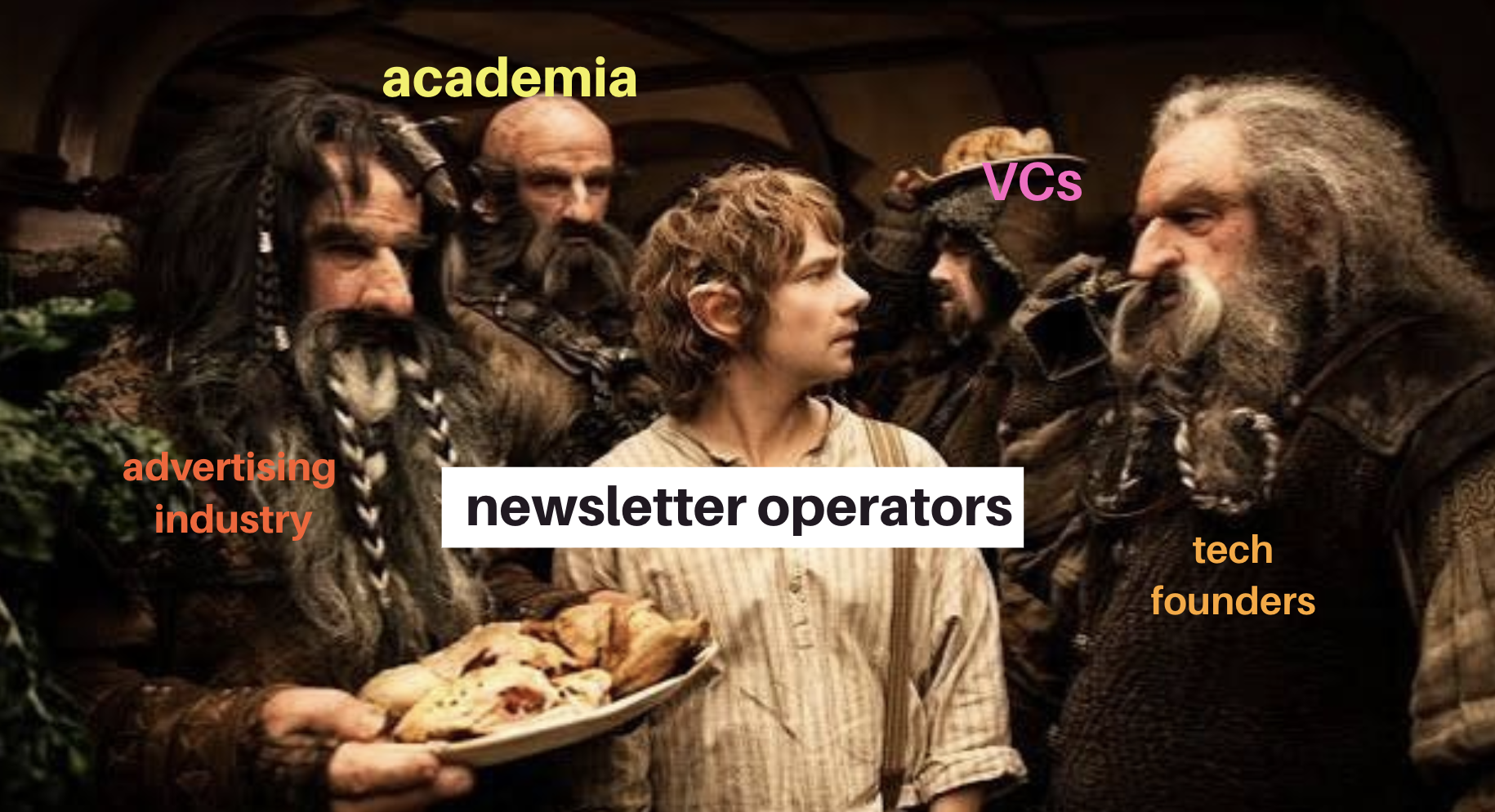
Newsletter operators everywhere after reading this.
🔥** **Note: If you’re in a hurry to deploy your own narrative capital strategy, purchase Heather’s Newsletter Narrative Capital framework here.
As we come to understand more and more of what it takes to be recommended by our favorite chatbots, let’s not throw the baby out with the bathwater: the most important factor in gaining any type of valuable endorsement is still getting humans—and now robots—to trust you. The fact remains that AI is trained on human consensus, and a well-orchestrated digital newsletter is nothing more than a high-intent network that concedes.
Truly effective marketing has never been about shouting from one's own soapbox. Word-of-mouth is the holy grail of advertising channels no matter what century or medium we look at. (Trust that ‘can’t be bought’.)
In the same way Google’s original ranking logic turned citations into a proxy for authority, modern AI systems are also learning to prefer what the wider network repeatedly confirms; much like a highly cited paper becomes more credible by virtue of who cites it and how often. And what AI finds to be preferred, it amplifies psychologically. |
With all of this in mind, I now believe that developing a digital publication is vastly more important than most understand, particularly for the voices who have traditionally been left out of or degraded by the prejudice of history. Again, AI tends to amplify the bias found in its training materials, so feeding it new and more accurate materials becomes a type of remedy.
Whether we like it or not, AI is affecting our perception of reality and therefore the reality we’re living in. Those who understand how to manipulate its view of the world hold the potential to either really fuck shit up or, hopefully, guide humanity into brighter days. Personally, I’m opting into something more solarpunk than apocalyptic technocracy, so I’m doing my part by encouraging all of you subject matter experts to write something that matters.
Contribute to the internet in a way that will help us all out. OSCEO works because of Bill’s unique editorial standards and perspective on the world, not just because he is writing to CEOs. Don’t just launch another business newsletter: create something that people will genuinely care about, however unique the perspective may be. The masses are starved for authenticity and fleeing social media for the peace of the written typed word. The more niche, genuine, original, and high-value, the better. That’s what develops trust—the influencer economy has already figured this out.
Serve the underserved, push boundaries, and remember that you are contributing to the mass library that will undoubtedly influence our fate as a species. Storytelling is fundamental to our humanity, and also happens to be increasingly profitable. Personally, I don’t think you need to choose between one or the other, but as we build this new world, we must absolutely choose our words wisely.
Annnnnnd cut. Back to late-stage capitalism.
Choose publications by fitness, not just size: Look through openly archived issues, ensure a consistent publishing cadence, and find an audience of people whose downstream signal actually matters (founders, operators, scholars, and practitioners who share and cite what they read). Use discernment in editorial integrity and in deciding whether your brand genuinely makes sense in their publication.Brief for depth, not awareness: Give the editorial team your origin story, your specific use case, the problem you solve, a concrete customer result, or whatever else does the best job of telling your brand narrative. Contextual density is what turns a placement into a mapping event. Provide as much information as possible but let the editorial team do what they do best. (Seriously. Let them write the thing.)Treat the archive link as an asset: Share it from your own channels, link back to it from your website, and encourage your team to amplify it. Every secondary mention adds a node to the network you're building. Paywalled content doesn’t get shared.Stack placements in the same ecosystem: One piece builds one node. Three pieces across three aligned publications build a cluster of reinforcing signals. Waaaay more powerful.Measure results consistently over time: For the first month or two, only RAG-first models will pick it up. But eventually, the foundational models will be trained on the narrative capital you have accumulated.
The arms race hasn’t truly started yet, and the window of arbitrage is real. Most brands don't know this mechanism exists. The world is still deciding how to interpret and measure GEO efforts. The chance to build these assets out before they become a standard line item in every marketing budget is probably now. Remember: early nodes in a scale-free network compound in ways that late entrants can't replicate. Go read some Barabási to maximize your network science content strategy.
On top of the above, AI will only become more selective in how it measures authority as it gets better at filtering noise and detecting manufactured signals. What works now because of genuine quality will become the only thing that works. So study it. Building real Narrative Capital is building real digital infrastructure—an investment that appreciates. Yep, you heard me: Ad spend that appreciates.
1970s narrative capital.
Copywriters, content strategists, and word nerds, rejoice. The time has finally come when we no longer need to write strictly for the Gods of Google. Knights of the Keyword, disband. Writers are resurfacing as the main power brokers in this new era—not the platforms, but the people with trusted voices in specific communities. Owned media will be the only media that compounds. And finally, for once, it’s a great time to be a writer.
Content marketing in an AI era: From SEO volume to brand fame- March, 2026The World’s Hottest Industry: Post-Training- March, 2026Why brand authority beats topical authority in AI search- May, 2026
BRAIN FOOD 🧠
TOOLS WE RECOMMEND 🛠️
Every week, we highlight tools we like and those we actually use inside our business and give them an honest review. Today, we are highlighting Framer*—the site builder trusted by startups to Fortune 500.
See the full set of tools we use inside Athyna & Open Source CEO here.
**HOW I CAN HELP **🥳
Hiring global talent:If you’re hiringtech, business or ops talent and want to do it 80% less, check out my startup,Athyna. 🌏See my tech stack: Find our suite oftools & resourcesfor both this newsletter and Athynahere. 🧰Reach an audience of tech leaders:Advertisewith us if you want to get in front offounders, investors and leadersin tech. 👀