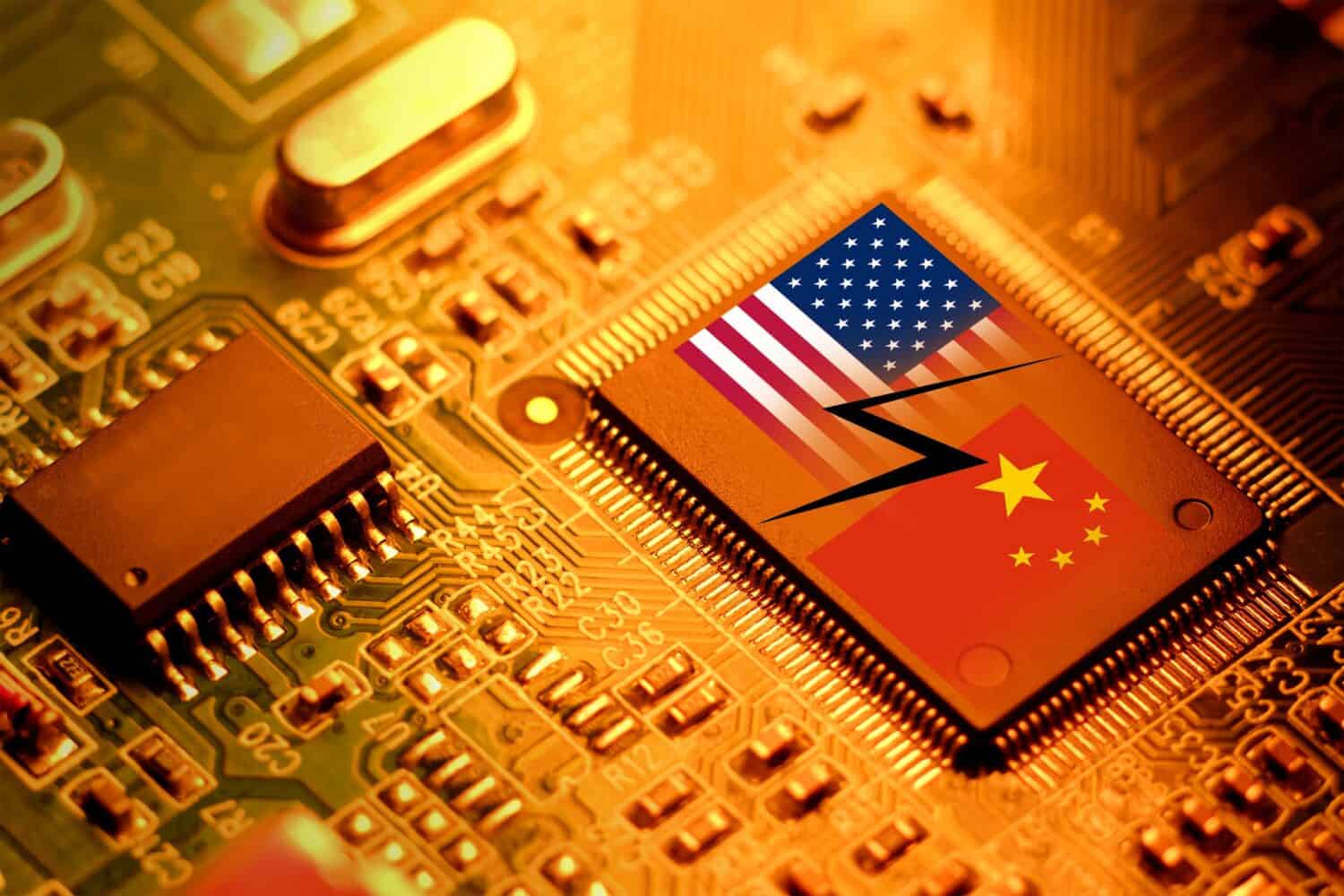
Wall Street's loudest AI bull spent Thursday morning declaring America's first technology lead over China in three decades, then named the one policy decision that hands it straight back to Huawei.
Wall Street’s loudest AI bull just declared the U.S. has taken the technology lead from China for the first time in three decades, then admitted a single policy move would hand it right back. Wedbush’s Dan Ives told CNBC on Thursday morning that “for the first time in 30 years, it’s the U.S. that actually has the lead” because of NVIDIA, the hyperscalers, and Palantir. When the anchor broke in with a Politico report that the Trump administration is weighing sweeping semiconductor tariffs covering chips, laptops, gaming consoles and data-center servers, Ives responded that “the one that ultimately wins is China tech and Huawei.”
What the Sell Side Is Pricing In #
The institutional setup on the four names Ives cites as the U.S. AI stack is uniformly constructive. On NVIDIA ( NASDAQ:NVDA | NVDA Price Prediction), the Alpha Vantage consensus target is $304.73 against a coverage panel of 10 Strong Buy ratings, 48 Buy ratings, two Hold ratings and one Sell rating.
Palantir
( carries a consensus target of $191.68 with one Strong Buy rating, 19 Buy ratings, 10 Hold ratings, one Sell rating and one Strong Sell rating.
NASDAQ:PLTR)Salesforce ( shows a $243.98 target with 35 Buy ratings against 13 Hold ratings and two Strong Sell ratings and
NYSE:CRM)CrowdStrike ( sits at a $210.53 target with 10 Strong Buy ratings and 31 Buy ratings. Institutional ownership is deep across the group: 71.2% of NVIDIA, 88% of Salesforce and 76.6% of CrowdStrike.
NASDAQ:CRWD)The fundamental data backing that positioning is stark. NVIDIA reported Q2 FY27 revenue of $96 billion, more than doubling year over year, guided Q3 to $108 billion plus or minus 2%, and told analysts it expects to grow revenue approximately 70% in fiscal 2028 on a supply-constrained basis. Ives quantified the imbalance: a roughly 12-to-1 demand-to-supply ratio, with equilibrium not arriving until late 2028 or early 2029. Palantir’s Q2 U.S. commercial revenue grew 149% year over year, Salesforce’s Agentforce ARR crossed $1.5 billion, and CrowdStrike’s AIDR ARR grew more than 250% sequentially. Reddit sentiment hit a bullish score of 74 on NVDA the morning after earnings.
Bull Case Versus Price Action #
Despite doubling revenue, NVIDIA closed at $209.66 on Aug. 26, up only 12.55% year to date and down 3.63% over the prior week. Salesforce is down 21.98% year to date, and Meta ( NASDAQ:META) is down 12.57%. Only CrowdStrike, at 61.43% year to date, tracks the exuberance in analyst decks. The
forward P/E of 24on NVIDIA against approximately 70% guided growth reads as a reasonable multiple. What the stock is pricing is policy risk, and Ives just described the exact policy that would puncture the thesis he was defending.
The options subreddit registered a sentiment score of 12 on Thursday morning while the broader stocks board sat at 76. That divergence is telling: leveraged positioning is hedging tariff headline risk even as fundamentals confirm.
Is the Smart Money Right? #
On fundamentals, yes. The demand curve Ives, Jensen Huang, Alex Karp, Marc Benioff, and George Kurtz described this earnings cycle is vertical. Huang framed it plainly: “At this moment, we have supply for 70%. Our demand is much higher than that.” On policy, the smart money is exposed. A tariff regime that extends to laptops, consoles, and data-center servers raises the cost of the AI buildout the entire bull case depends on, and it hits the power, cooling, and networking suppliers hardest (we profiled seven of them in a free report on the AI names that aren’t chipmakers).
The retail read is straightforward: Analyst targets are directionally correct on business quality, but year-to-date price action already reflects the tariff risk the sell side has not yet priced into models.
Contact [email protected] for any questions or corrections.