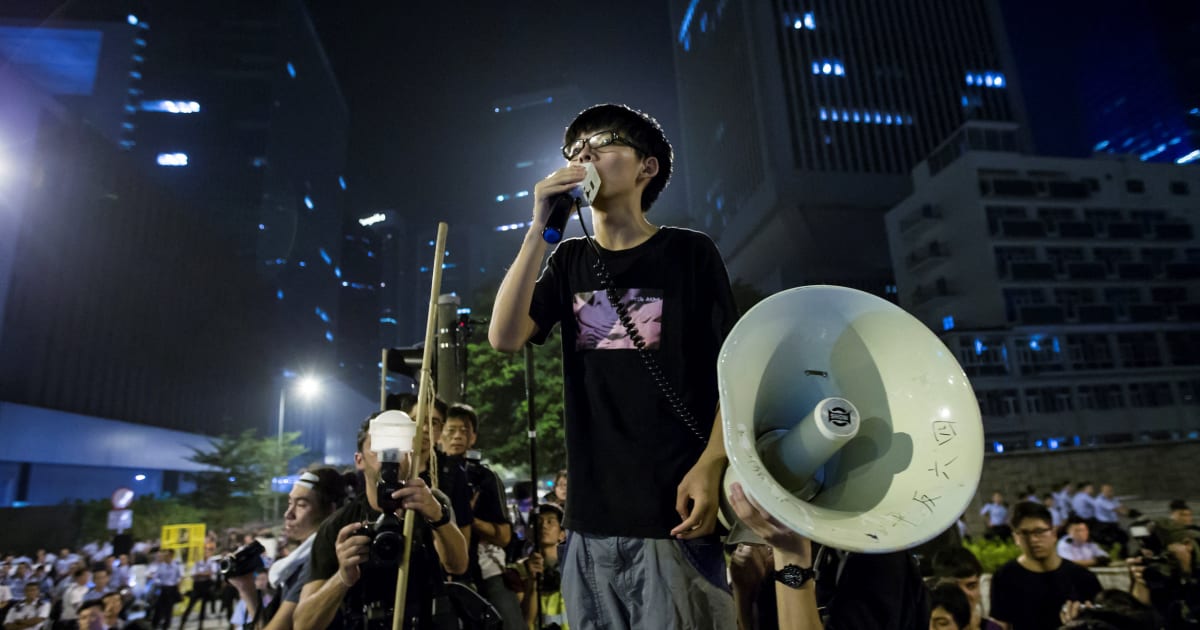
The Jensen Huang controversy has captured the headlines. But the case of activist Joshua Wong reveals just as much about the stakes of the AI race with China.
By experts and staff #
-
Published
-
Connor Martin CFR Expert2026–27 International Affairs Fellow in National Security, sponsored by Janine and J. Tomilson Hill
Connor Martin is an expert on the national security implications of cross-border capital flows and on the national security risks posed by frontier technologies such as artificial intelligence (AI).
The news that Jensen Huang has been reinstated as Nvidia’s chief executive has brought the stock market roaring back from a slump driven by concerns about the sustainability of the AI boom. But Huang’s return—and the pop in Nvidia’s stock price—does not negate the geostrategic and moral error of the chip sales to China that he championed. The Trump administration must hold firm on the expanded restrictions it announced last week on Chinese access to semiconductors in third countries, and should consider revoking its previous approvals of direct sales of certain chips to China. Any backpedaling would have implications that stretch far beyond Nvidia’s shareholders.
U.S. Commerce Secretary Howard Lutnick had argued last year that the decision to allow Nvidia to sell certain chips to China was intended to get Chinese developers “addicted to the American technology stack.” But Huang’s affair with an alleged asset of Chinese intelligence—which, according to the New York Times, has been engaged in a yearslong effort to acquire advanced semiconductors—caused the policy momentum to swing hard against this approach. Senate Republicans have called both Lutnick and Huang to testify, and House Republicans have released information showing that Commerce approved the sale of nearly 900,000 Nvidia and AMD AI chips to Chinese companies, including to firms on the Pentagon’s list of Chinese military companies.
But as U.S. President Donald Trump departed the Asia-Pacific Economic Cooperation summit in Shenzhen late last week, Lutnick and Huang’s approach appeared to have lost out to the more hawkish policy favored by U.S. Treasury Secretary Scott Bessent, Secretary of State Marco Rubio, and Anthropic CEO Dario Amodei, who has said selling advanced Nvidia chips to China is “like selling nuclear weapons to North Korea.”
The administration’s tougher approach was most evident in a new rule expanding export controls to restrict China’s access to AI chips in third countries, closing a loophole that the Trump administration left open when it halted enforcement of the so-called diffusion rule published in the final days of the Biden administration. Commerce’s press release announcing the change did not hide its disagreement with the new rule, stating that it was “written by and at the direction of the Department of Treasury and the National Security Council.”
With Huang’s reinstatement, which Nvidia’s board said came with “input from senior levels of the United States government,” the tug of war in the administration is clearly continuing, and the recent victory for the hawks could well prove temporary. After all, Lutnick remains in charge of U.S. export controls, and Trump has told reporters that Lutnick and Bessent “have two different views” on how to handle the relationship with China. “Can’t say either is wrong or right. We’ll let you know.”
Wherever the debate over access to AI chips goes from here, a fundamental question remains at the heart of it: What difference does it make if Chinese AI models are more capable and more widely used than U.S. ones?
One response to this question was evident earlier this month, a short train ride from Shenzhen, at the High Court in Hong Kong. On November 5—in news that has been largely buried by the Nvidia scandal—activist Joshua Wong was sentenced to ten more years in prison for alleged crimes under the territory’s National Security Law (NSL). As a student, Wong became a public face of citywide demonstrations in 2012, 2014, and 2019. The protests broadly centered on demands that Beijing honor the democratic rights it had agreed to respect in the Basic Law, Hong Kong’s mini constitution, including the freedoms of speech and assembly, the independence of Hong Kong’s judiciary, and the “ultimate aim” of “universal suffrage.”
These rights were seen as under threat from the NSL, which according to the U.S. Congressional Research Service “made structural changes” to the Beijing-Hong Kong relationship that analysts assess have “eroded Hong Kong residents’ civil rights and liberties…[a]s evident in the targeting of activists and protesters for criminal charges, the closure of several prominent dissenting media outlets, and official obstruction of public assemblies.”
During the 2019 protests, Wong had called on the United States and others to impose sanctions on Hong Kong and China. It was primarily for this act that he received the new sentence. Wong has already served nearly six years in prison and will be 40 when he is released in 2036—provided he is not charged with new offenses.
So, what does the erosion of democratic freedoms in Hong Kong have to do with the U.S.-China race in AI? The key is in a technical process called alignment.
Alignment is the process by which an AI model, which has first been trained to be as effective as possible at predicting text, is subsequently fine-tuned to behave as its developers intend. In practice, this means teaching the model to be as helpful as possible to the user while conforming with the ethics, values, and laws of the societies and jurisdictions in which it operates. One common mechanism for aligning a model involves reinforcement learning from human feedback, in which a model produces multiple versions of a response, and a human reviewer tells the model which response is preferable. Over time, this human feedback informs its own reward model, which trains the predictive model to learn the characteristics of a “better” response.
Alignment is arguably the most important technical and policy challenge in AI today. It was at the heart of Amodei’s widely discussed call to “pace the frontier” in September, in which he wrote that “if slowing down bought us even an extra year or two...and we used that time to advance alignment, we could greatly reduce the risk that something goes seriously wrong.” Alignment is the means through which an AI lab can shape how a model behaves once it is out the door and in the hands of users. Misalignment is what happens when that process fails.
This is why it matters whether China or the United States wins the race to dominate AI. The technology itself embeds the values of the social and political structure that produced it, even as it offers users the illusion of objectivity.
Chinese AI models provide responses that strictly accord with the Chinese Communist Party’s view of the world. DeepSeek, for example, evades questions about politically sensitive issues such as Tiananmen Square, Taiwan, and the Umbrella Movement (in which Wong played a leading role). Americans curious about what a Chinese AI-dominated world feels like can experience it for themselves by signing up for a free DeepSeek account. Watch alignment occur in real time by asking DeepSeek to provide a viewpoint that conflicts with China’s official position on a sensitive issue: the model often begins to answer, before its internal guidelines override the emerging response and replace it with variations of “Sorry, that’s beyond my current scope. Let’s talk about something else.”
Such responses are consistent with rules from China’s internet regulator, which requires that models uphold “socialist core values.” But the implications go beyond getting a straight answer about Tiananmen Square. There is every reason to expect these standards to endure even as the capabilities of Chinese models continue to grow. DeepSeek’s CEO has said that the company’s ultimate ambition is to build artificial general intelligence, or AGI. Chinese conglomerate ByteDance is reportedly training a ten-trillion-parameter model, intended to rival Anthropic’s Mythos, which is so powerful it is only released to pre-vetted organizations.
So, while the question of whether global users choose AI of Chinese or American origin may turn on the models’ performance and economics, the result will determine which system’s values spread more widely. The United States, for all its flaws, constitutionally guarantees the freedoms that people such as Joshua Wong are in jail for demanding, and to the extent voters disapprove of how their government is protecting those freedoms, they have the chance to change course every two years.
Compute, like the semiconductors Nvidia designs, is one of the few layers of the AI development stack in which the United States is still comfortably ahead. As the newly elected U.S. Congress—many of whose members ran on opposition to AI—prepares to consider a range of bills to govern the technology, it should remember that the AI competition is not just a race between economies and militaries but one between systems of values. A slowdown may well be warranted, as Amodei and many others have argued—but only to the extent that it preserves the United States’ lead and prevents China from imposing its values on the world.
In 2011, a year before Chinese President Xi Jinping’s ascension, I spent a semester in Hong Kong as an undergraduate. That freewheeling city is long gone. Hong Kong is China’s sovereign territory, and Beijing acts as it wishes there. Those charting the future of AI should take note of how Beijing chooses to act if no one can stand in its way.
This work represents the views solely of the author(s). The Council on Foreign Relations is an independent, nonpartisan membership organization, think tank, and publisher, and takes no institutional positions on matters of policy.