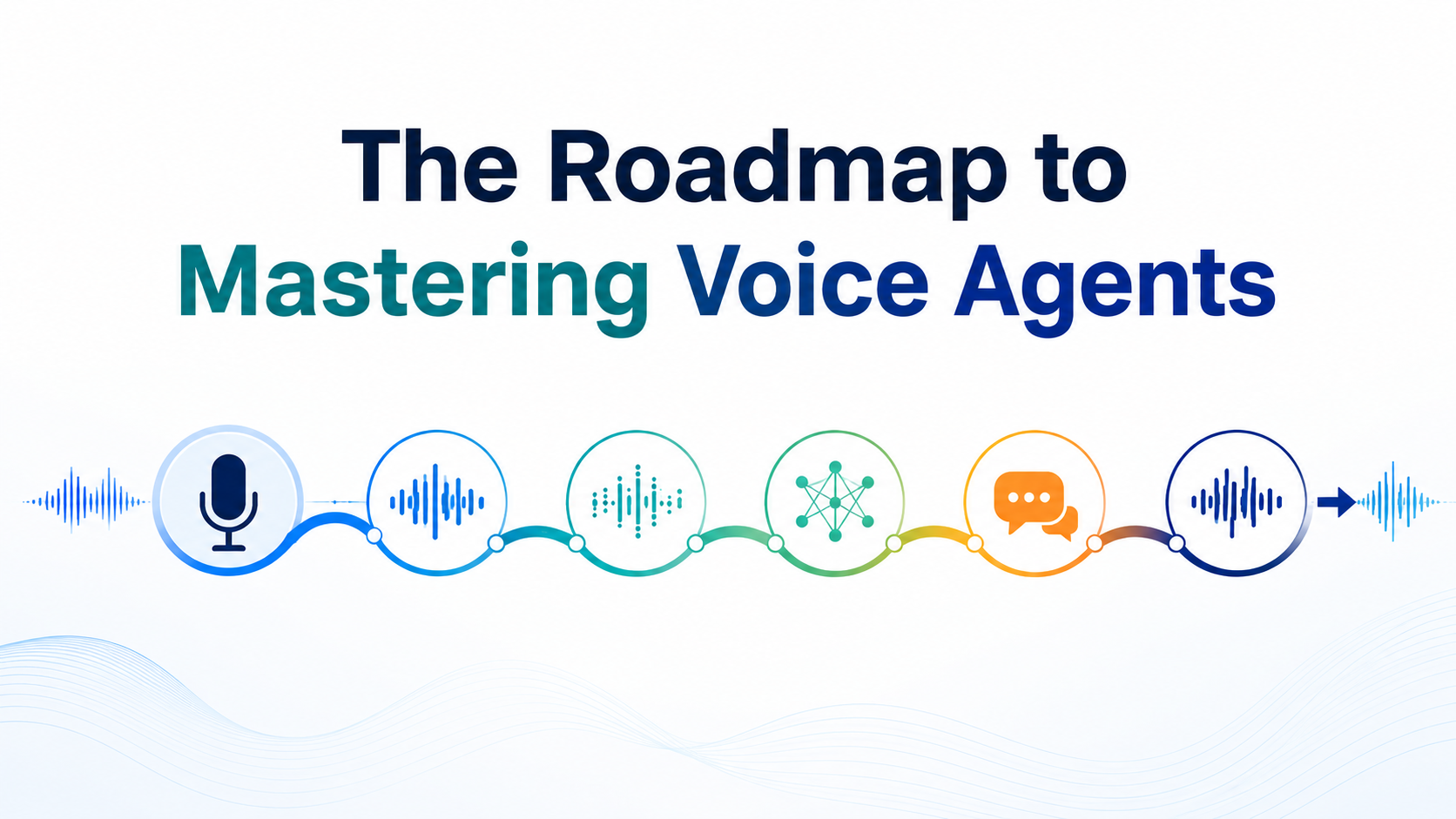
In this article, you will learn what voice agents are, how they differ from text-based AI systems, and how to build your knowledge from the ground up using a structured seven-stage roadmap.
Topics we will cover include:
- The core three-stage pipeline that defines how voice agents work, from speech-to-text through language processing to text-to-speech.
- The key ways voice agent development differs from building text-based agents, including latency, conversation design, and compounding errors.
- A seven-stage learning roadmap that takes you from foundational concepts through deployment and advanced specializations.
Introduction #
Voice interfaces are no longer a novelty. They’re quickly becoming the standard way people interact with AI systems, from customer service bots to healthcare assistants to smart home devices. If you’ve spent time learning about large language models (LLMs) or text-based agents, you already have a strong foundation. Voice agents build on many of the same ideas but add one important layer: the ability to listen, understand, and respond in natural spoken language.
This tutorial introduces what voice agents are, how they differ from text-based systems, and lays out a clear learning roadmap for building your knowledge from the ground up. By the end, you’ll have a clear picture of what it takes to go from concept to working voice system.
What Is a Voice Agent? #
A voice agent is an AI system that communicates through spoken language. It listens to what a person says, interprets the meaning, decides how to respond, and delivers that response as speech in a way that feels natural and conversational.
Think of a voice agent as a text agent with two additional layers wrapped around it. On one side, audio comes in and must be converted to text before the agent can process it. On the other side, text must be converted back to audio before the agent can speak its response.
This structure gives voice agents three distinct stages that text agents don’t require:
Speech-to-Text (STT): The system listens to a user’s spoken words and transcribes them into text. This is sometimes called Automatic Speech Recognition (ASR).
Language Understanding and Response: The transcribed text is passed to an LLM or similar reasoning system. This stage works almost identically to a text agent. The model interprets the input, retrieves information if needed, and generates a response.
Text-to-Speech (TTS): The text response is converted back into audio and played to the user through speakers or a phone line.
These three stages run sequentially and must complete quickly enough that the conversation feels natural. Delays of even a second or two can make a voice agent feel clunky or unresponsive, and that constraint shapes almost every design decision you’ll make. Which brings us to one of the most important questions about voice agents: how do they actually differ from text-based systems?
How Voice Agents Differ from Text Agents #
Now that we have a picture of the core pipeline, it’s worth pausing on what makes voice work genuinely different from building text agents. If you’re coming from a background in LLMs or chat-based systems, several of these differences will reshape how you approach design decisions.
Latency matters much more. In a text-based chat interface, a user can tolerate a few seconds while waiting for a response to appear. In a spoken conversation, that same delay feels like an awkward silence. Voice agents need to respond quickly, which affects every design decision from model selection to pipeline architecture.
There is no visual formatting. Text responses can use bullet points, headers, bold text, and code blocks to organize information. Spoken responses cannot. A voice agent must communicate everything through sentence structure, pacing, and word choice alone, so responses need to be shorter, cleaner, and structured to make sense when heard rather than read.
Interruptions and turn-taking are natural. In human conversation, people sometimes speak over each other, correct themselves mid-sentence, or change direction. Voice agents need to handle these dynamics gracefully, something text agents never encounter.
Audio quality affects performance. Background noise, accents, speaking speed, and microphone quality all influence how accurately the STT layer transcribes speech. A voice agent working in a quiet office may perform very differently from one deployed in a noisy retail environment.
Errors compound across stages. This last point is especially worth keeping in mind. If the STT layer mishears a word, the language model receives incorrect input and generates a response to the wrong question. The TTS layer then speaks that incorrect response aloud. Each stage in the pipeline is a potential point of failure, and mistakes in early stages affect everything that follows.
Together, these constraints make voice agent development a discipline that rewards careful, end-to-end thinking.
Why Voice Agents Are Worth Learning #
Given these added complexities, you might wonder whether voice agents are worth the extra effort. The answer becomes clear when you look at where the field is headed. The practical applications are expanding fast, and industries across the board are actively deploying them.
- Customer service : Automating call center interactions for banking, insurance, utilities, and retail.
- Healthcare : Handling appointment scheduling, symptom triage, and medication reminders.
- Education : Providing conversational tutoring and language learning practice.
- Accessibility : Serving users who can’t easily read or type due to visual impairments or motor limitations.
- Smart devices : Powering assistants in homes, vehicles, and wearables.
For anyone already working with text-based AI systems, voice agent skills open doors to a much wider range of deployment scenarios. And with a clear roadmap, the path from foundational understanding to real-world deployment is more straightforward than it might appear.
The Roadmap: Building Your Voice Agent Knowledge #
Learning voice agents well means working through several interconnected layers of knowledge. The roadmap below moves from foundational to advanced, so you can build understanding progressively rather than jumping in at the deep end. Each stage connects directly to the next, and skipping ahead tends to create gaps that cause confusion later.
Stage 1: Understanding the Core Pipeline
Before building anything, you need a clear mental model of the three-stage pipeline: STT, language processing, and TTS. Spend time understanding what happens at each stage, what can go wrong, and how the stages connect to each other.
Key questions to answer here: What formats does audio data come in? How do STT models handle noise and accents? What is word error rate and why does it matter? How do TTS systems differ in quality and expressiveness? Getting comfortable with these questions builds the intuition you’ll need for every stage that follows.
Stage 2: Learning the Language Processing Layer
With the pipeline structure in mind, the next step is to go deeper on the layer at its center. If you already have experience with LLMs or text agents, this stage will feel familiar. The language processing layer in a voice agent works the same way as in a text agent: a model receives input, reasons about it, and generates a response.
The differences are in the constraints. Responses must be short and conversational. The model can’t use formatting. It must handle incomplete or imperfectly transcribed input gracefully. Understanding prompt engineering for voice-specific constraints is a key skill at this stage, and one that pays dividends throughout the rest of the roadmap.
Stage 3: Exploring Real-Time and Streaming Architectures
Building on your understanding of the pipeline and its language layer, you can now tackle one of the most distinctive engineering challenges in voice: latency. Standard text agents can afford to wait until a full response is generated before displaying it. Voice agents often can’t.
To reduce perceived latency, many voice systems use streaming, where text is sent to the TTS layer incrementally as the language model generates it rather than waiting for the complete response. This stage involves understanding how streaming works, what tradeoffs it introduces, and how to architect a pipeline that delivers fast, fluent responses without sacrificing accuracy. This is where the abstract pipeline starts to feel like a real system.
Stage 4: Studying Conversation Design
This is where things get interesting, and where many technically strong developers are surprised. Building a voice agent that works technically is only half the challenge. Building one that users actually enjoy talking to requires deliberate conversation design.
This discipline draws from linguistics, user experience research, and human factors. It covers how to write prompts and responses that sound natural when spoken, how to handle misunderstandings gracefully, how to design turn-taking logic, and how to give a voice agent a consistent personality.
The difference between a voice agent that feels robotic and one that feels genuinely helpful is usually in the conversation design, not the underlying model. You can have a capable LLM at the core and still produce a frustrating experience if the conversation design is poor.
Stage 5: Integrating Tools and Memory
With a well-designed conversational core in place, the next layer is about extending what your agent can actually do. Just like text agents, voice agents can call external APIs, look up information, or take actions in the world. A voice agent handling customer service calls, for example, might look up account information, process a payment, or schedule a callback.
Memory is equally important. Voice agents that can remember context across a conversation, or even across multiple conversations with the same user, deliver a much better experience than those that treat every interaction as a fresh start. This is where agents start to feel less like scripts and more like genuine assistants.
Stage 6: Deploying and Evaluating
Getting a voice agent into production introduces a new set of considerations that don’t apply to text agents. You need to think about telephony infrastructure if the agent will operate over phone calls, real-time transcription costs at scale, audio encoding formats, and latency monitoring.
Evaluation is also more complex than you might expect. You can’t simply read a transcript and judge quality. You need to listen to recordings, measure task completion rates, track where conversations break down, and iterate on both the pipeline and the conversation design. This feedback loop between deployment data and design improvements is what separates good voice agents from great ones.
Stage 7: Advancing into Specialized Topics
Once the foundations are solid, several advanced areas are worth exploring. Multilingual voice agents require additional care at both the STT and TTS layers. Emotion detection lets agents respond differently based on a user’s tone. Voice cloning and custom voice creation allow organizations to build branded audio identities. Real-time interruption handling makes conversations feel genuinely bidirectional.
These topics build directly on everything covered in the earlier stages, which is why they reward the patient, sequential approach the roadmap recommends.
Where to Start #
The right entry point depends on where you’re starting from, and it’s worth being intentional about this before diving in.
If you’re comfortable with LLMs and text agents, start with Stage 3 after a quick review of Stage 1. Your language processing knowledge is already strong, so focus on what makes voice pipelines different structurally.

If you’re newer to AI systems generally, follow the roadmap in order from Stage 1. Each stage builds on the previous one, and the progression is designed to make each new concept feel grounded rather than abstract.
The key is to treat voice agent development as a discipline that combines technical skill with communication design. The best voice agents are both technically functional and genuinely pleasant to talk to.
Conclusion #
Voice agents extend text-based AI systems by adding the ability to communicate through spoken language. The core pipeline (STT, language processing, and TTS) builds on concepts you may already know, but introduces real new challenges around latency, conversation design, and audio quality.
What makes voice agent development interesting is precisely this combination: solid engineering fundamentals alongside a thoughtful approach to interaction design. The technical pipeline gets your agent working. The conversation design makes it worth talking to.
The seven-stage roadmap above gives you a structured path from foundational understanding through deployment and advanced topics. Work through the stages in order, test your knowledge at each step, and you’ll be well positioned to build voice agents that hold up in production.