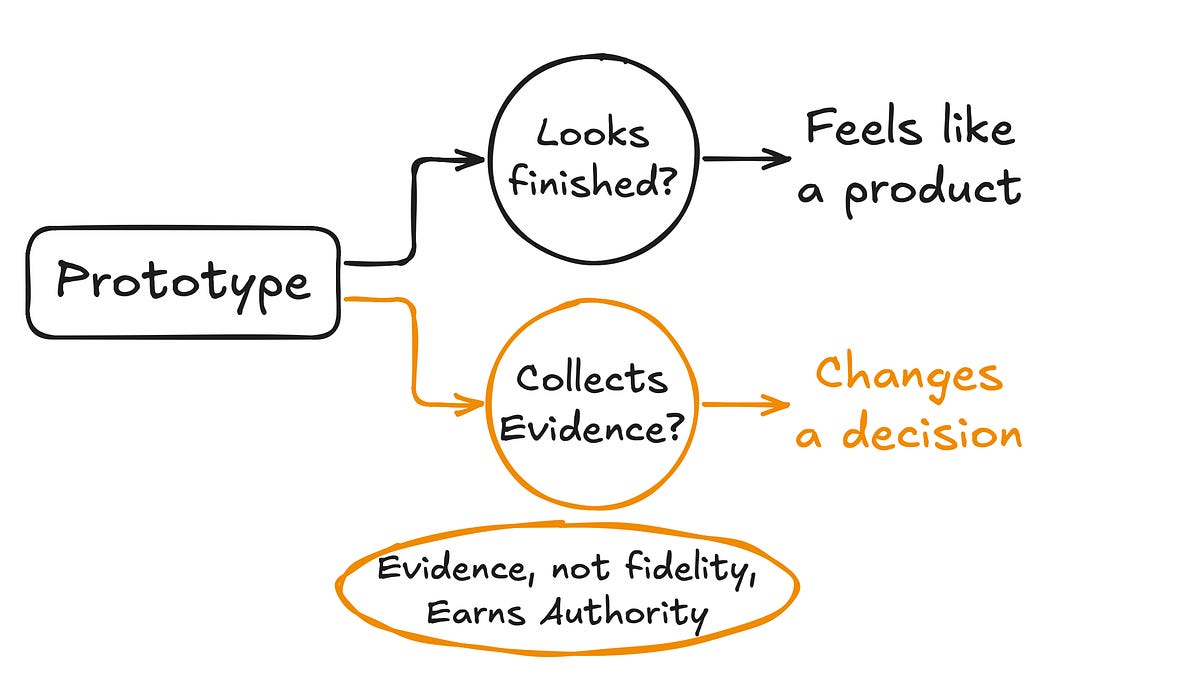
Use AI to turn disagreement into evidence without mistaking a polished demo for a product decision.
A product lead wants a natural-language setup flow for a developer tool. One engineer thinks it could remove most of the friction from the first integration. Another worries that authentication, error recovery, and the current SDK contracts will make the experience brittle. A staff engineer sees a different risk: if the demo looks convincing, it may become a roadmap commitment before the team understands what it would take to operate.
The team could spend another week improving the design document, or it could build a narrow prototype and put the disagreement in front of real evidence.
AI changes the economics of that choice. For throwaway prototypes, I have felt the speed gain directly: a proof of concept that once took two or three days can now land in an afternoon. That makes implementation cheap enough to use during the decision process, not only after the decision has already been made.
But AI makes the artifact cheaper, not the evidence. Once people can click through the flow, call the API, or watch the agent complete a task, the discussion shifts from “Should we build this?” to “What would it take to ship what we already have?”
The artifact has started answering a question nobody agreed to ask.
My recommendation is to build the disagreement when implementation can produce evidence, but treat the prototype as an expiring question rather than an early product. Before anyone prompts an agent, define what the prototype may prove, which shortcuts limit that conclusion, when its mandate ends, and what happens to the implementation afterward.
None of this is unique to AI. “What Do Prototypes Prototype?” frames prototype focus as a choice about which open design questions to examine, while “The Anatomy of Prototypes” describes prototypes as filters over a broader design space. AI changes how quickly a functional, convincing artifact can appear—and, I would argue, the organizational pressure to treat an answer-shaped artifact as a product.
When this rubric is worth using
Not every sketch needs a formal hypothesis. If two engineers are exploring a low-risk implementation detail for an hour, let them explore.
Use the rubric when the artifact could influence: roadmap scope or a customer promise;
an architectural or integration decision;
a production or security boundary;
a cross-team commitment; a claim about user behavior;
whether generated code becomes part of a maintained system.
The point is proportionality. Five lines written before two days of implementation are not heavy governance. They protect the team from spending the next six months maintaining an answer to the wrong question.
The prototype decision card
Every consequential prototype should begin with five fields:
Question
Evidence
Shortcuts
Expiry
Disposition
This is not a new approval process. The decision boundary must travel with the artifact. Keep the card inside the issue, design document, or pull request description, and put the question, expiry date, and status on the prototype itself. A forwarded link, screenshot, or recorded demo should still say what the artifact was designed to test and whether it is approved for production or customer commitments.
Prototype for:Expired-credential recovery
Expires:18 July
Status:Not approved for production or customer commitments
Decision card:Linked with this artifact
1. Question: What decision should change?
Name one decision the prototype will inform.
“Can we build this?” is usually too broad. Almost anything can be made to work once under favorable conditions. Narrower questions force the team to identify the disagreement underneath the implementation:
Can a target developer finish the first integration without leaving the guided flow?
Does the current API contract support recovery from an expired credential?
Can this architecture meet the latency target when one dependency degrades?
Can the agent handle the representative failure cases without taking an unsafe action?
A useful question has consequences. Before building, state what the team will do after a positive result and what it will do after a negative one:
If the result is positive, we will [action]. If it is negative, we will [action].

If neither result would change the decision, the team is not running an experiment. It is producing a demonstration. If the evidence lands between the predeclared criteria, call the result inconclusive and write a new card rather than rewriting the first question.
2. Evidence: What would count as an answer?
State what the team will observe or attempt, who will do it, and which results will count as positive, negative, or inconclusive. Define those criteria before seeing the artifact, so the team cannot move the goalposts after the prototype starts persuading people.
The evidence must match the question. A usability claim requires target users attempting the task. An operational claim requires load, failure, recovery, or maintenance evidence. A claim about agent reliability requires a representative evaluation set, not one impressive trace selected for the demo.
In “Prototyping with Prompts”, a CHI 2025 design study, researchers observed 39 industry practitioners across 13 team sessions as they prototyped prompts for a generative AI marketing application. The authors describe two layers of evaluation: teams assessed output validity and correctness while considering whether end users could understand and meaningfully interact with it. They also found that assumptions about cultural norms, user behavior, content formats, and conceptual abstractions could remain implicit and undocumented. This suggests that greater fidelity can expand what a team is able to inspect, but it does not determine which evidence a decision requires.
3. Shortcuts: What is intentionally unlike production?
List every condition that is fake, stubbed, omitted, unreviewed, not tested at scale, incomplete, or unusually favorable.
Typical shortcuts include:
mocked billing or permissions;
a test tenant instead of a real account;
one supported language or environment;
clean data that excludes known edge cases;
no production secrets or security review;
a single happy path;
manual intervention hidden behind an automated-looking flow;
generated code nobody has reviewed for maintainability.
Shortcuts are not a failure. They are what makes a prototype cheap. But a shortcut may only narrow the conclusions the team can draw; it cannot waive non-negotiable privacy, security, legal, or safety requirements.
Mocked billing may be irrelevant to a navigation test and fatal to an integration-feasibility claim. A test tenant may be enough to inspect the interaction and useless for understanding production permissions.
For each shortcut, ask: “Which conclusion are we no longer allowed to draw because this is fake?”
4. Expiry: When does the experiment end?
Give the prototype a time, budget, or learning limit.
Examples:
two days of implementation;
five user sessions;
one load-test cycle; twenty representative agent tasks;
confirmation of one API behavior;
the first unrecoverable security constraint.
Without an expiry, a prototype tends to keep absorbing work. Someone adds another path because the first one looked promising. Another engineer improves the error handling. A stakeholder asks whether it can be shown to a customer. The team quietly stops learning and starts developing, but the code never passes through the decisions expected of a real product.
An expiry does not mean the idea must die. It means the current artifact loses its mandate. Continuing requires a new question, a new experiment, or an explicit production proposal.
5. Disposition: What happens to the artifact?
Decide in advance whether a positive result leads to:
a clean rebuild;
a separate production proposal;
another experiment;
retention of only the findings or test fixtures;
a deliberate stop.
A prototype should not enter production because rebuilding feels wasteful. If the implementation is worth keeping, it should earn that decision independently through normal review, security, testing, ownership, and operational standards. The prototype label should not grant generated code a permanent exemption.
When the expiry condition arrives, append a short closeout to the card:
Result: What happened against the predeclared criteria.Decision: What changes now.Artifact status: Deleted, archived, retained for evaluation, or proposed for independent review.Owner and date: Who closed the experiment and when.
The closeout is not a sixth planning field. It is the durable record that stops later readers from reinterpreting the artifact after its context has faded.
In “From Throw-Away to Takeaway”, a CHI 2026 mixed-methods study combined an online survey of 85 people with interviews of 31 hackathon participants and eight practitioners. In its sample, cloud development environments accelerated prototyping and enabled non-technical users to create high-fidelity throwaway prototypes for experiential exploration. Deployment and long-term maintainability, however, continued to depend on technical expertise. The study supports separating prototype evidence from production readiness; it does not show that this five-field card improves team decisions. The card is my operating recommendation.
Match the evidence to the prototype
Vision prototypes belong in this model even when they are not experiments. Their evidence is discussion and alignment. Stakeholder enthusiasm shows that an idea is persuasive; it does not validate user need, technical feasibility, or roadmap priority.
A completed decision card
Return to the developer-tool disagreement from the opening. Instead of asking an agent to “build a natural-language onboarding flow,” the team writes this first: Question: Can a target developer complete the first integration—including recovery from an expired credential—without leaving the guided flow, using the current API contracts?
Evidence: Five target developers attempt both a clean setup and a scripted expired-credential case in a faithful test environment. A positive result means at least four complete both cases within fifteen minutes without manual backend intervention. A negative result means the current contract cannot support safe in-flow recovery, or more than one participant reaches an unrecoverable error. Any other result is inconclusive. The team records completion time, confusion, help requests, manual intervention, and unrecoverable errors.
Shortcuts: Test tenant only. Billing is mocked. One language is supported. No production secrets or customer data are used. The prototype makes no claim about scale, security approval, or maintainability.
Expiry: Two days of implementation and five user sessions, or immediate termination if the current contract cannot support safe in-flow recovery.
Disposition: A positive result leads to a separate production proposal and an independent decision about whether any implementation is retained. A negative result preserves the findings and evaluation fixtures, then deletes or archives the prototype. An inconclusive result requires a new card.
Now the team knows both what success means and what would falsify the experiment. A beautiful demo cannot settle the question if no target developer attempts the integration. A successful happy path cannot hide an API contract that makes recovery impossible, because recovery is part of the evidence plan. A weak result does not automatically kill the broader idea; it may show that the current contract, not the interaction, is the next question to investigate.
After the sessions, the closeout might read:
Result: Four of five developers completed the clean path; only two recovered from an expired credential, and three reached an unrecoverable error.Decision: Stop the onboarding prototype and investigate the API contract.Artifact status: Prototype archived; evaluation fixtures retained.Owner and date: Prototype lead, 18 July.
The failure modes to watch
The sales demo is built to persuade and later cited as validation. Label vision and sales artifacts explicitly, including what they were never designed to test.The happy-path proof shows that something can work once and becomes evidence of production readiness. Record which properties—load, recovery, security, observability, and maintainability—remain outside the experiment.The moving question appears when the team rewrites the hypothesis after seeing the result. Preserve the original card; if the artifact reveals a more useful question, create a new one.The evidence mismatch uses the wrong people or conditions. Internal stakeholders cannot validate customer usability, and a mocked API cannot validate current integration behavior.The accidental foundation begins with “We already have most of it.” Require an independent production decision. Do not measure waste by lines of prototype code deleted.The orphan prototype survives after the decision with no owner or status. Make cleanup part of the disposition and record the artifact’s status in the closeout.
What to do before the next prototype
Before anyone starts building, ask the team to spend ten minutes on the decision card.
During the experiment, record observations and newly discovered shortcuts. Do not expand the prototype merely because implementation is going well.
When the expiry condition arrives, stop and complete the closeout. A positive result should change only the decision named on the card. A negative result is useful when the test was valid. An inconclusive result means the question or evidence plan needs another pass.
AI makes it cheaper to turn disagreements into things a team can inspect. The prototype should earn authority from the evidence it collects, not from how much it resembles a finished product.
Before the next agent starts generating code, decide what its artifact is allowed to prove—and what your team has already agreed to do when the question expires.