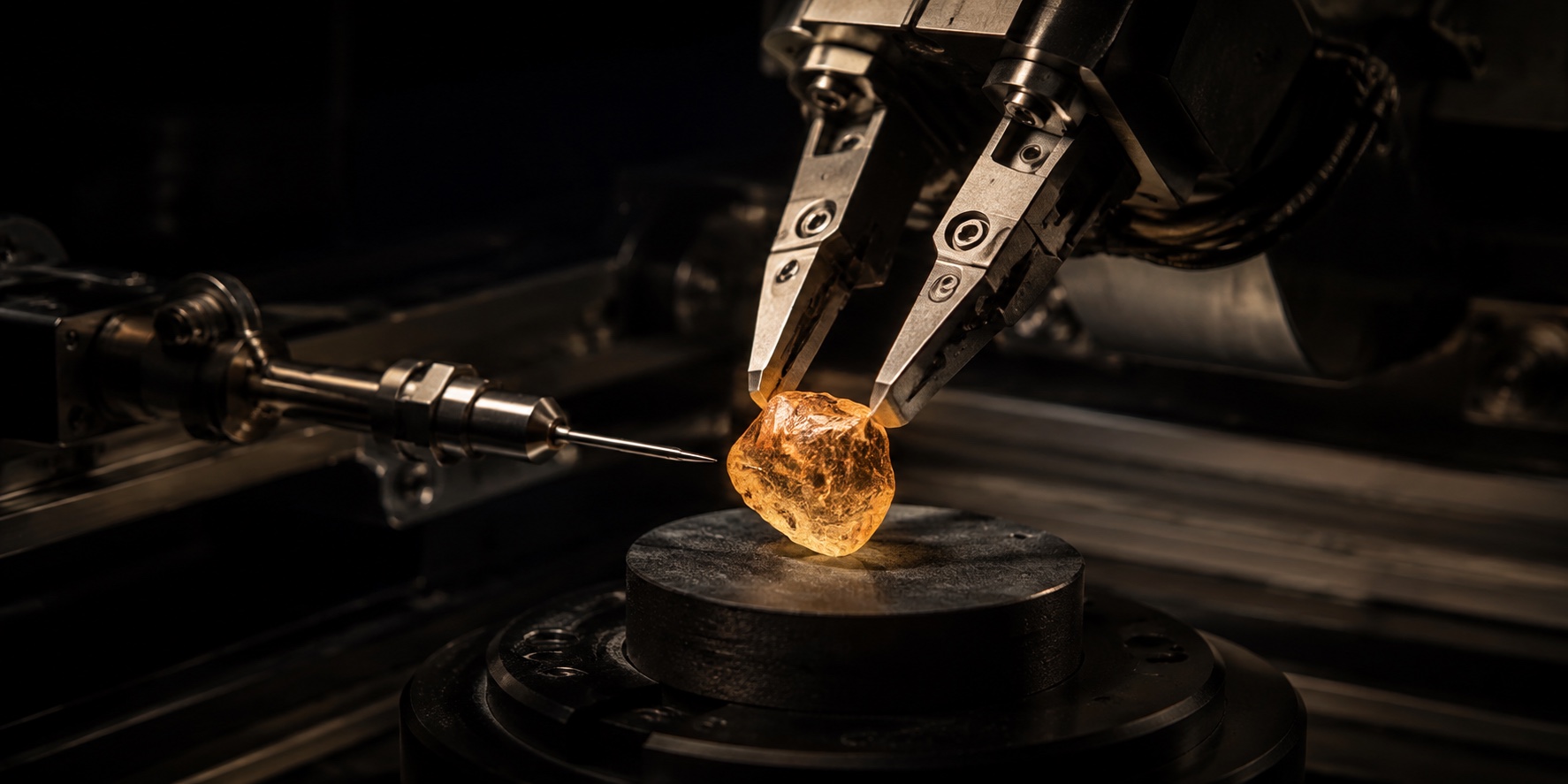
At Berkeley Lab, three robot arms work with powders, furnaces and instruments. Researchers choose a material they want to make. Software helps choose how to make it. The robots try, measurements come back, and the result informs the next attempt. Sometimes the useful thing that comes out of the room is a material. Sometimes it is a reason to stop trying that recipe.1
I find this more interesting than another conversation about when AI becomes smarter than everyone. A system like this can change the cost of finding things out. If it works well enough, we get more attempts at a better battery, a useful catalyst, a material we know how to describe but don't yet know how to manufacture.
My strongest bet about the next hundred years starts there. Intelligence, biology, matter and the physical environment become more open to deliberate intervention. We get better at asking for a particular outcome, building something that might produce it, and checking what happened.
The word programmable is doing a lot of work. I don't mean that a cell becomes as predictable as a function, or that a city can be compiled. I mean the distance between an idea and a testable change gets shorter. How far that distance can shrink is the interesting part.
One experiment should change the next #
The familiar software loop is forgiving. Change some code, run it, inspect the failure, try again. You can often restore the earlier version. In a laboratory, the experiment has to wait for the furnace. In a patient, you may be unable to undo the intervention. These differences don't disappear because the model proposing the next step gets better.
Still, the A-Lab example matters. The instruments, data and decision process are connected. A disappointing result can change what the system tries next instead of sitting in a notebook no one else will read. Berkeley's description is specific to an automated materials lab; extending that approach across science is my bet, not a result the lab has already delivered.1
There is a catch in the return arrow. What did the experiment measure? A material may be easy to synthesize and useless in a battery. A catalyst may perform well under laboratory conditions and deteriorate in a factory. An autonomous lab can get very good at satisfying a weak test.
So I would watch whether another lab can reproduce the result, whether failed attempts are preserved, and whether a promising sample survives the move into a product. Counting experiments is easy. Deciding which experiments taught us something takes more care.
A robot has to finish the job #
Imagine a robot clearing a table. It has to recognise a glass, grasp it without breaking it, move around a chair, notice someone walking past, find somewhere to put the glass, and let go. Then do the next one. A good grasping demonstration answers one part of this problem.
The newer robotics stacks at least make those parts visible. Google DeepMind's July 2026 Gemini Robotics 2 release separates motor action, embodied reasoning and on-device adaptation. Its own published examples also show the unevenness: success rates vary substantially across tasks, and dexterous finger work remains difficult. That is a more useful starting point than treating a video of one successful attempt as evidence of a dependable worker.2
The arithmetic becomes uncomfortable surprisingly quickly. Suppose each step works 98% of the time. In a simplified job with fifty independent steps, all fifty work only about 36% of the time. Real failures are often correlated, and real robots can recover. This is an illustration of the burden placed on recovery, not a forecast of a particular robot's performance.
That is why I expect useful autonomy to spread through places where the task can be shaped around the machine. A warehouse can standardise containers. A lab can fix the positions of instruments. A home has a dog, a charging cable on the floor and furniture someone moved yesterday. You can improve the model or simplify the environment. Usually you need some of both.
Simulated worlds can make practice cheaper, but a convincing-looking simulation can still teach the wrong thing about friction, contact or an unusual object. The final test belongs in the environment where the machine will work. I care about how often a person has to rescue it, how long that takes, and whether the same failure returns tomorrow.
Personal AI has a version of this problem too. Remembering a conversation, deciding it is relevant, and acting on it are different responsibilities. A system can recall the right fact and still send the wrong message. Permissions and a way to inspect or undo an action become part of the product. The interface may be glasses, a small wearable or a screen; the difficult work continues behind it.
Biology makes “programmable” a harder word #
Casgevy became the first FDA-approved CRISPR therapy in December 2023. For sickle cell disease, it edits a patient's blood stem cells outside the body and returns them through a transplant. The treatment increases fetal haemoglobin rather than directly repairing the sickle-cell mutation. It also requires high-dose chemotherapy beforehand. “We can edit DNA” leaves out a great deal of what a patient has to go through.3
In 2025, a team developed a different kind of intervention for an infant with CPS1 deficiency, a rare disorder affecting the liver's ability to process waste from protein metabolism. The treatment used a base editor customised to the child's mutation, delivered to liver cells inside the body. NIH reported roughly six months from diagnosis to treatment. The early response was encouraging; it was one patient with short follow-up.4
Put those two examples next to each other and the engineering question becomes clearer. Knowing what to change is one part of treatment. Getting the editor to the right cells, controlling its activity and knowing what else changed are separate problems.
I expect the next few decades to bring more therapies built around particular mutations and cell types. I am less confident about the jump from those treatments to replacement organs on demand, or broad control over ageing. Even an organ with the right shape has to be supplied with blood, interact with the immune system and keep functioning over years. Calling it a manufacturing problem doesn't make those requirements smaller.
There is also an economic question I don't want to hide in a footnote. Can the work done for one rare mutation make the next treatment cheaper and faster? If every patient requires a largely new development effort, the science can advance while access remains narrow. Reusable delivery methods and manufacturing processes would change that forecast considerably.
The first neural interfaces people depend on
The same distinction between a demonstration and daily use matters for brain interfaces. In a July 2026 report, NIH described a man with ALS using a speech BCI at home for more than 3,800 hours over almost 23 months. His caregivers learned to set it up. He could rate and correct its output; 79% of more than 180,000 rated sentences were judged correct or mostly correct by him.5
The correction mechanism is part of what makes the result interesting. A decoder that produces words also needs a way for its user to say, “That isn't what I meant.”
I would expect restorative uses to matter well before elective consumer implants become ordinary. That is a forecast about the balance of benefit and burden, not a claim that restoration is easy. An implant has to keep working, remain usable through changes in the signal, and give the person control over when communication happens. More bandwidth alone doesn't settle any of that.
Everything in this essay needs electricity #
A forecast can make intelligence feel weightless. The equipment below is a useful correction.
More capable models may help design better materials or control a power system, but their deployment also needs electricity, cooling and hardware. If those are expensive or unavailable where the work needs to happen, cheaper reasoning doesn't automatically produce cheaper medicine or manufacturing.
Geothermal is worth taking seriously here. The IEA's 2024 assessment says it could supply up to 15% of global electricity demand growth to 2050 if technology improves and project costs fall. That qualifier matters: it is a conditional estimate of additional demand, not a claim that geothermal will supply 15% of all electricity.6
Fusion is a different bet. ITER's revised baseline places deuterium-tritium operations in 2039. That is a research milestone, not a date for commercial electricity. A useful power station must also turn heat into electricity, cover its own power needs, survive damage and spend enough time operating to justify its cost.7
I can be optimistic about fusion research and still expect much of the next decade's construction to depend on power sources we already know how to build. We also have to connect them. A factory waiting for a grid connection gets little help from a better forecast.
Quantum computing belongs in this part of the discussion because it, too, has a substantial physical burden underneath an elegant idea. IBM's Starling roadmap targets 200 logical qubits and circuits with 100 million gates in 2029. That is the company's target, not an independently demonstrated result. I would judge useful quantum computation by a specific problem solved better than the best available classical approach, with error correction and operating costs included.8
The last fifty years are harder to put on a calendar #
Past mid-century, I trust dependency chains more than dates. If launch gets cheaper, if machines can assemble and repair equipment in orbit, and if there is something worth doing there, a space industry can grow. Those are three different conditions. Progress on one doesn't guarantee the others.
NASA's in-space servicing, assembly and manufacturing work describes activities such as refuelling and repairing spacecraft, or assembling structures after launch. It is an intelligible path toward infrastructure beyond Earth. It does not, by itself, establish demand for a self-sufficient Mars city.9
There are failed projects along that path. NASA cancelled OSAM-1 after technical, cost and schedule problems, and a lack of a committed partner. The ability to describe a useful orbital service was insufficient to sustain that particular mission.10
I can imagine much more precise manufacturing, engineered microbial communities and habitats that recycle a larger share of what they use. Each is a direction to investigate. I can't give a credible year when they add up to a civilisation resembling The Culture. Among other things, someone has to demonstrate that the parts remain stable when they interact.
Brain emulation is an even larger extrapolation. The 2025 MICrONS work reconstructed more than 200,000 cells and 523 million synapses in roughly one cubic millimetre of mouse visual cortex, alongside functional measurements. The scale of the achievement is difficult to hold in your head. So is the amount left to understand.11
A wiring map constrains a model. It doesn't automatically provide the dynamics of the whole living system. And a model that reproduces someone's behaviour would leave a further question: did their subjective experience continue, or did a convincing copy begin? I don't know how to settle that. Writing “mind up” into the 2080 column would merely conceal the uncertainty.
What I would put on the calendar #
My confidence is higher in an order of development than in a schedule. The near-term bets have machines and experiments behind them. The later ones depend on several things becoming practical together. These horizons are a way to organise my attention as of September 2026, not probabilities calculated from a model.
The evidence that would change my mind is fairly concrete:
- A robot doing useful work for longer between interventions, with the cost of each rescue included.
- A material discovered autonomously, reproduced elsewhere, then manufactured without losing its useful properties.
- A gene-delivery platform reused across treatments, with durable benefit and a development process more people can afford.
- A neural interface that people choose to keep using over years, with less setup and dependable control over its output.
- An energy or quantum system that wins on the complete operating calculation, rather than one impressive measurement.
These are slower stories to follow than model releases. They would also move my forecast more.
There is one more gap the machinery won't close for us. Making something cheaper does not decide who gets it. Better treatments can coexist with unaffordable healthcare. More automated production can coexist with concentrated ownership. A world with more energy still has finite land, contested power and people who want incompatible things.
I want more of this forecast to become possible. In particular, I want the work behind that first personalised treatment or useful material to make the second one easier. If the gains can be reused, and more people can use them, the century could change in ways I can't sensibly list today.
The question I'd keep asking is who can afford the next attempt.