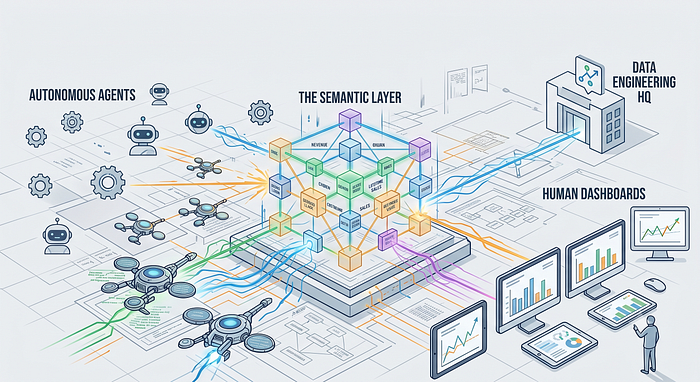
Semantic layers once seen as mere BI conveniences are now important for autonomous AI, sparking competition among data platforms.
In the relentless pursuit of self-service analytics, the data engineering sector has witnessed a seismic shift. The vision? To enable any stakeholder to harness data insights without a hitch. While much progress has been made with lightning-fast cloud data warehouses and democratized SQL knowledge, the industry hasn't yet crossed the finish line. Conflicting metrics across departments reveal a persistent flaw. The earnings call told a different story.
The Rise of Semantic Layers #
Once a footnote in BI discussions, semantic layers have now taken center stage. This is primarily because autonomous AI systems require a deterministic translation layer between raw data and business insights. Early semantic layers in monolithic BI tools offered governance but locked users into proprietary systems. The new wave flattens semantics into physical tables, leading to chaos instead of clarity. The strategic bet is clearer than the street thinks.
Decoupled Semantics: The Future? #
Today's data landscape emphasizes headless, decoupled semantic layers that are version-controlled and API-first. Why is this important? Because without deterministic semantics, the non-deterministic prompts of large language models (LLMs) can lead to unreliable outcomes. A semantic engine must handle object graph modeling, declarative metrics, dynamic SQL, and security controls. Platforms like dbt MetricFlow, Cube, and AtScale are at the forefront. The capex number is the real headline here, with Snowflake and Databricks competing fiercely for storage dominance.
Architecting for the Future #
Deploying semantic meshes isn't for the faint-hearted. It requires a nuanced approach with GitOps, tiered governance, continuous integration, and cost management. But why is this battle significant today? As businesses lean into autonomous systems, semantic context isn't just a luxury, it's an operational necessity. Management said AI fourteen times on the call. Here's what they meant: future-proofing data infrastructure.
So, what does it all mean for businesses? Are you ready to embrace the semantic shift, or will you be left behind in the data dust?
Get AI news in your inbox
Daily digest of what matters in AI.