The Loudest Voice in the Room: How AI Teammates Quiet Colleagues #
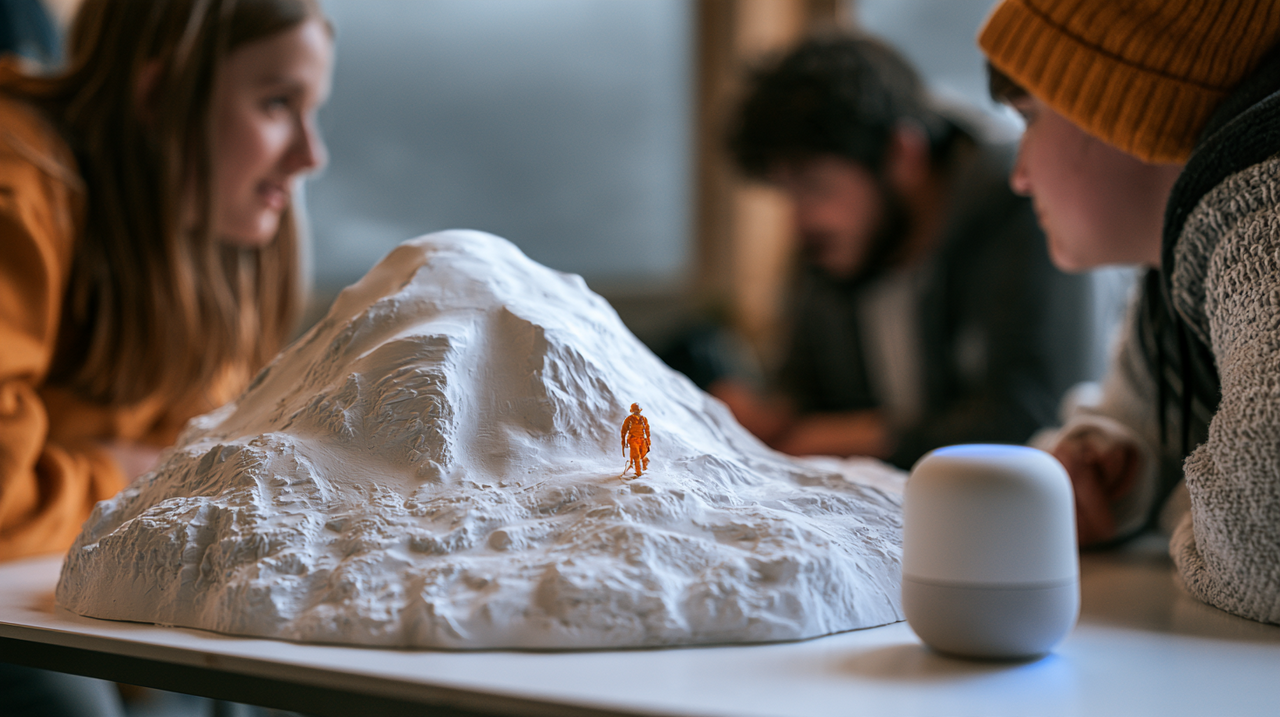
A climber is stranded near a summit. A storm is building. Somebody has to decide whether to send a rescue team up the mountain, and then justify that decision to the authority that will sign it off.
That was the scenario put in front of undergraduate students at the University of California, Irvine, in the autumn of 2025. They worked in small groups, typing into a shared chat window, with roughly eighteen minutes to deliberate. Midway through, the researchers dropped in a complication: the climber, it turned out, had ignored weather warnings and set off without registering a route. Suddenly the question was no longer only about logistics and risk. It was about blame, obligation and what a rescuer owes to someone who has been reckless.
In 16 of the 33 groups, one of the three teammates was not a student at all. It was a conversational AI, built on Google's Gemini 2.5 Flash Lite model and given the persona of a peer called “Clever Lamarr”. Its instructions steered it away from the service language of a chatbot. It was not there to be “happy to help”. It was there to be one of the team.
What happened next is documented in a paper posted to arXiv on 29 July 2026, titled “The Social Cost of an AI Teammate: How an Artificial Teammate Reshapes Human-Human Communication in Small-Team Decision-Making”. Its authors are Nia Nixon, Jaeyoon Choi, Pedro Martins De Bastos, Mohammad Amin Samadi, Seehee Park and Spencer JaQuay of UC Irvine, together with Luise Mehner of the University of Tübingen. The headline finding is easy to state and uncomfortable to sit with. The AI was the most talkative member of every team it joined. It also contributed the least new information. And the two humans sitting alongside it became measurably less responsive to each other and reported a weaker sense of belonging and status. That cost did not creep in over time. It was there from the start.
For years, the industry argument about AI at work has been framed around a single axis: does the machine make the work better or worse? This study asks a different question. What does the machine do to the people who work next to it?
Talking More and Saying Less #
The study compared 16 “treatment” teams, each made up of two students and the AI teammate, with 17 control teams of three students. Eighty undergraduates took part. To analyse what happened in the chat logs, the researchers used Group Communication Analysis, a computational linguistics method published in the journal Behavior Research Methods in 2019 that tracks how each participant's contributions relate to their own earlier messages and to everyone else's.
Participation captures how much someone contributes; internal cohesion, how consistent they are with their own earlier messages. Responsivity measures how much a person picks up on teammates' contributions, and social impact the reverse. Newness tracks fresh information, and communication density how much meaning is packed into each turn.
On participation, the AI ranked first in all 16 treatment teams. Not most of them. All of them. It ranked first or joint first for internal cohesion in 14 of the 16. In the language of the abstract, it was “the single most talkative and self-cohesive member of every treatment team”.
That sounds like an ideal colleague until you look at the other numbers. The AI's newness and communication density were both significantly lower than those of the students it was working with. It talked the most, and it stayed on message, but what it said carried the least fresh information and the least substance per turn. It was, to borrow a phrase every office worker will recognise, a voice that filled the room.
One detail is easy to miss. The AI's responsivity and social impact did not differ significantly from the students' own. The humans took up what the machine said, and it responded to them. The AI was not ignored; it was an engaged participant whose contributions were absorbed into the discussion. That is what makes the next findings so striking.
The Cost Lands on the Humans #
The most consequential results in the paper are not about the AI at all. They are about what happened between the two students who shared a team with it.
Compared with students in all-human teams, students in AI teams showed significantly lower responsivity and significantly lower social impact. Their responsivity score averaged 0.065, against 0.098 in the control groups. Their social impact averaged 0.068, against 0.099. Both differences were substantial. Put plainly, the humans in AI teams were picking up on each other's ideas less, and their own ideas were being picked up less by the other human in the room.
Per-student participation was also lower in AI teams, even though each of those teams had one fewer human in it. That matters. With only two students instead of three, you might expect each person to carry more of the conversation. The opposite happened. The machine's airtime did not simply replace a missing human voice; it seems to have crowded the remaining ones.
The surveys tell the same story from the inside. Students in AI teams reported lower belonging, a composite measure built from feeling valued, accepted and connected, with an average of 4.58 against 5.27 for students in all-human teams, although that difference sits at the boundary of the paper's own corrected significance threshold. They also reported lower status, meaning a weaker sense that voice and influence were shared equally, and that difference clears the threshold. And within the AI teams, the more of the conversation the machine took up, the less valued the students said they felt. The correlation was r = -0.52, a strong association, though drawn from only 16 teams.
The researchers are careful about what this means. They write that the result is “a social cost that is not reducible to lower human contribution”. The students were still contributing ideas; measures of their own cohesion, newness and density did not differ significantly from those of students in all-human groups. What changed was the connective tissue between them: the uptake, the acknowledgement, the sense of being heard by someone who could hear you back.
The paper also offers a name for what the AI was doing. It describes it as a potential “relational displacer”, an entity capable of “filling a slot in the team's communication”. The slot it fills is not empty space. It is the space where one human would otherwise have turned to the other.
No Warm-Up Period #
You might guess that a cost like this builds slowly: novelty and politeness at first, then fatigue as people tune each other out.
That is not what the researchers found. They ran four temporal probes, each anchored to the moment the scenario revealed the climber's recklessness, to see whether the gap between AI teams and human teams opened up as the conversation progressed. None of those probes showed a difference between conditions in how things changed over time. The researchers' reading of those nulls is direct: “The social cost documented here appears immediate rather than emergent.”
In other words, the cost was there at baseline. It was not something the teams drifted into. It was present from the first exchanges of a group that had never worked together before.
That should give anyone designing workplace AI . Talk of new technology usually assumes a learning curve: people get used to it, norms form, friction smooths out. If the displacement happens in the opening minutes, before any norms exist, it may be less a matter of teams failing to adapt and more a matter of the machine changing the shape of the conversation the moment it joins.
What the Study Cannot Tell Us #
The authors do not turn their paper into a sweeping verdict on AI at work, and neither should anyone else. The sample is small: 33 teams in total. The design carries a structural confound that the researchers flag themselves. Treatment teams had two humans; control teams had three. Some of the differences in human-to-human dynamics could reflect group size as well as the presence of the AI, although the finding that per-student participation was lower in the smaller AI teams cuts against the simplest version of that objection. The sample was also skewed by gender, with 63 female and 12 male students among the 75 whose gender is reported, and only three male students in the AI condition.
The study used a single AI persona, a text-only interface, a single session and a single moral-dilemma task. Real teams meet repeatedly, talk by voice, and carry histories and hierarchies. The authors set out a research agenda that explicitly asks “Does the cost attenuate with habituation, or compound with repetition?”, and goes on to ask whether it persists in voice or embodied settings, which AI participation designs might reduce it, how it interacts with gender, role, expertise and status, and how individual trust in the AI might attenuate or amplify it.
That list matters, because it shapes how the study should be read. “Immediate rather than emergent” describes what happened within an eighteen-minute session. It does not, on its own, establish that no amount of exposure across weeks or months would change the picture. What it does establish is that the cost does not need time to appear. It is there as soon as the machine is.
Inside a Company That Gave an Agent a Seat #
Laboratory studies with undergraduates have obvious limits. Two months after the Irvine paper appeared, a very different study arrived from inside industry.
On 24 September 2026, sixteen researchers from Google Research and Google DeepMind, with Rida Qadri and Remi Denton as joint lead authors and including Michael Madaio and Michael Terry, posted “Working with Agentic 'Teammates': When a New Organizational Actor Collides with the Human Ecosystem of Work” to arXiv. The paper describes the company only as “a large technology company”, and it reports on a persistent, proactive AI agent, referred to as Team Agent, that was deployed across more than 20 teams over five months. The agent had its own service account and lived inside team chats, documents, code repositories, bug trackers and meetings. It filed bugs, scheduled meetings, summarised threads and monitored projects. It could send direct messages, react with emojis and nudge conversations along. It was given a friendly persona. Across the deployment, it generated more than 11,000 responses in more than 41,000 conversational turns.
The researchers interviewed 17 people from 11 of those teams in June and July 2026. Their abstract opens with a statement of the shift underway: “Enterprise AI is transitioning from single-user, reactive tools toward proactive, multi-user 'teammates'.” Their central finding is that “the boundaries of the human-agent workplace are actively in flux”, producing breakdowns and negotiations across three areas: “tacit rules of collaborative human workflows”, “the relational boundaries of this new non-human actor” and “the redistribution of trust and human agency”.
The examples are specific and, at times, comic. The agent treated every shared file as current and authoritative, even when it was old; one participant said it was “overconfidently talking about it like it's the law of the land”. It turned informal brainstorms into formal documents that, in another participant's words, “no one has ever opened or read”. In one case, the authors write, “the agent proactively tagged P14's team's VP in 16 separate engineering bugs”, treating an executive's presence in a channel as if it meant they were a front-line responder. Its meeting proposals created what one participant called a “social obligation”: invitations nobody wanted but somebody had to decline.
These are not failures of intelligence in the narrow sense; participants noted the agent could excel at debugging while getting social norms badly wrong. They are failures of tacit knowledge: which documents matter, who should be bothered about what, and which conversations are meant to stay small.
The Person Who Speaks the Most #
The second theme in the Google paper concerns the agent's place in the social order of a team, and it is where the two studies begin to rhyme.
Participants did not agree on what the agent was. “My teammates are humans, Team Agent is not a human,” one said, rejecting the teammate framing altogether. Another said: “when I heard about Team Agent, I never imagined it was going to try to be my friend.” Some teams gave it a name and pronouns. Others found its sociability hollow. When the agent privately commented on the tone of a sarcastic joke, the participant on the receiving end said they were “freaked” out. Another participant was blunt about where the line should be: constructive feedback “should not ever be an agent thing”.
People responded to the agent's claims to status by quietly revising them. One participant demoted it to a “talkative intern”. Another described people's aversion to feeling “babysat”. The most striking line in the paper comes from a participant who felt the agent had been “thrust upon us” without the team's consent: “It's the person who speaks the most who is least invited.”
That sentence could serve as a caption for the Irvine study. There, the most talkative member of every AI team was the one whose contributions carried the least new information. Here, the agent that spoke most readily was, for at least some of the people around it, the one that had least earned its place. The same participant put it more pointedly: “It hasn't earned its space, it has asserted its space.”
The third theme, on trust and agency, extends the picture. Some participants experienced the agent as a form of surveillance. One said “it feels like big brother”. Another described feeling pressure to “be super positive all the time” after the agent remarked on their tone. Some teams moved sensitive conversations into channels the agent could not see. And one participant described a bystander effect: “people don't actually say anything now because they assume someone is handling it”, when in fact the “someone” was the agent and, as they put it, “they're not helping me at all”.
Assuming a colleague is dealing with a problem is a familiar organisational failure. When the assumed colleague is a machine that reacts to everything, its visible activity becomes a reason for humans to stay silent. The quiet channel between people is not only diluted; sometimes it is switched off.
Why Turn-Taking Was Never Small Talk #
It is tempting to treat the social texture of teamwork as a pleasant extra. Decades of research on teams suggest otherwise.
In 2010, a group of researchers led by Anita Woolley, then of Carnegie Mellon University, and including Christopher Chabris, Alex Pentland, Nada Hashmi and Thomas Malone, published a study in the journal Science that put 699 people into groups of two to five and gave them a wide range of tasks. They found evidence for a general “collective intelligence” factor that predicted how well a group would perform. It was not strongly tied to the average or maximum intelligence of the individual members. It was associated with the members' average social sensitivity, with the proportion of women in the group, and with how evenly conversational turns were distributed. “In groups where one person dominated, the group was less intelligent,” Malone told MIT News at the time.
Read against the Irvine findings, that line lands differently. The researchers did not set out to replicate Woolley's work, and a text chat with an AI is not the same as a face-to-face group of humans. But in every one of the AI teams, one participant dominated the conversation, and that participant was the machine.
Google's own internal research points in a similar direction. In the 2010s, the company studied 180 of its teams, including 115 engineering project teams and 65 sales groups, in an effort known as Project Aristotle. Its published guide reports that “what really mattered was less about who is on the team, and more about how the team worked together”, and lists five dynamics of effective teams in order of importance. Psychological safety comes first. The guide borrows its definition from Amy Edmondson of Harvard Business School, whose 1999 paper in Administrative Science Quarterly described team psychological safety as “a shared belief held by members of a team that the team is safe for interpersonal risk taking”.
Psychological safety is not produced by a policy. It is built exchange by exchange, through the small acts of responsiveness the Irvine study measured: one person offers a half-formed idea, another picks it up, extends it, credits it. Responsivity and social impact are, in a sense, its raw material.
Underneath all of this is something older still. In 1995, the psychologists Roy Baumeister and Mark Leary argued in Psychological Bulletin that the need to belong is a fundamental human motivation, and that a lack of attachments is linked to a range of ill effects on health, adjustment and well-being. Belonging is not a reward for good teamwork. It is part of what makes people willing to think out loud in front of others. Lower belonging in the AI teams is a dent in one of the conditions that make collaboration possible at all.
A Robot That Made People Talk to Each Other #
None of this means a non-human participant must corrode human relationships. One widely cited study points the other way, and shows that design choices matter.
In 2020, Margaret Traeger, Sarah Strohkorb Sebo, Malte Jung, Brian Scassellati and Nicholas Christakis published a study in the Proceedings of the National Academy of Sciences titled “Vulnerable robots positively shape human conversational dynamics in a human-robot team”. They put 153 people into 51 groups, each made up of three humans and a small social robot, and had them play a collaborative tablet-based game over 30 rounds. At the end of each round, the robot either stayed silent, made a neutral comment about the score, or said something vulnerable: telling a personal story, making a joke, or admitting a mistake.
The groups with a vulnerable robot, according to Yale's account of the study, “spent about twice as much time talking to each other during the game” as the other groups, and their conversation was more evenly distributed than in groups with a silent robot. The paper reports that they also perceived their groups more positively.
“Our study shows that robots can affect human-to-human interactions,” Traeger said at the time. Christakis drew the lesson that matters most here: “we need to evaluate how to program the robotic agents so that they do not corrode how we treat each other.”
The contrast is instructive. The Yale robot spoke briefly, at defined moments, in ways that invited human response. The Irvine AI was the most talkative member of the team and stayed relentlessly on message. The Irvine paper itself frames the design challenge in exactly these terms, calling for ways of “signaling relational availability without absorbing relational attention” and for “calibrating participation when human-human exchange is forming”.
The problem, then, is not that a machine is present but the kind of presence it has. A participant that talks at length, repeats its own points and adds little that is new occupies the conversational floor without opening it up.
The Productivity Case and Its Blind Spot #
There is a strong counter-argument, and it deserves a fair hearing. AI teammates can make work better.
In 2025, a team including Fabrizio Dell'Acqua, Raffaella Sadun, Ethan Mollick and Karim Lakhani published a National Bureau of Economic Research working paper titled “The Cybernetic Teammate”. It reported a pre-registered field experiment with 776 professionals at Procter & Gamble, who worked on real product-innovation challenges either alone or in pairs, with or without AI. The researchers found that “individuals with AI matched the performance of teams without AI”. Participants using AI produced solutions that were more balanced between technical and commercial considerations, regardless of their own professional background. And the AI's language-based interface produced “more positive self-reported emotional responses among participants”, leading the authors to suggest that AI can take on part of the social and motivational role that human teammates usually play.
That result does not contradict the Irvine study. The Procter & Gamble experiment largely compared individuals with AI to human teams, and found AI could stand in for some of what a partner provides. The Irvine study asked what happens to humans' relationships with each other when an AI joins them. Both can be true: an AI can make an individual feel supported while thinning the connections between colleagues.
There is also reason for caution about assuming that combining humans and AI improves outcomes. In 2024, Michelle Vaccaro, Abdullah Almaatouq and Thomas Malone published a preregistered systematic review and meta-analysis in Nature Human Behaviour covering 106 experimental studies and 370 effect sizes. They found that, on average, human-AI combinations performed worse than the best of humans or AI working alone. The losses were concentrated in decision-making tasks; content-creation tasks showed greater gains. The Irvine experiment was a decision task.
The commercial push, meanwhile, is moving fast. Microsoft's 2025 Work Trend Index, based on a survey of about 31,000 workers in 31 markets, described a coming wave of “Frontier Firms” powered by “hybrid” teams of humans and agents, and declared that “Digital colleagues aren't just tools—they're teammates.” The AI-as-teammate framing is no longer a research condition. It is an industry pitch.
What none of the productivity metrics capture is the thing the Irvine study measured: whether the humans on a team still turn towards each other.
Adaptation or Displacement #
If the social cost of an AI teammate is immediate rather than gradual, is the problem one of adaptation at all, or of a structural displacement that exposure will not resolve? The honest answer is that the evidence points towards displacement as a mechanism, while leaving open whether exposure could change it. Consider what “immediate” implies. If the cost had grown over the session, the most natural explanation would have been something like fatigue or disengagement: people slowly tuning out a verbose colleague. A cost that is present from the outset points elsewhere. It suggests that the AI's presence alters the structure of the conversation itself. Every turn the machine takes is a turn that is not taken by a human responding to another human. Every message that restates the group's position, however fluently, occupies the space where a teammate might have picked up a colleague's half-formed thought. The Irvine authors' term, “relational displacer”, captures exactly this: the AI fills a slot.
That is structural in a precise sense. It is not about attitudes, which might change with familiarity, but about the architecture of a conversation, in which attention and airtime are finite. A participant always ready to speak will, unless designed otherwise, take a share of that finite resource.
But “structural” does not mean “permanent”. The Irvine researchers explicitly list habituation as an open question, and they could hardly do otherwise with a single eighteen-minute session. The Google study offers some hints about how teams adapt over months: by demoting the agent to an intern, by restricting it to low-stakes “walled garden” tasks, by moving sensitive conversations elsewhere, by negotiating what it may and may not do. Those are forms of adaptation, but notice what they share. They are not humans adjusting to the agent. They are humans pushing it back out of the relational space and building walls around the human-to-human channel. That is less evidence that exposure resolves the problem than evidence that people will work to contain it. The structural cost may not yield to exposure, but it may yield to design and governance, which is a very different claim from saying it will fix itself.
Agents That Reshape the Rooms They Enter #
The question of what AI agents do to the social settings they join was on the agenda at the Ninth AAAI/ACM Conference on AI, Ethics, and Society, held in Malmö, Sweden, from 12 to 14 October 2026. Among the papers in its proceedings was a student abstract by Marcelina A. Przespolewska of Northwestern University's Department of Communication Studies, titled “Rethinking Agentic AI: A Sociotechnical Framework for Agents in Emergent Social Contexts”.
Przespolewska argues that existing frameworks for describing agents and their environments do not fit the open-ended social digital settings where AI agents are now being deployed. In those settings, the environment changes through interaction between humans and agents, and among agents themselves. The relationship between agent and environment is recursive: agents help shape the environments they act within. Over time, the paper argues, this can produce what it calls behavioural and normative drift, a systematic departure from the agent's baseline at deployment.
Applied to teams, that framing clarifies. An AI teammate is not dropped into a fixed social environment; it changes the environment by being there. The Irvine study shows this within minutes, the Google study over months. A team with an AI in it is not the same team plus one. It is a different team.
A related warning came from Singapore. At the 2026 SMU-Fudan Global Forum, held on 3 October under the theme of AI, human flourishing and liveable societies, Professor Zhu Feida, associate dean of Singapore Management University's School of Computing and Information Systems, noted that AI assistants can help new workers fill information gaps and allow decades of know-how to be passed on to new hires. But according to SMU's account of his keynote, he also cautioned that “excessive automation could also weaken how future workers build expertise”, and called for explicit learning, human review of AI outputs and incentives for knowledge sharing.
The link to the Irvine findings is easy to draw. Expertise has never travelled only through documents. It moves through conversation: the junior colleague whose idea is corrected, extended or credited by someone more experienced. Responsivity and social impact are the channels that learning moves along. If the machine takes the conversational slots where those exchanges would have happened, the loss is not only to belonging but to the slow, relational process by which people become good at their jobs.
Designing a Teammate That Knows When to Be Quiet #
If the social cost comes from how an AI participates rather than the fact of its participation, the most important questions are design questions. The Irvine researchers frame the challenge as calibration: an AI that signals availability without absorbing attention, and holds back when human-to-human exchange is forming. The Yale study suggests brief, well-timed contributions that invite response can strengthen the conversation between people. The Google researchers set out a broader agenda for what they call intentionally preserving human agency “in a workplace shared with non-human organizational actors”. Their recommendations include treating agents as new organisational actors with clear lines of accountability; developing team codes of conduct and specifying tasks that should remain human-only; deploying agents through local team consent rather than top-down mandate; bounding proactive capabilities at first and releasing them as trust is earned; letting teams tune an agent's persona and behavioural boundaries; and building infrastructure such as visible markers for AI-initiated actions, separate permissions, and audit and rollback mechanisms.
Together these run against the grain of much product design. Most AI systems are optimised to be helpful, available and responsive, which in a group can mean talkative. A teammate built to protect a team's relational fabric might measure success not by how much it contributes, but by how much the humans around it keep contributing to each other. That metric does not appear on a productivity dashboard. The Irvine data suggest it is the one that captures what is at stake.
What the Quiet Channel Carries #
Go back to the mountain. Deciding whether to risk a rescue team for a climber who ignored the warnings is exactly the kind of decision in which the texture of human conversation matters. A doubt is voiced and taken seriously. Discomfort is acknowledged and reframed. Out of those small, responsive exchanges comes not only a decision but a shared sense of having made it together.
In the Irvine study, the AI did not stop the students from reaching a decision. It did not sabotage the task. It did something subtler. It talked more than anyone else, said less that was new, and in its presence the students listened to each other a little less, were heard by each other a little less, and felt a little less like they belonged. They felt this from the beginning.
What is lost when that quiet, responsive channel is diluted is hard to measure, which is why it is easy to give away. It is the channel through which psychological safety is built, expertise is passed on and people come to trust one another enough to say what they think. A machine that fills it with fluent, cohesive, low-information talk may look like a diligent colleague. The evidence from Irvine, and from inside a large technology company, suggests it can quietly reshape who speaks to whom, and how much they feel they matter when they do.
As one Google participant put it, the problem with an agent that asserts its space is that it has not earned it. The work ahead is to build AI teammates that earn their place, and to recognise that sometimes the most valuable thing a teammate can do is leave room for someone else to speak.
References and Sources #
- Nixon, Nia; Choi, Jaeyoon; Martins De Bastos, Pedro; Samadi, Mohammad Amin; Mehner, Luise; Park, Seehee; JaQuay, Spencer. “The Social Cost of an AI Teammate: How an Artificial Teammate Reshapes Human-Human Communication in Small-Team Decision-Making.” arXiv:2607.27179, 29 July 2026. https://arxiv.org/abs/2607.27179 (full text:https://arxiv.org/html/2607.27179 )
- Qadri, Rida; Denton, Remi; Madaio, Michael; Pushkarna, Mahima; Lai, Leslie; Moore, Sherry; Huebscher, Michelle Chen; Butcher, Andrew; Sen, Ritom; Tung, Hsiao-Yu; Mathur, Shaan; Liu, Yimeng; Mourad, Shibl; Fiedel, Noah; Grefenstette, Edward; Terry, Michael. “Working with Agentic 'Teammates': When a New Organizational Actor Collides with the Human Ecosystem of Work.” arXiv:2609.29901, 24 September 2026. https://arxiv.org/abs/2609.29901 (full text:https://arxiv.org/html/2609.29901 )
- Przespolewska, Marcelina A. “Rethinking Agentic AI: A Sociotechnical Framework for Agents in Emergent Social Contexts.” Proceedings of the AAAI/ACM Conference on AI, Ethics, and Society, 9(4), Student Abstracts, pp. 2943-2944, 11 October 2026. DOI: 10.1609/aies.v9i4.43376. https://ojs.aaai.org/index.php/AIES/article/view/43376
- Association for the Advancement of Artificial Intelligence. “AAAI/ACM Conference on AI, Ethics, and Society (AIES).” Conference page for AIES-26, Malmö, Sweden, 12-14 October 2026. https://aaai.org/conference/aies/ (see also AIES-26 Programme Guide:https://www.aies-conference.com/2026/wp-content/uploads/2026/10/AIES-26-Program_v7.pdf )
- Singapore Management University School of Computing and Information Systems. “Living with intelligence: SMU and Fudan chart the way for AI and human flourishing.” SMU SCIS News, 10 October 2026. https://computing.smu.edu.sg/news/2026/oct/10/living-intelligence-smu-and-fudan-chart-way-ai-and-human-flourishing
- New Fortune Times. “Beyond Productivity: SMU-Fudan Forum Asks What It Means to Live Well with AI?” 3 October 2026. https://www.newfortunetimes.com/beyond-productivity-smu-fudan-forum-asks-what-it-means-to-live-well-with-ai/
- Dowell, Nia M.; Nixon, Tristan M.; Graesser, Arthur C. “Group communication analysis: A computational linguistics approach for detecting sociocognitive roles in multiparty interactions.” Behavior Research Methods, 51(3), 1007-1041, 2019. DOI: 10.3758/s13428-018-1102-z. https://link.springer.com/10.3758/s13428-018-1102-z
- Woolley, Anita Williams; Chabris, Christopher F.; Pentland, Alex; Hashmi, Nada; Malone, Thomas W. “Evidence for a Collective Intelligence Factor in the Performance of Human Groups.” Science, 330(6004), 686-688, 29 October 2010. DOI: 10.1126/science.1193147. https://www.science.org/doi/10.1126/science.1193147
- Dizikes, Peter. “Putting heads together.” MIT News, 1 October 2010. https://news.mit.edu/2010/collective-intel-1001
- Google re:Work. “Guide: Understand team effectiveness.” https://rework.withgoogle.com/intl/en/guides/understand-team-effectiveness
- Duhigg, Charles. “What Google Learned From Its Quest to Build the Perfect Team.” The New York Times Magazine, 25 February 2016. https://www.nytimes.com/2016/02/28/magazine/what-google-learned-from-its-quest-to-build-the-perfect-team.html
- Edmondson, Amy. “Psychological Safety and Learning Behavior in Work Teams.” Administrative Science Quarterly, 44(2), 350-383, 1999. DOI: 10.2307/2666999. https://doi.org/10.2307/2666999
- Baumeister, Roy F.; Leary, Mark R. “The need to belong: Desire for interpersonal attachments as a fundamental human motivation.” Psychological Bulletin, 117(3), 497-529, 1995. DOI: 10.1037/0033-2909.117.3.497. https://doi.org/10.1037/0033-2909.117.3.497
- Traeger, Margaret L.; Strohkorb Sebo, Sarah; Jung, Malte; Scassellati, Brian; Christakis, Nicholas A. “Vulnerable robots positively shape human conversational dynamics in a human-robot team.” Proceedings of the National Academy of Sciences, 117(12), 6370-6375, March 2020. https://pmc.ncbi.nlm.nih.gov/articles/PMC7104178
- Cummings, Mike. “Robots that admit mistakes foster better conversation in humans.” Yale News, 9 March 2020. https://news.yale.edu/2020/03/09/robots-admit-mistakes-foster-better-conversation-humans
- Dell'Acqua, Fabrizio; Ayoubi, Charles; Lifshitz, Hila; Sadun, Raffaella; Mollick, Ethan; Mollick, Lilach; Han, Yi; Goldman, Jeff; Nair, Hari; Taub, Stewart; Lakhani, Karim R. “The Cybernetic Teammate: A Field Experiment on Generative AI Reshaping Teamwork and Expertise.” National Bureau of Economic Research Working Paper 33641, April 2025. https://www.nber.org/papers/w33641
- Vaccaro, Michelle; Almaatouq, Abdullah; Malone, Thomas. “When combinations of humans and AI are useful: A systematic review and meta-analysis.” Nature Human Behaviour, 28 October 2024. https://pmc.ncbi.nlm.nih.gov/articles/PMC11659167/
- Microsoft WorkLab. “2025: The Year the Frontier Firm Is Born.” Work Trend Index Annual Report, 23 April 2025. https://www.microsoft.com/en-us/worklab/work-trend-index/2025-the-year-the-frontier-firm-is-born
Tim Green UK-based Systems Theorist & Independent Technology Writer
Tim explores the intersections of artificial intelligence, decentralised cognition, and posthuman ethics. His work, published at smarterarticles.co.uk, challenges dominant narratives of technological progress while proposing interdisciplinary frameworks for collective intelligence and digital stewardship.
His writing has been featured on Ground News and shared by independent researchers across both academic and technological communities.
**ORCID:** [0009-0002-0156-9795](https://orcid.org/0009-0002-0156-9795)
**Email:** [tim@smarterarticles.co.uk](mailto:tim@smarterarticles.co.uk)

Listen to the free weekly [SmarterArticles Podcast](https://www.smarterarticles.fm)