The performance gap has closed, the capability gap hasn't
The data warehouse earned its place. For two decades, it was the most reliable way to store structured data, enforce schemas and serve SQL queries to dashboards and reports. If your workload was "analysts writing SQL against clean tables," the warehouse was hard to beat.
That workload still exists. But it's no longer the only workload that matters, and it's no longer the workload that determines competitive advantage. In 2026, the organizations pulling ahead are the ones whose data platform serves BI analysts, data engineers, ML models, streaming pipelines and AI agents from the same governed foundation. The warehouse was built for one of those consumers. The lakehouse was built for all of them.
This post makes the case with benchmarks, customer evidence and architectural analysis. We'll be direct about where the warehouse still has strengths, because credibility matters more than cheerleading.
The most common objection to the lakehouse has always been SQL performance. "Sure, it's flexible, but can it match my warehouse for dashboards?" In 2026, the answer is yes.
Databricks reported that its production SQL workload mix was 77% faster in late 2024 than its 2022 baseline, equivalent to roughly a 4x improvement in the Databricks Performance Index. That index is derived from billions of production queries across BI, ETL and data exploration workloads, not a single synthetic benchmark.
The improvements came from compounding gains across the Photon vectorized execution engine, query planning, caching, predictive optimization, join algorithms and concurrency management. Specific workload categories improved approximately 14% for BI, 13% for data exploration and 9% for ETL over a recent five-month measurement period.
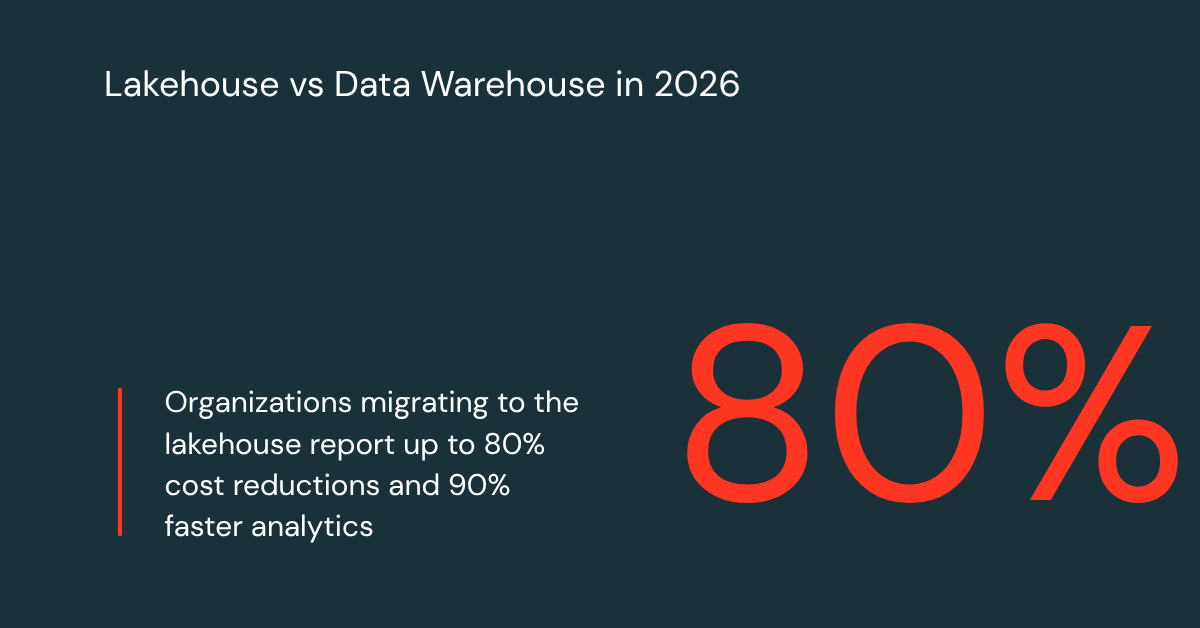
The strongest evidence isn't synthetic benchmarks, it's production results. Lumen Technologies migrated 133 TB of mission-critical telecom data from Cloudera/on-premises to Databricks Lakehouse and measured a 90% query performance improvement, with queries that took hours completing in minutes. Lumen also cut compute costs by 30-40% using Databricks Lakehouse Serverless. Trek Bicycle saw 80-90% faster retail analytics after moving to the lakehouse, going from one daily refresh to three. These aren't lab results. They're production workloads serving real business operations.
For workloads that need sub-second latency at high concurrency, Lakehouse//RT is a serverless SQL warehouse designed specifically for analytical reads. Databricks reports as low as 10 ms and up to 12,000 queries per second. It queries governed lakehouse tables directly, eliminating the need for a separate OLAP serving copy, CDC pipeline or synchronization layer. This matters because the traditional architecture for real-time analytics required maintaining a separate serving database alongside the warehouse. The lakehouse collapses that into one governed layer.
Matching SQL performance was the prerequisite. The real argument for the lakehouse is what it does beyond SQL.
Traditional warehouses were built for SQL users and BI tools. AI agents need governed access to structured tables, unstructured documents, embeddings and real-time signals from the same platform. Gartner describes this shift as a movement from the warehouse toward a broader "analytical control plane" that combines governed data, semantic layers, AI agents and execution capabilities.
Deloitte reported in 2026 that only about one in five companies had a mature governance model for autonomous AI agents. We believe the path forward requires platforms that govern data, models and agent behavior together, not warehouses that govern only tables
The lakehouse treats AI as a first-class workload. The same governed tables that power dashboards also power model training, feature engineering, retrieval-augmented generation and agent tool-calling. Unity Gateway extends governance to the AI runtime: controlling which models agents can call, logging prompts and responses, enforcing rate limits and governing MCP servers and tools.
Warehouses excel at rows and columns. But enterprise knowledge lives in documents, emails, PDFs, images, logs and code. A 2026 Komprise survey identified data classification and tagging as the leading challenge in preparing unstructured data for AI, while McKinsey's research on AI data readiness highlights the importance of connecting unstructured content with structured enterprise data.
The lakehouse stores all data types in open formats on cloud object storage. Structured tables, semi-structured JSON, unstructured documents and vector embeddings coexist under the same governance model. You don't need a separate system for each data type.
This is where the TCO argument gets real. Most warehouse architectures require data to flow from a lake to the warehouse, then get copied again into ML environments, feature stores or departmental extracts. Every copy costs storage, compute and governance overhead.
The lakehouse eliminates this by serving all workloads from the same governed data. SQL queries, Spark transformations, streaming pipelines, Python notebooks and ML training jobs all read from the same Delta Lake or Apache Iceberg™ tables. No copying, no synchronization, no lineage breaks.
Warehouses are batch-first. Data arrives on a schedule, gets transformed and becomes queryable hours later. The lakehouse supports streaming ingestion alongside batch, with data becoming queryable in seconds rather than hours. For use cases like fraud detection, operational monitoring and real-time personalization, it's a requirement and not a nice-to-have.
Warehouses that tightly couple storage, compute and proprietary data formats create switching costs that compound over time. The lakehouse runs on Delta Lake and Apache Iceberg™, open table formats that any compatible engine can read. Unity Catalog provides an open, multi-engine catalog layer with Apache 2.0 licensing, and UniForm generates Iceberg-compatible metadata from Delta tables so external engines can read the same data without copying it.
Customer stories are where the argument moves from theory to evidence. Here's what organizations measured after migrating from warehouses to the lakehouse.
| Organization | Migration | Cost result | | AXA Japan | Legacy warehouse to Databricks Lakehouse | 60% warehouse cost reduction, 70% lower ETL costs | | Posti | Oracle + Azure Synapse + custom warehouses to Databricks | 30% reduction in data-landscape costs | | Nationwide | SQL warehouses to Databricks Serverless | 29% overall cost reduction, 33% lower idle-compute costs |
| Vivriti Capital | Amazon Redshift to Databricks Lakehouse | 25-30% lower TCO | The pattern is consistent: 25-75% cost reductions, driven not just by cheaper queries but by eliminating redundant systems, duplicate data copies and multi-platform governance overhead.
| Organization | Migration | Performance result | | Lumen Technologies | Cloudera/on-premises to Azure Databricks Lakehouse | 90% query performance improvement (hours to minutes), 133 TB migrated | | Trek Bicycle | Legacy warehouse to Databricks Lakehouse | 80-90% faster analytics, 3x daily refreshes (from 1x) | | Thomas International | Snowflake to Databricks Lakehouse | 40% increase in development productivity |
| Organization | Scale | Timeline |
| [IndusInd Bank](https://www.databricks.com/customers/IndusInd-Bank) | 1.5 PB across 44 business areas | 15 months (vs. original 2.5-year estimate) |
| [Vivriti Capital](https://www.databricks.com/customers/vivriti-capital) | Redshift migration | ~8 weeks |
| Lumen Technologies | 133 TB, mission-critical telecom systems | 9 months, on time and on budget |
Migration timelines have compressed dramatically. Lakebridge automates assessment, transpilation and reconciliation across Snowflake, Oracle, Teradata, Redshift, BigQuery and SQL Server. The Databricks Migration Agent uses AI agents to translate SQL scripts across dialects, converting up to 300 files per batch. These tools don't eliminate the need for human validation, but they reduce the manual effort that made migrations prohibitively slow.
Here's where the warehouse retains advantages:
But these advantages matter less in 2026: the percentage of enterprise data workloads that are "SQL-only BI" is shrinking. Forrester's Q3 2026 Wave evaluated 14 leading lakehouse vendors. Gartner published its first Market Guide for Data Lakehouse Platforms in 2025 and followed with a Lakehouse Reference Architecture in 2026. Both firms now treat the lakehouse as a mainstream enterprise data-platform category. This tells us the warehouse's strengths are real but increasingly narrow as AI, streaming, and unstructured data become core enterprise requirements.
The organizations reporting the strongest results aren't running a lakehouse instead of a warehouse. They're running a lakehouse that is a better warehouse, plus everything else.
The architecture looks like this:
You don't need to migrate everything tomorrow. But you should start measuring the gap.
The warehouse was the right answer for a long time. The lakehouse is the right answer now, not because the warehouse broke, but because the question changed.
Get started:
[Try the TPC-DS evaluation on Databricks](https://docs.databricks.com/aws/en/sql/tpcds-eval)

[Read the warehouse-to-lakehouse migration guide](https://docs.databricks.com/aws/en/migration/warehouse-to-lakehouse)

[Try Databricks for free](https://www.databricks.com/try-databricks)
Is the lakehouse actually faster than a data warehouse for SQL queries? For most workloads, the lakehouse now matches or exceeds the performance of warehouses for SQL. Databricks Lakehouse has improved 77% since 2022, and independent TPC-DS testing shows sub-second p50 latency on 1-TB workloads at 74% lower cost than classic compute. The warehouse may still edge ahead on highly concurrent short queries with warm caches, but the gap is narrow and closing.
How much can I save by migrating from a warehouse to a lakehouse? Published customer results range from 25% to 75% cost reduction. AXA Japan reduced warehouse costs by 60%. The savings come from eliminating redundant systems and data copies, not just cheaper queries.
What about my existing BI tools like Power BI and Tableau? They work natively with Databricks Lakehouse through standard JDBC/ODBC connections. Your existing dashboards and reports connect to lakehouse tables without rebuilding. AI/BI Dashboards and Genie Agents add natural-language analytics on top.
How long does a warehouse-to-lakehouse migration take? It depends on complexity, but timelines have compressed. Vivriti Capital migrated from Redshift in ~8 weeks. IndusInd Bank migrated 1.5 PB across 44 business areas in 15 months. Lakebridge and the Agentic Code Converter automate assessment, SQL translation and data reconciliation to accelerate the process.
Can the lakehouse handle real-time analytics? Yes. Lakehouse//RT delivers sub-second analytical queries at high concurrency directly on governed lakehouse tables. Databricks reports sub-100-ms latency at 12,000 queries per second. For streaming ingestion, Zerobus and Apache Spark™ Declarative Pipelines provide sub-second data freshness.
Subscribe to our blog and get the latest posts delivered to your inbox.