Open Source CEO by Bill Kerr- Posts
- The Lab Builders Are Leaving
An interview with Andrew Dai, Co-Founder & CEO at Elorian AI. 📐 #
👋 Howdy to the 4,316 new legends who joined since our last edition! You are now part of a 477,403-strong tribe outperforming the competition together.
LATEST POSTS 📚
If you’re new, not yet a subscriber, or just plain missed it, here are some of our recent editions. 🧗🏻 Unfiltered: The System Vanta Built To Grade Its Own AI. How they build language models as the judge, human as the jury and more.
⚡️ [The Founder Lightspeed Backed Twice](https://www.opensourceceo.com/p/ali-hussain-interview). An interview with Ali Hussain, Co-Founder & CEO at Tabs.

🗑️ [The Future New Media: a16z](https://www.opensourceceo.com/p/a16z-guest-post). How the famous VC firm has thrown out the old playbook.
**PARTNERS **💫
Founding a company is easy, scaling it is hard. Operational systems break, people problems increase, and your calendar keeps getting fuller. Mochary Method is an executive coaching firm founded by Matt Mochary—coach of Sam Altman and Brian Armstrong, and writer of The Great CEO Within—that specializes in helping growing startups.
The Mochary coaching team, who coaches companies like AngelList, Lovable, and Midjourney, is offering a complimentary coaching session to founders and executives for a limited time.
Every founder hits the wall where there's more work than people. Viktor is the AI employee that lives in your Slack and Teams.
Brief him like a new hire and he writes the docs, builds the landing page, runs the campaign, and ships the code. Connects to 3,200+ tools and gets to work before you ask.
Interested in sponsoring these emails? See our partnership options here.
HOUSEKEEPING 📨
I’m sure by now everybody has seen the Trump financial disclosure report. But I feel like it’s irresponsible for me not to talk about it here today. What we are watching is brazen, unfettered corruption. The most disgusting part of it isn’t the 14,000 trades he’s on to make this year (Pelosi averages 15); it’s the fact he’s rug-pulled his closest supporters of $1.4 billion dollars personally, much more if you count his family.
Source: Reuters. This is the leader of the free world and someone whom many young people look up to. The damage that will have been done to our culture by the time these four years are up will be felt for decades to come. What a sad state of affairs. Anyhow, onto today’s interview!
INTERVIEW 🎙️
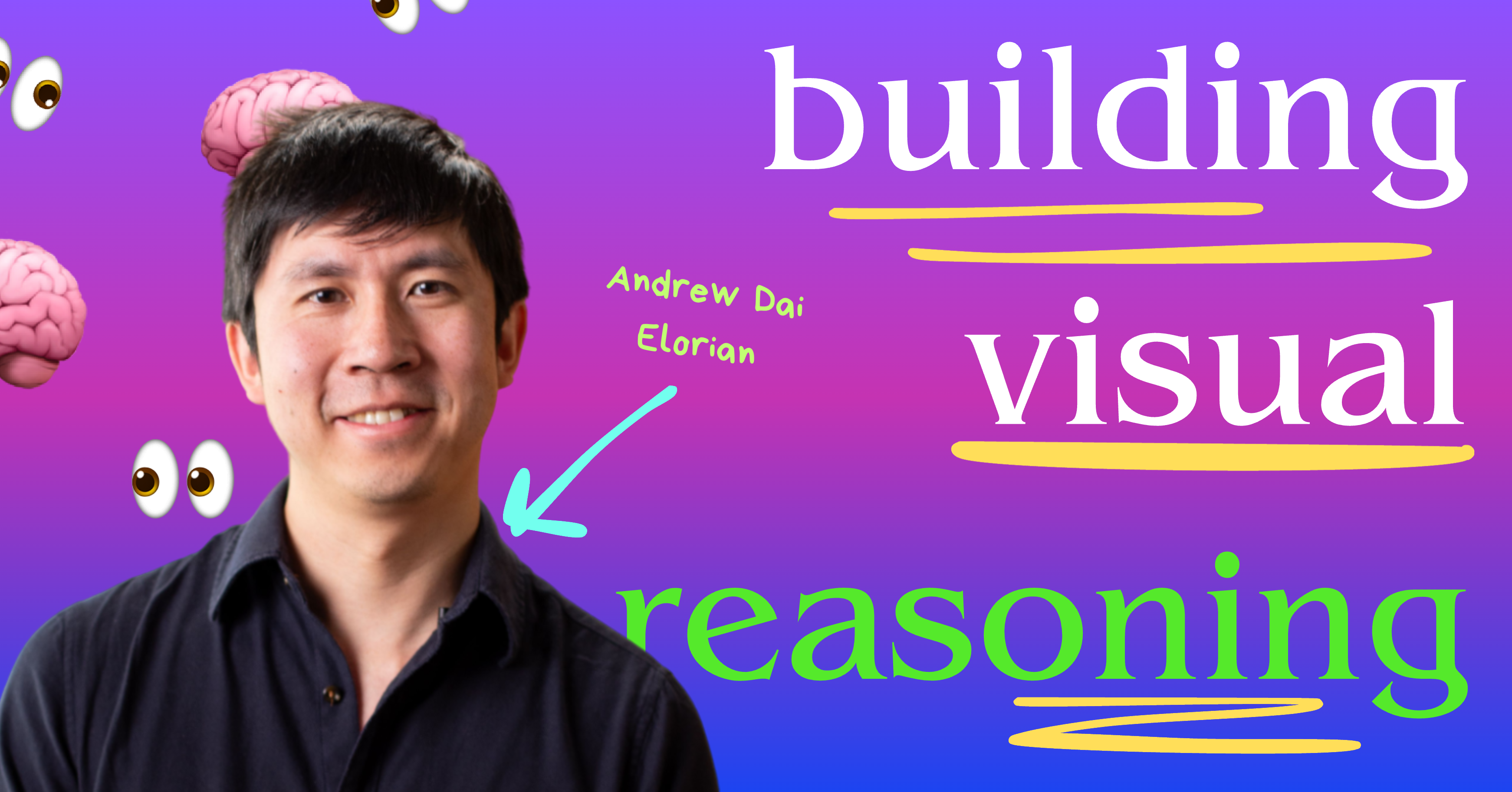
Andrew Dai is the Co-Founder & CEO of Elorian AI, a multimodal reasoning research and product lab based in Palo Alto, announcing a $55M seed round backed by NVIDIA, Menlo Ventures, Altimeter, Striker Venture Partners, and Jeff Dean personally. Andrew spent 12 years at Google Brain and DeepMind, most recently co-leading data for Gemini, a team that grew to 400+ contributors. Before that, he co-authored papers that quietly shaped the trajectory of modern AI, including an early sequence-learning paper with Quoc Le that predated GPT and GLaM, and a foundational paper on mixture-of-experts architectures.
The thesis at Elorian is that today's frontier models (including the ones Andrew helped build) have a fundamental blind spot: they can't reliably count, match shapes, or reason over what they actually see. He calls this the visual AGI gap, and believes it's both underappreciated and foundational. His co-founders are Yinfei Yang, who led multimodal research at Apple, and Seth Neel, a former Harvard assistant professor. The fact that Jeff Dean, the man Andrew reported to at Google, chose to back the company he left to start says something worth paying attention to.
We're building models for visual AGI. If you look at the current frontier models, they really fail some basic tasks that elementary school or high school kids can do, such as counting, reasoning over things, matching shapes, similar objects, and objects that aren't similar. The current models are really unable to do that.
I firmly believe you can't have AGI that can't count. If people are running out of a flaming building, you need to be able to count how many people ran out. That's a pretty important thing. We're filling that gap, and we're calling it ‘visual AGI’. It's a big gap that's not really well covered by any of the frontier models, and to do that, we're building a research and product lab. So not only are we pushing the frontier in research, but we also believe in having that research really affect people and improve their lives.
It's a lot more meetings than I expected. Even more than when I was leading the data area in Gemini. Meeting with candidates, meeting with our investors, meeting with potential customers, people in the industry who could really benefit from using these models. |
And then, of course, meeting with the team to brainstorm what the next research idea we want to go after is, the next modeling technique or data transformation we want to try to build a better model. I still have some time to do some vibe coding myself, or set up the AV system, user access, and even some random admin stuff.
Very different. The biggest thing is that we feel much more connected to what we're building. DeepMind is a few thousand people—a very big team—and there it's several steps between what you're building and seeing it in the actual Gemini product. That makes things a bit less connected. Things seemed further away.
Here, we have full control end-to-end: from building the model, to knowing exactly what data is going into it, to having full control over the API and whatever safety tuning we build. In Gemini, you could build something great, but then safety tuning could affect the final result in ways you couldn't fully predict. For us, we have complete ownership over the model and the product, and with that comes more responsibility to do it properly.
Our most important goal on the research side is getting to state-of-the-art in visual reasoning. We want to be better than any other model out there. The definitive model people use for visual reasoning and multimodal reasoning tasks. But we also want a solid public external API launch, which we're hoping for later this year. We want to get our model into the hands of people, into the hands of enterprises, and really see that it's clicking for them for their use cases. So, in the end, it's both: the research side and the product side.
Source: Elorian AI. We're an AI-native company, of course. We've all had a hand in building these models, so we don't shy away from using AI for coding and developing our infrastructure. But I think what's a bit more unique for us is that we also understand where AI is not working, where it's failing, where you shouldn't use it. These days, that's just as important to know. It's not only about knowing where to use it, but knowing where you shouldn't, and where you need to double-check the code and make sure everything is actually working.
We've seen a lot of issues, especially around visual tasks, where AI gives unreliable answers, so there we have to be more careful.
But it's definitely helping a lot with coding, which means we can build up our infrastructure very quickly. The other benefit is that we're starting from scratch. We're a new lab, and whereas other companies have a lot of old code that needs to be onboarded into coding agents, we don't have anything to onboard. Our codebase is a blank piece of paper, which means |
My motivation is the vision I have for making Elorian AI one of the world's leading frontier labs. If you look at a lot of the other labs out there (OpenAI, Anthropic, Thinking Machines Lab, Periodic Labs), a lot of those founders come from Google Brain—the same heritage I have. I spent 12 years at Google Brain, and I know a lot of those founders personally. It's very motivating that there are people who've gone down this path and been able to build great models and awesome companies. It gives me confidence that I can do the same: build really great models and build a company that genuinely pushes the frontier of AI.
Company culture is very important to us. We've seen how cultures can go badly at other places, creating toxic working environments and real problems, especially with researchers. For us, it starts with hiring. We have a very high bar. After our public launch, hundreds of people applied through our website, and we're likely going to hire very few of them. We've decided that even if someone is brilliant, if they can't work in a team, we wouldn't hire them. Maintaining a culture where everyone can work together matters more than any single person's individual output.
The Fellowship.
We also don't want to build five separate research groups that never talk to each other. You see that at big companies because they're so big; that's the only thing they can do. We've built a very close-knit team where everyone knows each other's strengths and weaknesses. Only then you can build the kind of trust and reliability that makes a team actually strong. That comes from both hiring and from team events. We have board games whenever people from our New York side join us. We have fun events, and we like to liven up the office. We even have a fountain on the patio one of our researchers is centering a zen space around.
We want to give people some variety in their days, a supportive team, and a mental space to think about things outside of work. With vibe coding, a lot of the boring stuff can just be done by AI now. We want to emphasize the team's creativity.
Ex-Google DeepMind researchers’ Elorian raises $55m- April, 2026Elorian Founder Spotlight | Andrew Dai- April, 2026AI Mastered Language. The Harder Problem Was Vision- April, 2026
And that’s it! You can follow Andrew on LinkedIn or check out Elorian AI on their website to keep up with what they’re building!
BRAIN FOOD 🧠
TOOLS WE RECOMMEND 🛠️
Every week, we highlight tools we like and those we actually use inside our business and give them an honest review. Today, we are highlighting Lightfield*—an AI-native CRM that assembles itself from your email, calendar, and meetings.
See the full set of tools we use inside of Athyna & Open Source CEO here.
**HOW I CAN HELP **🥳
Hiring global talent:If you’re hiringtech, business or ops talent and want to do it 80% less, check out my startup,Athyna. 🌏See my tech stack: Find our suite oftools & resourcesfor both this newsletter and Athynahere. 🧰Reach an audience of tech leaders:Advertisewith us if you want to get in front offounders, investors and leadersin tech. 👀