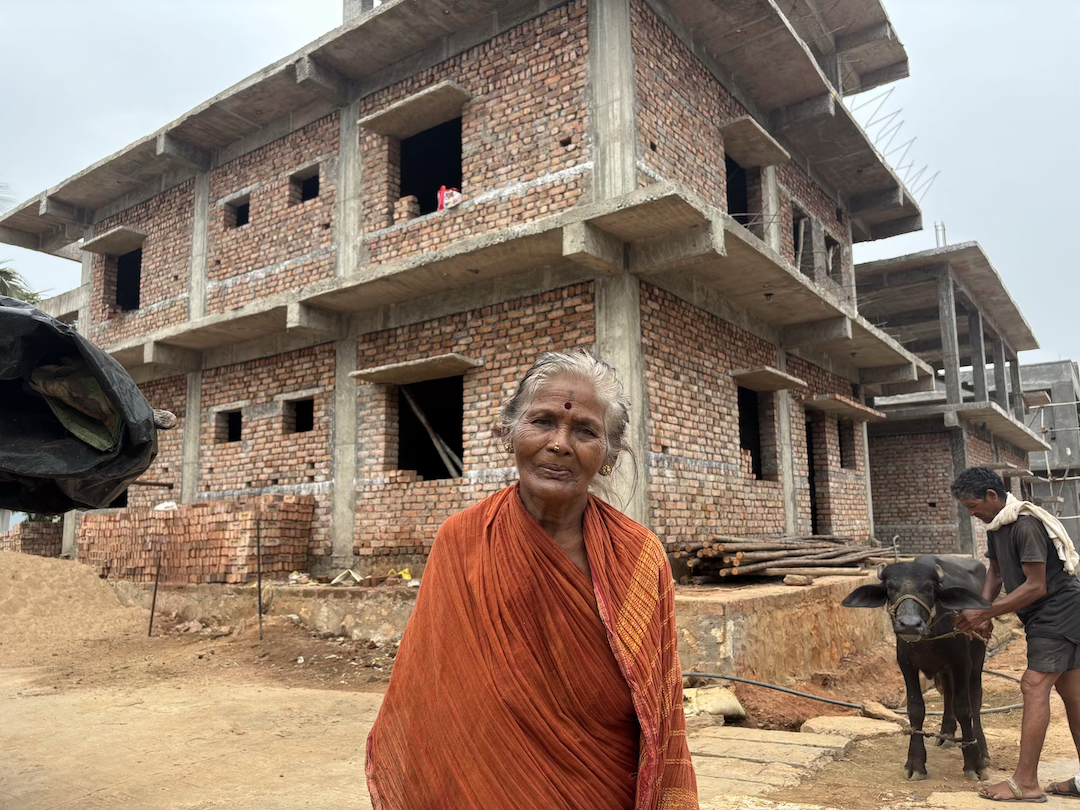
Google’s $15 billion AI data center in southern India is being hailed as triumph for India’s technological development. For the local Dalit farmers losing their land for the project, it is raising fears about the future of the region’s land and water.
For nearly six months, Relli Ramakrishna has not made the daily walk to the small farm where she spent most of her life cultivating cashews, mangoes, and seasonal vegetables. Now her mornings pass in a quiet repetition of boredom. She stays at home, attending to chores that end long before the day does. “There is nothing left for me to do,” she says. “The farm was my work. It was where I spent my time.” The land in Tarluvada, a village on the outskirts of Visakhapatnam in the southern Indian state of Andhra Pradesh, was acquired as part of Google’s ambitious plan to build a large data center across three sites, a project the government has championed as the cornerstone of India’s artificial intelligence ambitions.
Alphabet, Google’s parent company, plans to invest $15 billion over the next five years to build the data center, its largest outside the United States. It will be linked to Singapore, South Africa, Australia, and the US through a network of sub-sea and terrestrial fiber optic cables.
For families such as Relli’s, however, the arrival of AI has begun with the disappearance of the land beneath their feet.
The AI Land Grab #
Relli, who is in her late sixties, belongs to a Dalit community — a group historically discriminated against under India’s caste system and still, by most measures, India’s most land-poor community. Between 58 and 71 percent of rural Dalit households are landless. In the 1970s, the Andhra Pradesh government allotted small parcels of land to Relli’s family and fifty others in Tarluvada — two acres each for cultivation, along with additional plots for housing.
“Before this land, we survived on the goodwill of dominant-caste landowners we worked for,” Relli says. “Some days we weren’t paid at all — just given rice porridge for a day’s labor.”
The allotted land was rocky, uneven, and barely fit for cultivation, she says. Over the years, her family leveled the ground, improved the soil, and planted cashew and mango trees, turning it into a dependable source of income. “We made it fertile with our blood and sweat,” says Relli.
The farm earned her family nearly 100,000 rupees ($1,048) a year — modest by most standards but enough to transform their lives. “This land lets us stand on our own,” she says.
The Tarluvada site is now part of the land the state government has acquired for Google’s data center. The fifty-one families were offered eight million rupees ($83,848) — 4 million rupees for each acre — along with a promise of land equivalent to one-fifth of their acquired holding elsewhere, though where remains unclear.
The compensation has largely been distributed, but residents say they had little warning of what was happening. “No one asked us if we wanted to leave,” says Pyla Kondamma, a farmer and former head of the village council. “They just told us to hand the land over. This is our way of life — why should the decision about whether to give it up not be ours?”
The state has described the payout as generous, but Dr E. A. S. Sarma, a former secretary in India’s power ministry who has opposed the project, argues that the state has effectively subsidized Google’s investment by acquiring land at prices far below its market value. “The people who are subsidizing this project are Dalit and small landholding families,” he says. “They are being paid a fraction of what the land is actually worth.”
For many families, the compensation offers a chance to patch over years of deprivation. Some are expanding single-story homes into two- and three-story concrete buildings. Others are replacing aging brick structures with new houses. “The land is gone now. We cannot bring it back. At least this money gives us a chance to build a proper house on the land that remains,” says resident P. Bangarama, sixty.
Compensation Does Not Buy Consent #
The construction boom, however, should not be mistaken for acceptance of the acquisition, says Sushmita Pati, a political scientist at the National Law School of India University. Compensation, she says, often produces two parallel realities: the grief of losing land that embodies “livelihood, identity and emotional attachment,” alongside the opportunity to fulfil long-deferred aspirations through an unusually large lump-sum payment. “People don’t give up land out of happiness,” she says. “Those two realities can exist simultaneously.”
For Dalit families in particular, Pati says, compensation may finally enable investments that had remained out of reach for generations, but it does not erase the loss of agricultural land. Rather, she says, it reflects how communities negotiate dispossession — making pragmatic decisions about the resources they have left while continuing to mourn what they have lost. Not everyone is ready to build. Shankar Chandala, twenty-nine, remains undecided about whether to invest in a new home amid the uncertainty of what the data center might bring.
“What will these data centers leave us with?” he asks. “They will need enormous amounts of water and electricity. What if there isn’t enough water in the future? What if, a few years from now, they want to expand again, and we’re asked to give up our homes the way we gave up our fields?”
Chandala says he has spent months reading about such “hyperscale” data centers and the strain they can place on water, electricity, and the environment.
“I always dreamed of building my own house here,” he says. “But a dream house is one where I don’t have to worry about water, pollution, or losing my home again. I’m not sure I can build that here anymore.”
His worry tracks with what is publicly known about the industry: a large data center can draw up to five million gallons of water a day at full operation — roughly the daily water use of a town of 10,000 to 50,000 people.
Evading Public Review #
Google did not respond to Jacobin’s questions about the data center’s expected water and electricity consumption, nor has it publicly disclosed those figures.
For many residents of Visakhapatnam, water is already rationed. Households receive piped supply for only a few hours each day, while many informal settlements depend largely on private water tankers. As of April 2026, Visakhapatnam had Andhra Pradesh’s lowest groundwater reserves available for use. To position Visakhapatnam at the center of India’s AI ambitions, the Andhra Pradesh government has assembled an incentive package worth an estimated 220 billion rupees (about $21 million), offering Google’s project concessional land, tax waivers, subsidized electricity, and expedited clearances. But environmental groups say the government’s drive to accelerate the project has come at the expense of due process and ecological scrutiny.
Despite their vast demand for land, water, and electricity, data centers are regulated as conventional construction projects under India’s environmental clearance regime, placing them under a state-level appraisal process rather than the more stringent central review, which requires public consultation.
The regulatory distinction has had tangible consequences, with two of Google’s three proposed sites, covering about 440 acres, securing state environmental clearance in about ten days. One of the sites is less than a mile from Kambalakonda Wildlife Sanctuary, an ecologically sensitive forest that supports wildlife including the Indian leopard.
V. S. Krishna, an activist with the NGO Human Rights Forum, says the ongoing hill-cutting and forest clearance could disrupt the natural drainage that feeds the local Mudasarlova Reservoir, threatening both the wildlife corridor linking the sanctuary with the adjoining Kailasagiri forest and water supplies to much of Visakhapatnam.
At the third site, spanning the villages of Adavivaram and Mudasarlova, the Human Rights Forum alleges that forest land was cleared and hill-cutting had already begun before the project received environmental clearance. “The clearance process was reduced to a fait accompli,” says Krishna. The Andhra Pradesh State Environment Impact Assessment Authority later granted clearance for the site.
Hungry for Power #
Energy is another flash point. A data center of this scale could require as much electricity as a midsize city, raising concerns about the strain it could place on Andhra Pradesh’s power grid. Although Google has committed to powering the facility with renewable energy, state officials have acknowledged that renewable energy alone cannot reliably meet its demands, and that additional coal-fired generation will be required to ensure around-the-clock supply.
“Data centers don’t eliminate pollution by buying renewable electricity,” Krishna says. “If the grid still relies on coal to guarantee uninterrupted power, the environmental and health burden is simply displaced to communities living around coal-fired power plants. Someone else ends up paying the price.”
With construction advancing and earthmovers reshaping the landscape, many residents acknowledge that stopping the project may no longer be realistic. Instead, the struggle has shifted toward demanding transparency over its environmental impacts, stronger safeguards, and a greater share of its promised benefits. With villagers, the Human Rights Forum has filed objections, organized public meetings, documented construction activities, and launched a petition seeking the disclosure of the project’s water and electricity requirements.
Residents in Tarluvada say the space for dissent has narrowed as the project has gathered pace. Several people say police presence intensified around the village during the inauguration of the project in April by the chief minister of the state, N. Chandrababu Naidu, discouraging public protest.
The pressure has extended online. In recent months, the Human Rights Forum reported that its Instagram posts documenting the project were being restricted, and the Environmental Reporting Collective, a journalist network, says an investigative video examining the impact of the data center on Dalit land has been blocked in India.
Meanwhile, Google’s servers are expected to come online in 2028. Chandala says he is still trying to imagine what his future will look like by then.
“Will we get the land the government promised us to cultivate?” he asks. “Or will we become landless Dalits again?”