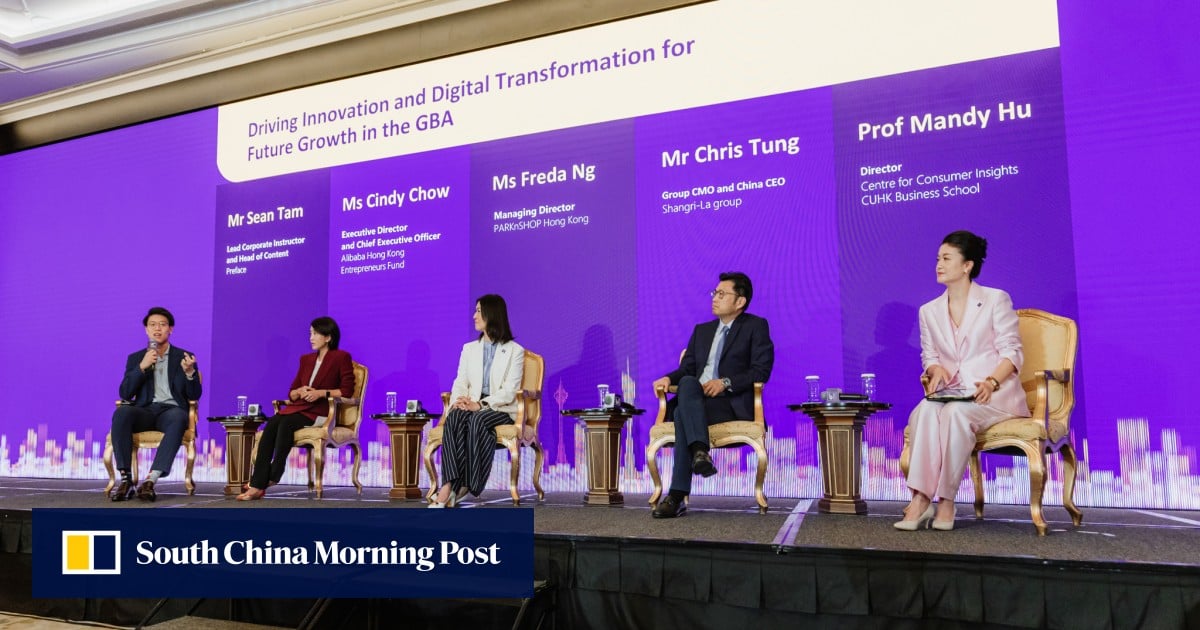
Discussion panels at the Greater Bay Area CEO Forum establish fiscal, digital, and consumer strengths that make it the ideal AI habitat
[The content of this article has been produced by our advertising partner.]
In 2022, the concept of functional, intuitive, and interactive artificial intelligence (AI) systems leapt from the domain of science fiction into reality, powering the imagination of consumers, corporations, and governments alike with its seemingly incalculable potential. In the four years since ChatGPT launched digital disruption into every facet of the global economy, the technology has evolved at breakneck speed, and a host of worldwide competitors have launched their own flagship AI models. Meanwhile, consumer behaviours and online experiences have transformed, with brands rushing to master AI implementation and emerge the victor in a new arms race for visibility. And while this initial burst of hype and energy was impressive, there are now growing calls for clearer financial sustainability and proven results. It seems likely the full value of AI will only be realised via its continued development and implementation in the stable and fully integrated economic ecosystems and digitally receptive markets offered in regions like the Greater Bay Area (GBA).
At the inaugural Greater Bay Area CEO Forum in April, 200 prominent business leaders, policymakers and industry experts convened. Hosted by the Chinese University of Hong Kong (CUHK) Business School, the conference showcased two panels, wherein attendees brought up factors that identify the GBA as the ideal nursery habitat for the next stage of AI’s evolution and investment in both fiscal and practical terms.
A financial foundation
It was during the first panel, *Navigating Global Headwinds and Forging Resilient Financial and Business Strategies *— moderated by Dr Eric Lam, senior lecturer in the Department of Finance at CUHK Business School — that the economic strength and security of the GBA was put in focus. Hong Kong’s individual role within the GBA was given special attention, especially as a super-connector for global markets and investment, the latter being crucial to the continued growth of AI.
Martin Matsui, former chief strategy officer, Exchange Fund Investment Office at the Hong Kong Monetary Authority, noted how consensus estimates placed the GDP growth of China (4.5%) and Hong Kong (3%) both ahead of the United States (2%) and the European Union (1%). But he expanded on Hong Kong’s specific role within the GBA as being defined by its stability. The resilience of its banks, linked exchange rate system, and financial infrastructure has made the city a trusted financial testing ground for fresh initiatives, citing Stock Connect, Bond Connect and Swap Connect as recent examples.
Matsui said, “Every time there is a new experiment, Hong Kong will play an important role.”
Yan Xuan, senior fellow, The Pacific Forum reinforced this message of Hong Kong’s continued value owing a great deal to its stability, adding his own thoughts that the city has also cemented its identity as an anchor for companies with global ambitions.
Yan said, “The winning formula for Hong Kong is to maintain and enhance its vital role in upholding predictability, consistency, the common law system and the tradition of respecting contractual rights. If this is accomplished, Hong Kong’s impact will only grow.”
These opinions on the power of stability were further echoed by Vincent Chui, head of wealth management, Asia Pacific, Morgan Stanley. Chui voiced that the GBA overall offers a degree of predictability that is enticing to investors, who are looking to take products from conception all the way to market at a reliably fast pace. When considering investment, Chui framed Hong Kong’s evolution as going from a fundraising centre into a full capital platform, with stability at the core.
Chui said, “What do institutional investors care most about? Stability, trust and assets. Hong Kong plays that role. We are no longer just a gateway. Hong Kong is now a platform that strategically connects China and global capital in a much deeper way.”
A solid support structure
It was during the forum’s second panel,* Driving Innovation and Digital Transformation for Future Growth in the GBA* — hosted by Professor Mandy Hu, director of CUHK Business School’s Centre for Consumer Insights — where the subject of AI was directly approached. The discussion covered how AI is currently thriving in the GBA, introducing new business models and changing both consumption patterns and brand approaches.
Cindy Chow, executive director and chief executive officer, Alibaba Hong Kong Entrepreneurs Fund drew attention to China’s multiple advantages as a leader in AI development. She stated that China maintains energy capacity at around eight times that of the United States, yet does so at only 40% of the cost, all while continuing to build data centres at around 60% of the US price. While China still falls behind in chip production compared to the US, Chow countered that the country is driving advancements in performance and in producing some of the world’s top open-source models. Adding to all this is something that cannot be replicated elsewhere: a wealth of data generated over 20 years by a population that is extremely comfortable using and adapting to online technology. All this has resulted in the GBA companies having the edge when it comes to AI.
Chow said, “We are still very optimistic about how AI agents can change how we work, how we live and help entrepreneurs turn their dreams into reality.”
Sean Tam, head of content, Preface provided the perspective that AI will not only benefit large corporate entities in the GBA but small to medium-sized businesses as well. The key factor in doing so, however, will be that they fulfil three competitive pillars: deploying AI agents strategically to maximise workplace productivity; moving on from identifying simple keywords for search engine optimisation to providing robust summary copy for generative engine optimisation; and carving out a recognisable niche through establishing a distinct online voice.
Tam said, “The workforce in the GBA is full of potential. It’s just about whether everyone can speak the same language and have the same basis of AI knowledge. I really look forward to hyper-connectivity, global connectivity and of course, cross-industrial vertical consolidation in the GBA.”
Building better brands
Chris Tung, group chief marketing officer and China chief executive officer, Shangri-La Group agreed that AI-savvy business leaders in GBA are adapting already, especially to the heightened importance of a brand voice. He suggested that brands should identify unique stories that will stand out and turn up in results beyond the standard information expected.
“We need even stronger differentiation in today’s AI era,” Tung said, “because otherwise the agents will not grasp your brand. This is a make-or-break factor.”
That message also resonated with Freda Ng, managing director, ParknShop Hong Kong. She emphasised that while AI features can help guide consumer experiences, brands in the GBA who thrive using AI will do so while focusing on building emotional connections.
“What is your brand about? What’s your personality, your purpose? How do you connect with your customers’ emotions? How do you make their experience fun?” Ng asked. “All of this is even more important than before.”