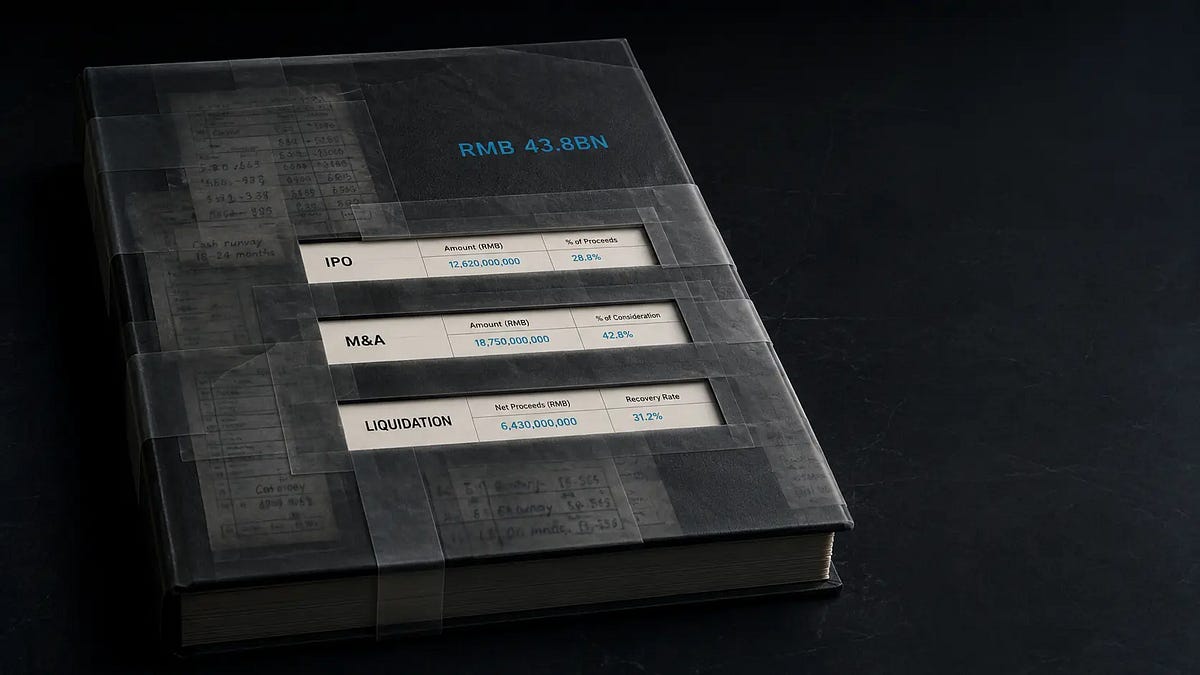
Rmb 43.8bn raised by June 12; the spending record is mostly rumor, and the few mandatory filings disagree.
In a story circulating through China’s robotics industry, an embodied AI company paid Rmb 100m, partly in equity, for a few minutes of exposure at a televised gala. The board was not asked. Investors later gathered in the founder’s office; at least one pounded the table. The episode comes from a contributed deep-dive published August 13 by TMTPost, a Chinese tech business outlet, which named neither the company, the show, nor anyone in the room.
The same report describes a dinner at which founders compared cash runways. One said his company had 50 months of cash. Another claimed 100. Neither number can be traced to a financial statement.
The stories may be true. The verifiable record is much thinner: robot makers did appear on CCTV’s 2026 Spring Festival Gala, China’s most-watched broadcast, and when 36Kr, a Chinese tech news site, relayed chatter that companies had bid Rmb 60m to Rmb 100m for gala slots, one company denied it and another went silent. Even the sector’s most public spending exists only as deniable rumor.
The money behind the rumors is real. By one count from QbitAI, a Chinese AI-focused outlet, embodied AI companies raised about Rmb 43.8bn (roughly $6.4bn) in 2026 through June 12; the figure is a media tally, not a regulatory dataset. Single rounds are enormous: TARS Robotics, a Chinese embodied AI startup, closed a $455m Pre-A round in April that the company billed as a sector record.
China’s embodied AI sector is described by two competing records. One is a folklore ledger: gala invoices, runway boasts, hoarded billions, sourced to people who cannot be named, making claims no filing can check. The other is the record produced under mandatory disclosure, and for a sector that has absorbed tens of billions of renminbi it is thin: three disclosure events. An IPO prospectus. An acquisition announcement. A liquidation file. Each shows a company losing the right to choose its numbers, and where those numbers touch the folklore, the folklore fares badly. In a market where consensus is manufactured faster than evidence, unverifiable spending stories help set prices whether or not anyone designed them to.
A ledger built from hearsay
The folklore’s consistent theme is cash as identity. The TMTPost report describes a house style of extreme thrift that insiders reportedly nickname the “outlast-them” playbook, with companies parking funding in wealth-management products and running teams off the interest. It describes two sets of accounts, one sent to an investor by mistake, killing a Rmb 20m to 30m round, and institutions posting finance and anti-fraud staff inside portfolio companies; not one of these stories names a company.
The anonymous accounts rarely follow the thrift through to its operating consequences. In the report’s grimmest anecdote, a company froze research hiring, cut component-validation batches and postponed data collection to stretch its runway by nearly a year, then watched rivals poach its engineers while a product meant for small-batch delivery failed to reach production because of component-compatibility problems. A hardware executive quoted in the report has a name for the condition: a well-funded stall.
Private-company stories describe discipline. Mandatory disclosure measures it: spending mix, losses, liquidity, who actually runs the company. The three cases that follow are not a sample of the sector; they are the moments it became measurable.
If the folklore ledger reading is new to you, this is a preview of what Hello China Tech does three times a week: reading China’s AI, chip, robotics, and EV sectors from primary sources most English coverage never touches. Subscribe free to get every new analysis as it publishes.