Tl;dr
New EU regulations (EU Directive 2024/2853) will require all software products to be held responsible for damages caused by faulty code. In the case of “Black Box” products that rely heavily on AI-assisted development, the courts may assume the software code is defective. Ninchi offers a lightweight, low-friction means to protect against this issue by documenting human understanding in AI-assisted software development.
The AI Liability Trap
Do you truly understand your code and the products it powers? The European Union regulatory landscape is undergoing a massive shift for software engineering; by December 9, 2026, companies need to know the level of human understanding in the code they ship.
Under EU Directive 2024/2853 (Product Liability Directive), software (“including standalone applications, cloud-hosted SaaS, embedded firmware, and artificial intelligence models”) is now classified as a “product” and subject to strict, no-fault liability. EU Member States must put this directive into national law by December 9, 2026, after which software providers will be held responsible for physical harm, medically certified psychological damage, and data destruction or corruption caused by defective code.
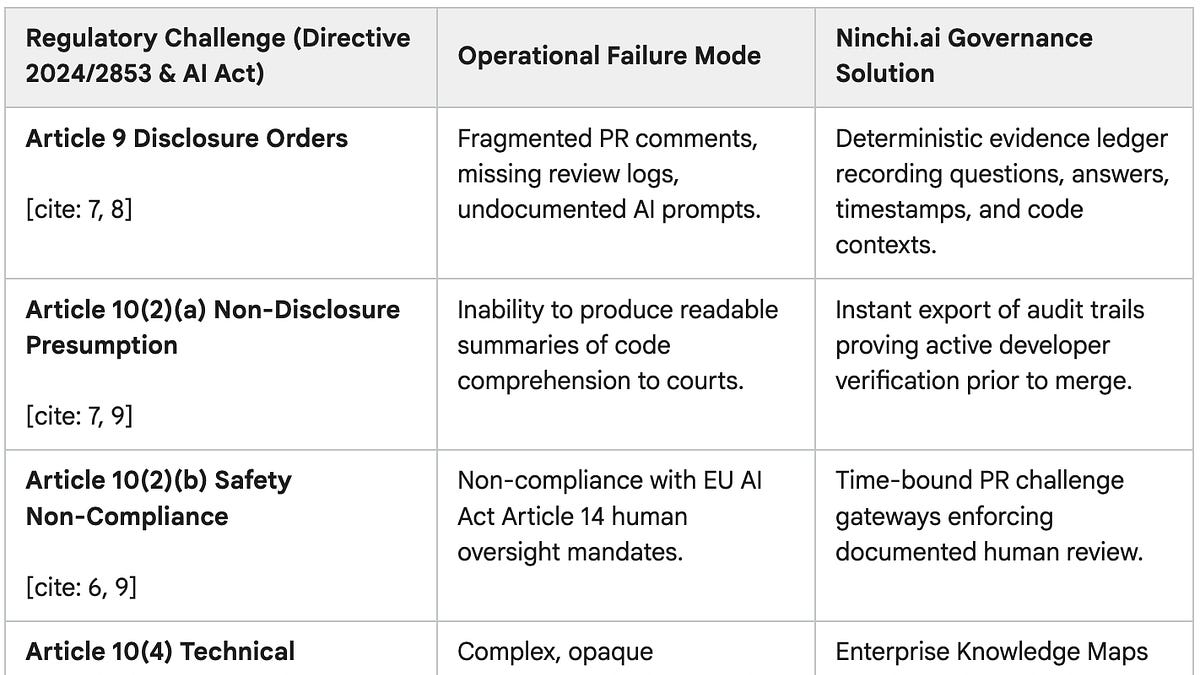
Let me be even clearer — Directive 2024/2853 transforms the mechanics of litigation through Articles 9 and 10:
-
Article 9 (Disclosure of Evidence): Courts can order software providers to disclose internal design files, risk assessments, and code review histories in easily understandable formats.
-
Article 10 (Presumptions of Defectiveness): If a company fails to comply with disclosure obligations, violates safety mandates (such as the EU AI Act’s Article 14 human oversight rules), or deploys complex “black-box” systems that make technical proof difficult for claimants, courts willlegally presume the software is defective .
This statutory realignment is happening just as we are adopting AI coding assistants across companies of all sizes. While 84% of software developers actively use generative AI tools—generating or assisting over 42% of newly written code—this reliance often outpaces engineering teams’ ability to verify the output. This creates a critical ‘Understanding Debt’ problem, in which an increasing portion of the codebase is deployed without confirmed human comprehension of its underlying logic, edge cases, or long-term structural integrity.
When software failure occurs, relying on superficial “rubber-stamp” pull request approvals offers no legal defense. Software developers and enterprise integrators must prove deterministic, documented human ownership and technical understanding of the AI-generated code deployed to production. It is no longer good enough for your code to function as expected or intended. If you can not show that your engineers understand the code, you can be held liable for a claim by default.
The “Understanding Debt” Gap in Modern Engineering #
While traditional engineering teams routinely track technical debt, generative AI introduces a far more dangerous phenomenon: Understanding Debt. Understanding Debt represents the proportion of a codebase where code is deployed without verified human comprehension of its underlying logic, edge cases, or security boundaries. When developers merge multi-hundred-line AI code diffs after only a brief visual glance, the organization loses context. If that unverified code later causes system corruption, data loss, or physical safety incidents, the lack of documented human review triggers the Article 10 presumption of defectiveness.
To survive judicial scrutiny under Directive 2024/2853, engineering leadership requires an operational platform that embeds accountability, transparency, and auditability directly into the daily developer workflow without destroying development velocity.
Ninchi.ai: The Accountability and Verification Layer for AI Code #
Ninchi provides the missing governance infrastructure for software development teams. Designed to integrate into existing Git workflows (including GitHub and GitLab) in seconds, Ninchi transforms subjective code approvals into verifiable, timestamped evidence of human understanding.
1. In-Workflow Developer Challenges (Sub-60-Second Verification)
Rather than adding heavy manual documentation requirements, Ninchi operates seamlessly within the Git pull request review cycle:
-
When a developer or AI assistant submits code changes, Ninchi analyzes the diff and automatically generates targeted, context-aware challenge questions.
-
Developers answer these lightweight challenges directly within their review flow in under 60 seconds, proving they understand the execution logic, edge cases, and safety implications of the submitted code diff.
-
The platform logs every verification event—capturing the specific question, response, difficulty score, code artifact context, and timestamp into a secure, verifiable evidence record.
2. Individual User Ledgers and Baselines
Ninchi establishes an individual Understanding Ledger for every engineer across connected repositories.
-
Organization administrators can inspect a developer’s recorded evidence broken down by specific repository areas.
-
The system distinguishes between evidence gathered dynamically during PR challenge history and evidence collected through targeted knowledge assessments.
-
Rather than ranking developers, this ledger acts as a transparent, objective mirror of demonstrated comprehension, providing concrete proof that a qualified human engineer actively vetted and owned the code before deployment.
Enterprise Governance: Knowledge Maps & Understanding Debt #
For larger organizations with complex and multi-layered product and code structures, Ninchi can turn fragmented codebase risks into quantifiable, actionable insights:
Repo Knowledge Maps
Ninchi automatically scans enterprise repositories, organizing them into key architectural areas ranked by codebase size, structural importance, and recent commit activity. It visualizes the programming language mix and continuously refreshes as the codebase evolves, giving leadership complete structural transparency.
Quantifying “Understanding Debt”
Ninchi combines repository facts with recorded challenge evidence to calculate Team Evidence Coverage.
-
Coverage is weighted by module importance—meaning critical safety components or core transaction engines contribute more heavily to overall coverage metrics than minor utility scripts.
-
The platform explicitly identifies “Single-Contributor” regions (where only one engineer possesses verified knowledge). It calculates the organization’s totalUnderstanding Debt —the percentage of important codebase areas lacking verified human understanding.
Privacy and Security Architecture
To meet strict enterprise compliance standards, Ninchi operates on a zero-retention, data-minimization architecture:
-
Source code is processed ephemerally solely to analyze changes and generate challenge questions; code is never stored long-term and is never used to train external AI models.
-
Enterprise clients can Bring Your Own LLM (BYO-LLM) provider, processing all content strictly through client-managed API keys.
-
All platform communications and stored evidence logs are encrypted at rest and in transit, supported by complete admin audit logs.
The Legal Strategy: Building a Defensible Audit Trail #
When the transposition deadline for Directive 2024/2853 passes on December 9, 2026, software providers will no longer be able to hide behind warranty disclaimers or black-box AI explanations. When a product liability claim arises:
-
Under Article 9 , courts will order the software manufacturer to produce evidence of due diligence. Unstructured Slack messages and empty PR approvals will fail this test. With Ninchi, organizations can instantly export a complete, court-ready audit trail detailing every developer verification event, timestamp, and challenge score tied to the exact code release.
-
Under Article 10 , claimants will argue that complex AI coding outputs create a presumption of defectiveness. Ninchi’s Enterprise Knowledge Maps and User Ledgers provide undeniable, mathematical evidence that human oversight was actively maintained, directly rebutting statutory presumptions.
By pairing AI development tools with solutions like Ninchi.ai, forward-thinking engineering leaders can accelerate software delivery velocity while building a strong legal defense—turning AI code accountability from a compliance headache into a competitive advantage.