Code review as we understand it today will probably not survive the shift to AI-generated code, but is that a problem? Code review is under pressure from agents producing code at an incredible pace, and reactions to that are quite split. There are many who want to protect code review as a core human software engineering practice, who put in place strict policies to preserve it. Others argue that code review is effectively dead, because it cannot keep up with the pace of production and will not survive competitive pressures if it becomes a bottleneck. Many experiment with automating code review at least partially. Implicit in this discussion is often the assumption that our prior code review practices were a gold standard, something to save or something to mourn. But is that really the case?
Code review did not always look the way it does now (or at least the way it looked until coding agents took off). The contemporary practice that we now all know – tool-mediated, CI-integrated, lightweight review of individual commits, usually integrated with testing, static analysis, and other automation – is what reviewers call modern code review to distinguish it from other forms of code review and inspection.
Modern code review is called modern in contrast to older practices that many junior engineers have probably never seen and that we barely teach these days, most popular among them Fagan-style inspections. These were heavyweight processes, popularized in the 70s and widely studied through the 80s and early 90s: Multiple reviewers read small fragments of code line by line before release (not incrementally while code is created), often meeting to talk it through and sometimes reading it aloud. Fagan-style inspection was widely taught and written about (e.g., Wiegers’ book “Peer Reviews in Software”). Studies showed it to be the most effective technique to find bugs we have, more effective than testing. But it is slow and expensive, easily costing more than 8 developer hours across 3 reviewers, a moderator, and the author for reviewing merely 400 lines of code. That cost limited how much code could be reviewed. Fagan-inspections were well known in principle but only sparingly used for high-stakes settings – often to review the critical core of a product.
The lightweight practice that eventually took over grew out of patch-by-patch review in open-source projects and converged, remarkably, on nearly the same practice in companies and in GitHub’s pull requests. Studies are clear that modern code review is pretty bad at catching bugs, catching mostly shallow ones and readability issues (though better tooling has given reviewers a chance to go deeper). However, compared to Fagan-style inspections, it is cheap enough to do for all changes. While modern code review is not great at catching bugs, it provides many other benefits: forcing “developers to write code that other developers could understand,” fostering collective code ownership and awareness, supporting learning and mentorship, surfacing optimization opportunities, and enforcing conventions. Review has shifted, in Rigby’s phrase, from a defect-finding activity to a group problem-solving one.
There may be many plausible reasons for the almost universal adoption of modern code reviews – whether companies copying successful open source practices (coined “inner source”) or just wanting to be more like Google, whether inertia, or whether developers just do not trust their interns – but let’s assume somewhat rational actors: If modern code review wouldn’t have provided any benefits, we would have stopped spending so much effort on it. For the sake of this argument, let’s assume, the community has eventually settled on an equilibrium where the value modern code review provides just justified its cost in a pre-AI world, whether through catching bugs or through those other benefits.
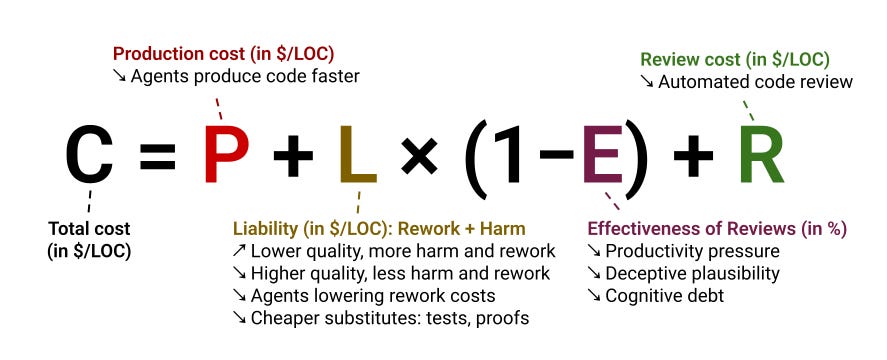
Before looking at how agentic coding puts code review under pressure, let’s posit a simple model that will help to untangle various moving parts to help put various forces into perspective.
- P : The cost of producing code, in $ per line.
- L : The liability of that code, in $ per line, meaning the expected future cost of its quality problems. Let’s assume liability has two parts: (a)Rework , the cost of finding and fixing bugs or in the worst case rearchitect the entire system. (b)Harm , the cost when problems escape to the outside world as security incidents, reputational damage, and losses to customers we may need to reimburse, sometimes after lawsuits. Rework is internal and is the main concern for low-stakes software, but harm is visible externally and can be substantial in high-stakes software.
- R : The cost of reviewing code, in $ per line.
- E : The effectiveness of review at reducing liability, as a percentage.
Overall cost per line is then P + L × (1 − E) + R. In a rational-actor world, teams invest in code review exactly up to the point where the last dollar spent on it just offsets the liability it removes.
For high-stakes code with high potential liability (L), it is rational to invest heavily (R) into making review more effective (E), up to Fagan-style inspections. For most code, stakes are not that high and liability comes mostly from rework. Also many other efforts have helped reduce liability without code review: Modern languages prevent whole classes of memory defects, static analysis catches many issues, and test generation and continuous-integration automation move testing into the cost of production. In that setting, shallow and fairly ineffective modern code review looks rational with modest cost for modest liability reduction. Agentic coding clearly has the potential to lower the cost of code production, but it can also influence the cost and effectiveness of code review, and the liability of typical code produced. The specific effects are often disputed, point in different directions, and interact with various things changing at the same time. The model can help us to untangle what we might expect to happen.
Production cost (P) is the obvious starting point but only part of the story. [↘ production cost] Agentic coding promises to drastically cut the cost of producing code (P). If nothing else changed (e.g., same code review, agentic code producing the same liability as human code), review cost (R) and liability cost (L) limit how much we can reduce overall cost. For example, even if production costs are reduced by 90%, overall costs would just be reduced by 30% if production accounted for only a third of the costs previously. This effect likely explains some of the discrepancies between frequent claims of 10X productivity improvement (which may even feel intuitively right seeing how quickly code is produced) and much lower productivity improvements measured in academic studies (rarely above 30%). If production cost is the only thing that changes, code review feels very much like a bottleneck limiting progress.
Agentic coding affects liability (L) in at least three plausible ways, and it is not obvious where we will land. When it comes to code quality and liability, the effect of coding agents is disputed.
[↗ liability due to lower code quality] First, there is some evidence (including our own study) that coding agents produce code of lower quality than humans, so that it needs more rework later. Also there are plenty of stories of harms from poor agentic code, like the multiple security incidents in the vibe-coded Moltbook and multiple AWS outages reported to be caused by agentic coding tools. All of that would point toward increased liability of code generated by coding agents, which could call for more scrutiny with code review.
[↘ liability due to better code quality] However, it is also plausible (even today with enough iteration and tool use, but plausibly more so with future improvements) that agentic code is of higher quality than human written code, lowering liability and the benefit of code review (E*L).
[↘ liability due to cheaper rework] Second, just like code production, agents promise to make rework cheaper too, with automation in debugging and repair, which shrinks the rework part of liability. Especially in low-stakes settings, rework is likely the larger part of the liability cost, and lower code quality may simply not matter much if it can be fixed easily later.
[↘ liability due to cheaper review substitutes] Third, alternatives to code review get cheaper too: Tests, static analysis, and automated code review, and maybe one day even formal verification and proof-carrying code at scale, can catch problems early during code production, reducing liability before code review. If such activities become effective and cheap enough, they render code review less important for liability reduction.
I do not think it is clear yet how this will pan out. In low-stakes settings, self-reviewing agents, more testing, and cheap rework may seriously reduce most liability, but it seems less obvious how it will affect the kind of downstream harms that matter in high-stakes settings – security issues, safety issues, financial losses. When issues can create real harms, patching a system in production after harms have occurred may not be the best strategy.
Productivity pressure, surface plausibility of agentic code, and cognitive debt can each undermine review effectiveness (E). [↘ effectiveness due to productivity pressure] Many practitioners report enormous pressure to improve productivity with AI. With more code arriving from agents and review becoming the bottleneck, this translates into pressure to review faster, which can result in rubber-stamping, undermining any effectiveness modern code review may still have had.
[↘ effectiveness due to deceptive plausibility of AI generated code and cognitive debt] In addition, agentic code may be harder to review well, because it looks plausible and well written (automation bias), and because a reviewer who was not engaged in producing it often lacks the context to judge it (cognitive debt). Both issues lower review effectiveness, or would require more investment into code review to retain effectiveness.
These effects make preserving traditional human code review particularly challenging if most code is generated by AI. Insisting on manual review, but pushing more reviews through faster, likely just hollows it out. I fully agree that this will not be sustainable and code review will not survive in this form.
Automating the code review may lower review cost (R). [↘ review cost with review automation] Many of the quality problems that surface in modern code review, especially the shallow ones modern code review catches, can be found by machines mimicking code review. Automated code review by agents can arguably find many of those kinds of issues and lower review costs similar to how AI lowered production costs. Some offerings of automated code review can be quite pricey (e.g., Claude’s code review costs $15-25 per reviewed PR), but they still likely undercut the costs of humans and they don’t share the human capacity bottleneck. Lowered review costs from automated code review cannot be viewed in isolation. Whether automated code review is more or less effective (E) than humans, or effective only for particular classes of bugs, is still unsettled. Automation is likely able to go much deeper and be more systematic than a typical human review (closer to Fagan-style inspections with checklists), but it may also miss issues obvious to humans. If automation produces more false positives than human reviewers, it would push production cost (P) back up, though if production is cheap that may not matter much.
Indirect effects of code review, beyond finding bugs, may or may not matter, and they will decide the future of code review. Code review has many well understood benefits beyond its ability to find bugs, including learning and mentoring, (collective) code ownership, and general awareness – not captured in the simplified model (P, L, E, R). Pushing more code through the review process or automating code review away will obviously degrade those benefits too: If developers review less, they may gain less experience that helps them in producing code or being effective at those reviews still remaining. Developers may not understand their code base at all, making it harder for them to write good prompts to change it further, possibly increasing liability indirectly through cognitive debt. Or tooling can cover enough of what is lost, freeing up developers’ time to focus on other parts that matter (e.g., requirements, specifications for test generation, infrastructure for testing in production).
Such effects are all plausible, but it is not clear to me how it will shake out. If we want to argue for code review, we should be clear about what benefits we want to gain from it (beyond finding bugs). And frankly, we should look for ways of getting those benefits without traditional code review. More research is needed, and in it we must be explicit about the mechanisms we expect and what effects we predict, whether on production cost, review cost, liability, or anything else.
Code review changed before #
Heavyweight inspection never became the norm, because it cost too much to run everywhere, and the lighter practice that spread in its place exchanged rigor for scalability. I suspect code review will change again, or will be replaced by something looking completely different. The previous “modern code review” practices were probably close to an equilibrium, but agentic coding changes the forces in play, making that form of code review no longer sustainable.
Personally, I cannot predict where things will go. I think market pressures to increase productivity in an era of AI hype will make it difficult to preserve anything resembling our current modern code review practices when it becomes the bottleneck. But I also don’t see modern code review as a practice to protect for its own sake, just because that’s what we have previously done. I expect that coding agents will get much better at reviewing their own code during production, so that few of those more shallow and predictable issues remain that traditional code review or static analysis tools might have surfaced.
I think the bigger question is about all the other benefits we got from code review that were not about code quality, like coordination and mentoring. I think the better question to ask is how much those are still needed and how we can get them in forms that are not code review. For example, would better standup meetings or AI summaries of changes be able to replace the awareness benefits of code review? Would deliberate feedback and mentoring mechanisms better support the junior to senior software engineering pipeline than code review? I think stepping back and rethinking a world without code review is a more useful exercise than tweaking existing code review practices.
Zooming out further, I think eventually the big question is really about where and how and how much humans will be in control in some form when producing software. Maybe that control is better focused on requirements, architectural design, test design, and security/safety safeguards, rather than reviewing lines of AI-generated code.
So my main point is to stop asking whether and how code review in its current form can be saved, but to have an open conversation about what we are trying to achieve here and the costs and benefits of alternative models.
Acknowledgment: This model grew out of a conversation with Courtney Miller about whether preserving code review is the right goal for researchers to support. I am no longer sure it is.